Winter sonnet

That bleak season

That Bleak Season

That bleak season the cold creek ceased to run,
Grey weeds withered beside the roadside ditch,
Flat leaden clouds obscured a sullen sun,
Winds lashed ice-lacquered leaves without a twitch.

Field stalks bowed down to winter’s weary weight,
The world conspired to pile pang upon pang,
Even the crusted snow cried, “Much too late!”
Caged by a skeleton hedge, no bird sang.

That bleak season love went the way of leaves,
Good green seeming, but poised to take the fall,
First frost stunned then assailed by windy thieves,
Some futile few sought stubborn to forestall
The impending end ’til a fell gust cleaves
Asunder with only a scrawny squall.


Notes:  If you read enough Gerard Manley Hopkins, it can mess up your iambic pentameter.  That’s because he often wrote in what he called “sprung rhythm,” which involved tossing out the sing-song metric rules that so many of his Victorian contemporaries followed.

Sprung rhythm was not free verse.  Hopkins followed his own complex set of rules, but he was wildly eccentric for those times.

I do not claim to follow Hopkins or his rules here.  This poem is more like “disjointed rhythm” than sprung rhythm.  But this seems to me to be very appropriate for the subject matter of a world and a love wrenched all out of joint.

This poem still faintly resembles a sonnet.  It still has 10 syllables to each line.  It still rhymes in a familiar pattern, close to the English sonnet, but ending in an e-f rhyme instead of g-g.

Winter echo

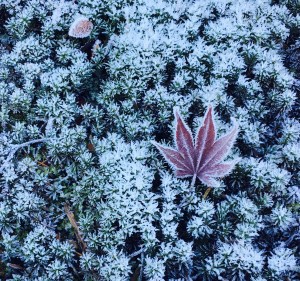
Hoarfrost

FROST IN MORNING

When the willow world is with hoarfrost hung,
And the white fog lifts leaving trees bright new,
The foliage flashes with a crystal clue
Of how the world looked when light first leaped young.

Before man’s weight and weakness had begun
To break the branch or bruise the sodden slough,
The garden grew unburdened, bathed in dew,
Grew like a canticle, perfectly sung.


NOTES: Many years ago and many miles away, I awoke one Minnesota winter morning to the most astounding display of hoarfrost I had ever seen.  The world was completely coated, clothed in white.

This was approximately 35  years ago.  Garrison Keillor was just getting traction with his Prairie Home Companion show.  He still had a day job on the local public radio station, and that morning, he celebrated the frosty morning by reading a poem.

I regret that I do not remember the name, or author of the poem he read that day.  Perhaps it could have been this poem, Hoarfrost and Fog, by Barton Sutter.  But I don’t think so.

It might have been his own work.  But his efforts inspired the modest 8 lines I’ve posted above.

This fall, I’ve been writing a lot about how the death of summer is a metaphor for the inevitable death we all as humans face.  This might be the single most-used image in all of literature.

Gerard Manley Hopkins wrote a marvelous poem along these lines, Spring and Fall.  It’s one of my most beloved poems of all time.

Hopkins also wrote a 2-part poem, The Leaden Echo and the Golden Echo, that gets at something even more.  The first part, The Leaden Echo, sets up the problem of the decline and decay of beauty.  It ends with despair.

But, in The Golden Echo, we come back to hope for redemption, for eternal life, and for the love of a Heavenly Father who restores.

“When the thing we forfeit is kept with fonder a care
Fonder a care kept than we could have kept it ….”

(For a real treat, listen to Richard Burton read this poem.  He reads poetry as it should be read, not with whiny, tinny detachment, but with passion.)

So, as I look at nature, there are signs of both despair and hope.   Leaden echoes and golden echoes alike.

When I see the world covered in frost, I think of a more perfect world.  A world like what may have been before sin and death entered into it.  Or the world that is to come.

Late fall sonnet

Autumn leaves

Falling Leaves Like Lovers

The leaves, the leaves are gone except the oak,
Which cling to trees and rattle needlessly.
The others flame and fall for all to see.
They streak and sizzle, leaving only smoke.

But oak leaves hang as by some unseen yoke,
All browned and curled awaiting sympathy,
Or sap to course and lend vitality–
The leaves cannot perceive the sorry joke.

For spring will end the lie and they will drop,
To drift and rot and turn in time to dust.
As sure as buds will burst to make a crop
Of new, the old will flutter down–they must.
The falling leaves like lovers never stop.
It’s hardly gentle, but ’tis just, ’tis just.


Notes:  Some of my favorite poems compare the death that comes in the autumn to the end of a love.  Or poems that use the dying natural world when winter approaches as the backdrop for the story.

I think of Robert Frost’s Reluctance, with its heartbreaking line about it being treasonous “to bow and accept the end of a love, or a season.”

Or Thomas Hardy’s Neutral Tones, which uses a frozen landscape as the setting for the realization that a relationship has ended.

Then, there is John Crowe Ransom’s Winter Remembered, with its wonderful image comparing the forsaken lover’s cold fingers to “Ten frozen parsnips hanging in the weather.”

I may never have discovered Ransom had it not been for my 11th grade English teacher,  Paul Hagedorn, back in Marshall, Missouri.  We spent an inordinate amount of time on poetry that year.  The major assignment, as I recall it, was to select an American poet from a lengthy list, and then immerse yourself in the writer’s work, and finally write a paper.

Knowing nothing about most of the choices, I picked John Crowe Ransom solely because I liked the sound of his name.  I got lucky, because I discovered I enjoyed his work.  Had I chosen Wallace Stevens with his difficult, cerebral verse, I probably would have flunked.

Another assignment was to prepare a notebook of our favorite poems.  I remember making daring choices, including song lyrics by such radicals as Paul Simon and Bob Dylan.  Now  that Dylan as been awarded the Nobel Prize for Literature, I consider myself foresighted.

I was fortunate that Mr. Hagedorn approved of my choices.  He was the cool, young teacher back then.  He managed to fan the flames of inspiration and love for poetry.  They smoldered for years, flaming up now and then, and have finally started burning here in this blog.

Civics Haiku

First Presyterian Church, Marshall, MO
Let me not forget
my dual citizenship,
and which one will last.


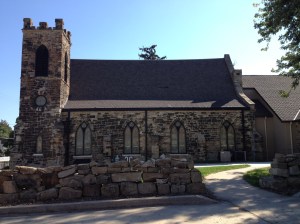
Notes:  Pictured is the First Presbyterian Church of Marshall, Missouri.  Known as “The Rock Church,” it is the most beautiful church building in my hometown.

Autumn haiku

Autumn sunset over the Olympic Mountains

The fragrance of leaves.
The chill that comes with evening.
Old wounds ache again.

Hometown haiku

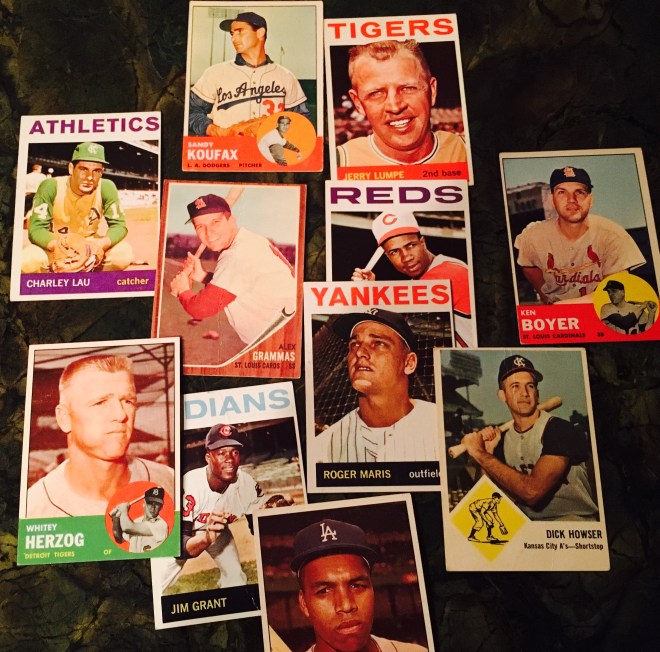
Baseball cards from the early 1960s
When I was a child
my heroes were immortal.
Now, they’re mostly gone.


Notes:

If you had talked to me when I was 9 or 10 years old, I would have told you I was sure I was going to be a baseball player when I grew up.  Many a long summer day was spent playing sandlot games in the vacant lot behind Fitzgibbon Memorial Hospital in what was universally known as “The Hospital Yard.”

No adult supervised.  A wide range of ages played.  There was Tommy Fox, with his wicked left-handed batting.  Big Wayne Halsey, an older kid, who once hit a ball over the huge trees at the far end of the lot.  Steve Cunningham, God rest his soul, played, and so did the Mounts brothers, Paul and Steve.  And many more long forgotten.

Somehow, we just figured it out, negotiating disputes and triangulating our way to make games fair.  When we didn’t have enough players to form respectable teams, we played games designed for smaller numbers like “Work-Up,” or “Five Hundred.”  These games might not have been as exciting as full-fledged baseball, but they enabled us to keep playing long after most of the other kids had to go home.

So we played until we wore ourselves out, until darkness fell, or until our mothers hollered for us to come in for supper.

To be sure, there was an organized baseball league out at the municipal park, but it was a pretty low-key affair, with maybe one or two games a week.  Not nearly enough to satisfy.

In between these baseball games, I would hang out with my buddy Royce Kincaid and play 2-man whiffle ball.  We had devised elaborate rules that enabled us to play entire games against each other all by ourselves.  We would each pick one of our favorite professional teams, and pretend to be each of the starting players.  We were such fanatics that — even though neither of were ambidextrous — we would bat right-handed if the player batted right, and bat left-handed if the player batted left.

We were pretty evenly matched and the competition was fierce.  We could argue close calls, and learned how to give and take for the sake of the game.  Neither of us wanted to push any argument to the point of risking the continuation of play.

We knew our information about the professional players because were also fanatical baseball card collectors.  For a stretch that spanned about 3 or 4 years, we devoted a very large percentage of our meager kid income to buying baseball cards at 5 cents a pack.  Back then, the cards came with a pink slab of bubblegum dusted with white powered sugar.

We didn’t really care about the gum.  We wanted the cards.  We would beg our parents for cards on every trip to the A&P, IGA, or MFA grocery store.  We would haunt the small neighborhood grocery stores that served our little town back in the days before convenience stores looking for good cards.

We figured out that the Topps Baseball Card Company would release the cards in flights over the course of a baseball season.  We would start the year with every pack full of unique new treasures.  But soon we would start finding our purchased packs full of cards we already had — “doubles,” we called them.

We would still cautiously buy packs here and there, sometimes prying the packs open to sneak a peak inside to increase our chances of getting a card we didn’t already have.

Then, when  we  discovered that a new series had been released, we rush out with our nickels in our hands ready to splurge again.  I remember riding my bike all the way to the west end of town to buy “fresh” cards at a little store that had gotten them  before anywhere else.

We would get together with other guys and trade cards, and show off our collections.  But mostly we looked at the cards and studied them.  I arranged them by team, and position. I studied the statistics on the back and memorized the trivia about each player.  When the St. Louis Cardinals or Kansas City A’s were on the radio, I would pull out the cards of each team and follow along as each player batted.

Back in those days, the Cardinals came in loud and strong on KMOX, and the games were called by Jack Buck and Harry Caray before Harry defected to Chicago.

I got to taste both victory and defeat.  The Cards were in one of their many periods of greatness. The A’s were pitiful losers, more of a backwater club that seemed to always sell its most promising players to the hated N.Y. Yankees just before they hit their prime.

In those days the A’s were owned by impresario Charlie Finley, who pushed the boundaries of good taste and good sense.  He introduced garish the  garish Kelly Green and Gold uniforms, and brought a mule named Charlie O into the stadium.  When Finley moved the team to Oakland in 1968, I washed my hands of them.  The fact that they soon started winning in their new city only made me hate them more.

But, did I  ever have some great cards!  Bob Gibson.  Mickey Mantle.  Hank Aaron.  Roberto Clemente.  Sandy Koufax.  Don Drysdale.  Ernie Banks.  Yogi Berra.  Willie Mays.  Tim McCarver.  All of the greats from the early 60s.

I was sure someday my face would be on one of those cards.

But life has a way of going in unanticipated directions.  I grew up and developed more of an interest in girls than baseball.

In just a few years the cardboard box of baseball cards was shoved back under my bed and largely forgotten.

It was not until I had kids of my own and came back to visit my parents that I inquired about the baseball cards.  They had disappeared, and my mother, who had guarded my old room like a museum shine, had gradually lost her memory.

I had pretty much given up ever seeing the old keepsakes again, when my father remembered that my mother had stashed some of my items in an old dresser drawer in her bedroom.

Sure enough, behind some old blouses I found a small box of baseball cards!  They were not the full set.  It was my old box of doubles.

But it was like a reunion with old friends.  There was Roger Maris and Sandy Koufax.  And Duke Snider and Kenny Boyer.  There was even an old Jerry Lumpe card.  A good player, but never a big star, Jerry was notable at least in our neighborhood because he played for the Kansas City A’s and Freddie Mueschke, the neighbor kid who lived on the corner, claimed to be Jerry Lumpe’s nephew.

We never verified Freddie’s story, but he got a lot of mileage from that claim to fame.

(I was gratified to learn that Lumpe has his own entry in Wikipedia.  He even managed to have such a good season in 1964 that he was named to the American League All Star Team.  That happened the year right after he was traded from the A’s, of course.)

A lot of my best cards were missing.  No Mickey Mantles or Hank Aarons.  But it was still like finding a treasure trove nonetheless.

Mom had reached through the years and through her senility to bless her little boy with one last small gift.  By this time she was lying in a nursing home without a  memory.  But  her gift to me had restored a whole storehouse of memories.

Poem for my first poetic champion

My first poetic champion

Ice Age

Dear gentle woman grown so early old,
You’ve all but left us on our lonesome own.
Now after many years to spirit sown,
A creeping glacier scrapes your memory cold.

You, greener days ago, recited verse,
And planted hardy seeds of simple song
That rooted deep, perennial and strong,
To flourish in the shadow of the hearse.

Today your weathered hands no longer know
The jonquil from the mum, nor how to weed.
Today you prattle on without the seed
Of sense, that for so long you toiled to grow.

So now for you I pick this small bouquet
Out of the garden patch you used to tend,
Now choked with worldly weeds from end to end,
In need of hands to cultivate its clay.


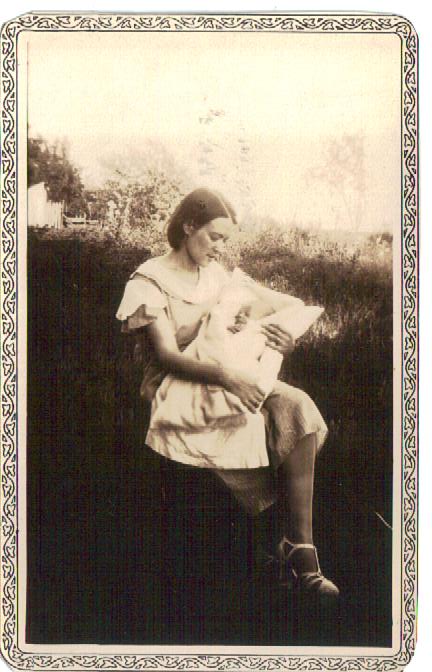
Notes:  This month, my mother would have been 105 years old.  She died nearly 30 years ago, but she began to leave us several years before that as she fell under the spell of some unnamed type of dementia.

She was my first poetic champion, instilling a love for poetry from an early age.  This poem was written back when she was still alive, but unable to communicate with us.

Mother was forced to drop out of grade school when her mother died in a flu epidemic.  She was needed at home to care for her younger brothers and sister.

Her tastes were simple and traditional, with a leaning towards folksy American poets, like James Whitcomb Riley and Eugene Field.  But she also like Robert Frost and Wordsworth.

We really only had one book of poetry in the house, a leather-bound volume entitled One Hundred and One Famous Poems, published in 1929. It contained remarkably robust collection of poems, and she read them aloud to me often.

There were selections from Shakespeare, Emerson, Poe, Kipling, Byron, Keats, and even Whitman.  In the back of the book were some bonus classics of English prose including the Gettysburg Address, the Magna Charta, the Ten Commandments, and the Declaration of Independence.

I daresay, I got a better education from that one book than I received in four years attending a semi-prestigious liberal arts college during the self-absorbed 1970s.


Autumn haiku

Autumn leaves

I’ve never been one,
For wallowing in the past,
But, the falling leaves …

Autumn poem

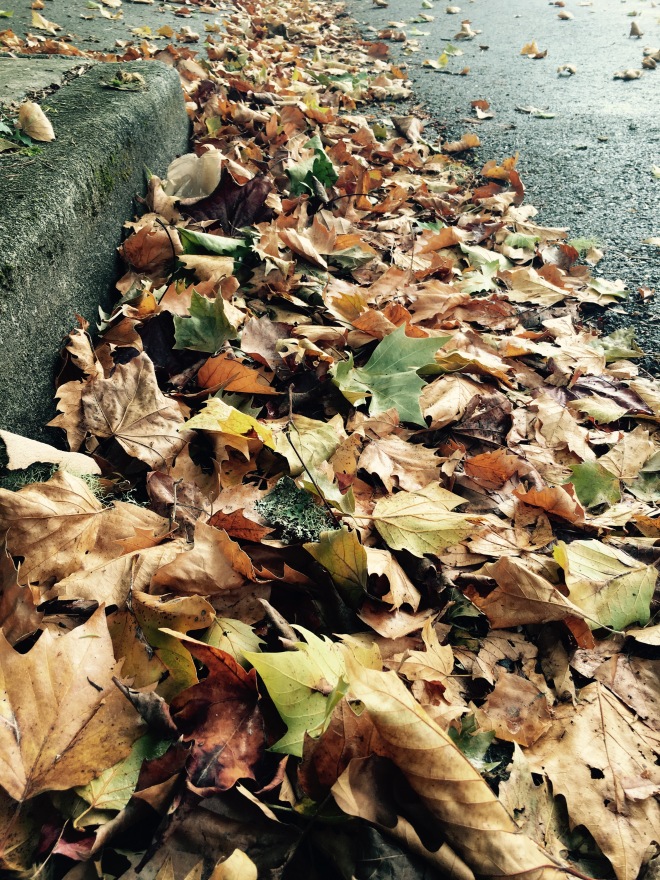
Autumn leaves in the gutter
Autumn Song

Afternoon in late September
Shows us signs we both can follow,
Shadows where there were no shadows
Days before, encroach on meadows,
Turning brittle brown and yellow.
Six o’clock’s a dying ember
Causing grown men to remember
Another fall’s disturbing echo.

When, unnoticed, fell the first leaves,
Yellow elm leave tired of sunshine?
Who suspected seeing such ease
When the first chill stunned the green vine?
Is embarrassment the reason
Sumac’s crimson hides its poison?
When was foliage last so supine?

Rainy night in mid-October
Brings the icy confirmation —
Twigs encased in shiny coffins
Clenched in cold that never softens.
Even daylight’s ministration
Alters no repose so sober
As the sleep of mid-October,
Sleep of spreading desolation.


Notes:  Written years ago and far away, when I lived in a much different climate.  My Puget Sound friends and neighbors might find it hard to relate to an autumn that leaves twigs encased in icy coffins, but my friends back in Minnesota understand all to well.

I recall one Halloween when my son and I set out at dusk to trick or treat in Minneapolis.  We made our way about two blocks as it began to snow hard, then harder.  We almost didn’t make it back home as we trudged through calf-deep drifts.

Autumn has its beauty.  “Every leaf is a flower,” is a beautiful sentiment.

Bit the fall is also one of God’s great metaphors.  And that makes it poignant, even as it is achingly beautiful.