There once was a time
when blossoms and I were both
fresh and unabashed.
NOTES: When I was a junior, my high school hosted a foreign exchange student from Japan. Susumu stayed with the DuBois family, who lived a few blocks away.
A couple of years ago, through the miracle of Facebook, I reconnected with Susumu. When I discovered he had taken several photos of his days in my hometown, I was excited. He very kindly shared them with me, and I have been lovingly looking through them and rekindling old memories.
Those photos include precious images of teachers long since gone. Of friends and classmates not seen for decades. And simple scenes of my hometown, a town that has changed so much since I walked its streets.
One of the photos was of me. I don’t remember it being taken. All evidence points to it being the spring of 1969. I am outfitted in what passed for a tennis uniform in those days. I must have just finished practicing with Susumu’s host brother, Dave DuBois. We were teammates on the Marshall High School tennis team, and we practiced out on the new hard surface courts at Missouri Valley College.
From the foliage, it was early spring. The tulip tree was in full bloom, but the other trees had not leafed out. I wore a leather bracelet on my right wrist, which was the cool, hippie thing to do.
My hair was growing out and would need to be cut before football practice started in August. (Coach Cecil Naylor really didn’t like long hair!)
Marshall High School Honor Stations 1969. (Photo courtesy of Susumu Wakana)
So blithely we scrapped
our outmoded traditions.
But what did we know?
NOTES: My high school had long observed a set of traditions at graduation time. While probably only a few decades old, to us callow kids, those customs may just as well have been prehistoric.
For as long as we could remember, our school had marked the end of the school year with a Baccalaureate service, a Commencement ceremony, and Honor’s Night. The first was inspirational, and still carried a whiff of religion. Commencement was more perfunctory, and mainly served to get your tassel turned and your diploma into your eager, waiting hands.
But the real ceremony happened at Honor’s Night. That was where academic achievement and athletic prowess were feted. Scholarships were announced. Awards and certificates of all types were handed out. But while the awards were many, there was still a good measure of exclusivity. Not everyone got a trophy. It was the merit system on steroids.
The pinnacle of Honor’s Night was–as it had always been–the presentation of the Honor Stations. Four couples from the senior class had been selected, each meant to represent one of the four cardinal virtues of our school. They were to be arrayed on the stage of the auditorium beneath solemnly lit candelabras dressed in formal gowns and white dinner jackets. They personified:
Most Industrious
Best Sport
Most Courteous
Best Citizen
(Historical note by way of full disclosure: My brother Larry had been named Most Courteous in 1960, coasting to the honor on his winning smile and prodigious gift of gab.)
At the center of the stage sat Miss Fair Marshall, complete with a tiara. We were not sure, but we suspected she represented all the good and pure and gracious qualities of Missouri womanhood.
I forget exactly how the Honor Stations were nominated and selected, but I seem to remember some sort of balloting by the student body.
THE DEMISE OF MISS FAIR MARSHALL
Miss Fair Marshall had a male escort, but he was merely unelected arm-candy. The star of the evening and the center of attention was the fair maiden.
I should add one more fact, especially for those too young to remember. The late 1960s were a time of upheaval and ferment. Across the country, kids were growing their hair, listening to loud music and protesting the Vietnam War.
The times were a’changing, and although change might have come more slowly to our Missouri farm town than other places, we were not immune.
When I was a junior, the senior class of 1969 did a bold and daring thing. (Many of my classmates and I admired our elders in the class of ’69. We saw them as smart and sophisticated and worldly.)
The dramatic move they made was to vote to eliminate Miss Fair Marshall. It was a shocking move.
I’m not sure if there was ever a cogent explanation made why this was a good idea. I suspect it had something to do with an unconscious awareness that having a “princess” without an equivalent prince was somehow unfair or sexist. Or perhaps it was a rejection of the whole patriarchal-vestal-virgin vibe given off by the institution
I dunno. But the hippies and the intellectual artsy kids rejoiced that year over the demise of Miss Fair Marshall. And, I suspect that many would-be beauty queens wept.
THE NEXT YEAR, OUR CLASS HAD ITS TURN
I recall sitting the next year in our snoozy all-senior-class meeting called for the sole purpose of deciding whether we would bestow a clock or a plaque as our senior gift to the school.
At some point in the proceedings, I turned to my friend Clyde Smith and joked, “Wouldn’t if be funny if we abolished Honor Stations?”
He replied that that was a great idea, and that I should propose it. I told him to do it. He looked directly at me and said, “No, it’d be better if you did it.”
Thinking back, I do recall that there had been some earlier joking about how ridiculous the Honor Stations had become. The year before, the position of male Most Industrious had been filled by our older friend John Swisher. Now John was one of the smartest, funniest and cleverest guys you’d ever want to meet. But he was the first to admit that he was nowhere close to being the most industrious member of his class.
John had even made many a hilarious joke about his lackluster work ethic and the irony of him being named Most Industrious.
So, I had already concluded that the Honor Stations were hypocritical. And, with no more forethought than that, I popped out of my seat, walked to the front and made a motion to abolish Honor Stations.
I think I heard what you might call an audible silence.
I’m not sure exactly what happened next. I thought I detected murmuring from the gaggle of popular girls. Probably looking forward to wearing formal dresses up on the stage, I thought.
There may have been a person or two who spoke in opposition. But I distinctly remember the debate ending after Tom Nicholas stood up. Tom was the most rock ‘n’ roll member of our senior class. He had long hair before anyone else. He played guitar in a real band, and he exuded rebel cool.
Tom strode forward, leaned into the microphone, and pronounced with authority, “We have a word for this. It’s called ‘ego-trip.'”
That pretty much sealed the deal. Honor Stations were ego trips. The question was called, and the motion overwhelmingly carried.
The Class of 1970 had finished the work of our predecessors. We had killed off the Honor Stations and drained the pomp from “Pomp and Circumstance.”
I was exhilarated and pretty darn proud of myself–for a short time.
A UNEXPECTED LESSON
Later that day, I was pulled aside by Mrs. Van Meter for a brief, one-way conversation. Dorothy Van Meter taught English, and was pretty much universally regarded as one of the “cool teachers.” She conducted discussion nights at her apartment for students and former students. These were heady salons where heady subjects like philosophy, truth and beauty were seriously discussed.
Mrs. Van Meter had hung a small peace symbol over the door to her classroom, and on the day of the Vietnam War Moratorium, she came to school dressed in black. So, she had credibility with the free-thinking, progressive students. She was actually the last teacher I suspected would hector me for my blow against hidebound tradition.
She was also known to take an interest in the character formation of her students. She was known to prescribe books or disciplines she thought would round out a particular student’s soul. I was a muscle-bound jock and she told me to pick up a book on yoga. And when I was flirting with the moral perils of agnosticism she gave me her copy of Screwtape Lettersby C.S. Lewis. She even recommended weight-lifting for one of my classmates who was musical and brilliant, but soft and plump.
Her word to me on this day was matter of fact and brief.
“You know,” said Mrs. Van Meter, “some ideals are worth preserving whether they are fully lived out or not.”
That was it, and she wheeled around and left.
Her words took a while to sink in. But that simple truth just might have been the most important thing I learned in high school.
Mrs. Dorothy Van Meter (Photo courtesy of Susumu Wakana)
Father, when you spoke
I believed you, for you spoke
with authority.
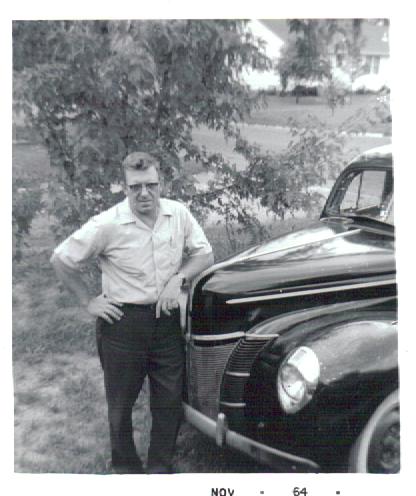
NOTES: In many ways, my dad was a simple man. Farmer. Mechanic. Forced to drop out of high school to work during the Great Depression, he never had the opportunity go back to school to pick up his education again.
He never travelled to Europe or learned a foreign language. He never made a lot of money, or tasted the luxuries of life.
But he knew what he thought and what he believed. And when he talked about his beliefs, his strength of conviction came through his voice.
Often he was expressing his belief in the products of the Ford Motor Company. He was a confirmed Ford man. He claimed he had seen the insides of enough cars and tractors to know how each one held up, and which ones were made out of cheap materials.
He would just utter a phrase like, “The Ford Model T …” and let it hang there and resonate in the air. He said it with such reverence that those who heard it just knew that the Ford Model T had not only been a great automobile, but a miraculous product of a genius.
He could inspire similar feelings of reverence with exclamations like, “President Abraham Lincoln,” or “Old Thomas Edison.” You just knew these were great men.
We didn’t have pastors or full-time clergy in our tiny little Church of Christ congregation. The leadership was handled by laymen like himself. When he would stand up on Sunday mornings to “wait on the communion table,” he would recite the words by heart from the King James Version of Paul’s first letter to the Corinthians:
“That the Lord Jesus, on the night he was betrayed took bread, And when he had given thanks, he brake it, and said, Take it, eat: this is my body which is broken for you. This do in remembrance of me.”
Hearing him say it, you had no doubt that this was just the way it had happened.
Perhaps the most convincing and poignant expression of his conviction came many years later, as his wife lay in a nursing home, long lost to dementia. “Your mother,” he said, “was the best. I never met another women like your mother. Never.”
When I was a child
my heroes were immortal.
Now, they’re mostly gone.
Notes:
If you had talked to me when I was 9 or 10 years old, I would have told you I was sure I was going to be a baseball player when I grew up. Many a long summer day was spent playing sandlot games in the vacant lot behind Fitzgibbon Memorial Hospital in what was universally known as “The Hospital Yard.”
No adult supervised. A wide range of ages played. There was Tommy Fox, with his wicked left-handed batting. Big Wayne Halsey, an older kid, who once hit a ball over the huge trees at the far end of the lot. Steve Cunningham, God rest his soul, played, and so did the Mounts brothers, Paul and Steve. And many more long forgotten.
Somehow, we just figured it out, negotiating disputes and triangulating our way to make games fair. When we didn’t have enough players to form respectable teams, we played games designed for smaller numbers like “Work-Up,” or “Five Hundred.” These games might not have been as exciting as full-fledged baseball, but they enabled us to keep playing long after most of the other kids had to go home.
So we played until we wore ourselves out, until darkness fell, or until our mothers hollered for us to come in for supper.
To be sure, there was an organized baseball league out at the municipal park, but it was a pretty low-key affair, with maybe one or two games a week. Not nearly enough to satisfy.
In between these baseball games, I would hang out with my buddy Royce Kincaid and play 2-man whiffle ball. We had devised elaborate rules that enabled us to play entire games against each other all by ourselves. We would each pick one of our favorite professional teams, and pretend to be each of the starting players. We were such fanatics that — even though neither of were ambidextrous — we would bat right-handed if the player batted right, and bat left-handed if the player batted left.
We were pretty evenly matched and the competition was fierce. We could argue close calls, and learned how to give and take for the sake of the game. Neither of us wanted to push any argument to the point of risking the continuation of play.
We knew our information about the professional players because were also fanatical baseball card collectors. For a stretch that spanned about 3 or 4 years, we devoted a very large percentage of our meager kid income to buying baseball cards at 5 cents a pack. Back then, the cards came with a pink slab of bubblegum dusted with white powered sugar.
We didn’t really care about the gum. We wanted the cards. We would beg our parents for cards on every trip to the A&P, IGA, or MFA grocery store. We would haunt the small neighborhood grocery stores that served our little town back in the days before convenience stores looking for good cards.
We figured out that the Topps Baseball Card Company would release the cards in flights over the course of a baseball season. We would start the year with every pack full of unique new treasures. But soon we would start finding our purchased packs full of cards we already had — “doubles,” we called them.
We would still cautiously buy packs here and there, sometimes prying the packs open to sneak a peak inside to increase our chances of getting a card we didn’t already have.
Then, when we discovered that a new series had been released, we rush out with our nickels in our hands ready to splurge again. I remember riding my bike all the way to the west end of town to buy “fresh” cards at a little store that had gotten them before anywhere else.
We would get together with other guys and trade cards, and show off our collections. But mostly we looked at the cards and studied them. I arranged them by team, and position. I studied the statistics on the back and memorized the trivia about each player. When the St. Louis Cardinals or Kansas City A’s were on the radio, I would pull out the cards of each team and follow along as each player batted.
Back in those days, the Cardinals came in loud and strong on KMOX, and the games were called by Jack Buck and Harry Caray before Harry defected to Chicago.
I got to taste both victory and defeat. The Cards were in one of their many periods of greatness. The A’s were pitiful losers, more of a backwater club that seemed to always sell its most promising players to the hated N.Y. Yankees just before they hit their prime.
In those days the A’s were owned by impresario Charlie Finley, who pushed the boundaries of good taste and good sense. He introduced garish the garish Kelly Green and Gold uniforms, and brought a mule named Charlie O into the stadium. When Finley moved the team to Oakland in 1968, I washed my hands of them. The fact that they soon started winning in their new city only made me hate them more.
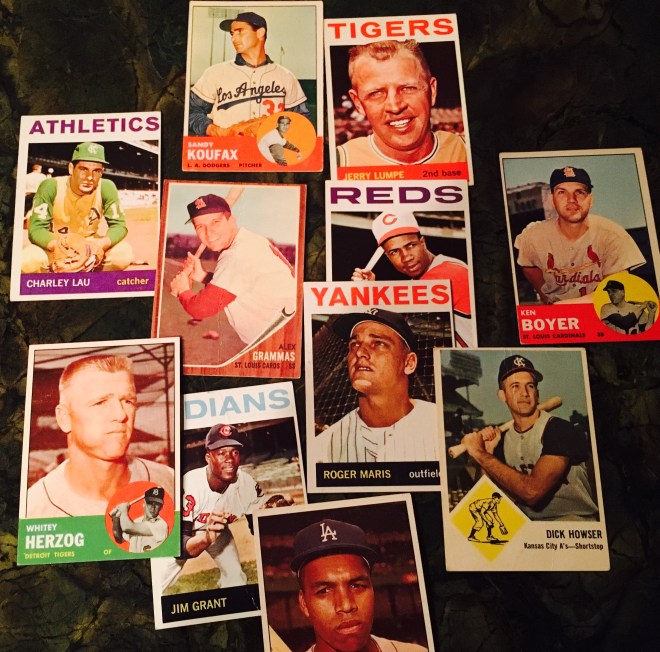
But, did I ever have some great cards! Bob Gibson. Mickey Mantle. Hank Aaron. Roberto Clemente. Sandy Koufax. Don Drysdale. Ernie Banks. Yogi Berra. Willie Mays. Tim McCarver. All of the greats from the early 60s.
I was sure someday my face would be on one of those cards.
But life has a way of going in unanticipated directions. I grew up and developed more of an interest in girls than baseball.
In just a few years the cardboard box of baseball cards was shoved back under my bed and largely forgotten.
It was not until I had kids of my own and came back to visit my parents that I inquired about the baseball cards. They had disappeared, and my mother, who had guarded my old room like a museum shine, had gradually lost her memory.
I had pretty much given up ever seeing the old keepsakes again, when my father remembered that my mother had stashed some of my items in an old dresser drawer in her bedroom.
Sure enough, behind some old blouses I found a small box of baseball cards! They were not the full set. It was my old box of doubles.
But it was like a reunion with old friends. There was Roger Maris and Sandy Koufax. And Duke Snider and Kenny Boyer. There was even an old Jerry Lumpe card. A good player, but never a big star, Jerry was notable at least in our neighborhood because he played for the Kansas City A’s and Freddie Mueschke, the neighbor kid who lived on the corner, claimed to be Jerry Lumpe’s nephew.
We never verified Freddie’s story, but he got a lot of mileage from that claim to fame.
(I was gratified to learn that Lumpe has his own entry in Wikipedia. He even managed to have such a good season in 1964 that he was named to the American League All Star Team. That happened the year right after he was traded from the A’s, of course.)
A lot of my best cards were missing. No Mickey Mantles or Hank Aarons. But it was still like finding a treasure trove nonetheless.
Mom had reached through the years and through her senility to bless her little boy with one last small gift. By this time she was lying in a nursing home without a memory. But her gift to me had restored a whole storehouse of memories.
Dear gentle woman grown so early old,
You’ve all but left us on our lonesome own.
Now after many years to spirit sown,
A creeping glacier scrapes your memory cold.
You, greener days ago, recited verse,
And planted hardy seeds of simple song
That rooted deep, perennial and strong,
To flourish in the shadow of the hearse.
Today your weathered hands no longer know
The jonquil from the mum, nor how to weed.
Today you prattle on without the seed
Of sense, that for so long you toiled to grow.
So now for you I pick this small bouquet
Out of the garden patch you used to tend,
Now choked with worldly weeds from end to end,
In need of hands to cultivate its clay.
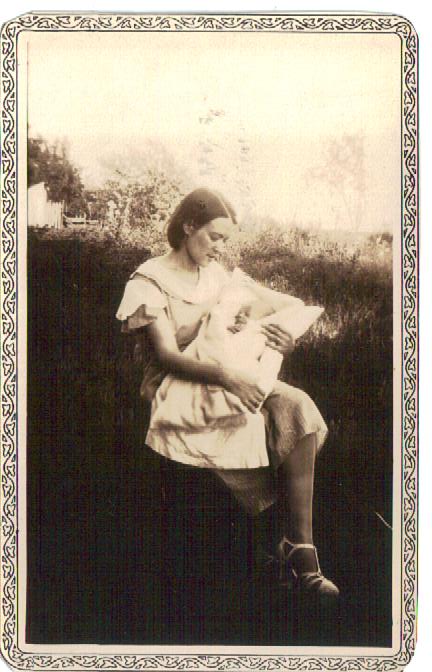
Notes: This month, my mother would have been 105 years old. She died nearly 30 years ago, but she began to leave us several years before that as she fell under the spell of some unnamed type of dementia.
She was my first poetic champion, instilling a love for poetry from an early age. This poem was written back when she was still alive, but unable to communicate with us.
Mother was forced to drop out of grade school when her mother died in a flu epidemic. She was needed at home to care for her younger brothers and sister.
We really only had one book of poetry in the house, a leather-bound volume entitled One Hundred and One Famous Poems, published in 1929. It contained remarkably robust collection of poems, and she read them aloud to me often.
I daresay, I got a better education from that one book than I received in four years attending a semi-prestigious liberal arts college during the self-absorbed 1970s.
Afternoon in late September
Shows us signs we both can follow,
Shadows where there were no shadows
Days before, encroach on meadows,
Turning brittle brown and yellow.
Six o’clock’s a dying ember
Causing grown men to remember
Another fall’s disturbing echo.
When, unnoticed, fell the first leaves,
Yellow elm leave tired of sunshine?
Who suspected seeing such ease
When the first chill stunned the green vine?
Is embarrassment the reason
Sumac’s crimson hides its poison?
When was foliage last so supine?
Rainy night in mid-October
Brings the icy confirmation —
Twigs encased in shiny coffins
Clenched in cold that never softens.
Even daylight’s ministration
Alters no repose so sober
As the sleep of mid-October,
Sleep of spreading desolation.
Notes: Written years ago and far away, when I lived in a much different climate. My Puget Sound friends and neighbors might find it hard to relate to an autumn that leaves twigs encased in icy coffins, but my friends back in Minnesota understand all to well.
I recall one Halloween when my son and I set out at dusk to trick or treat in Minneapolis. We made our way about two blocks as it began to snow hard, then harder. We almost didn’t make it back home as we trudged through calf-deep drifts.
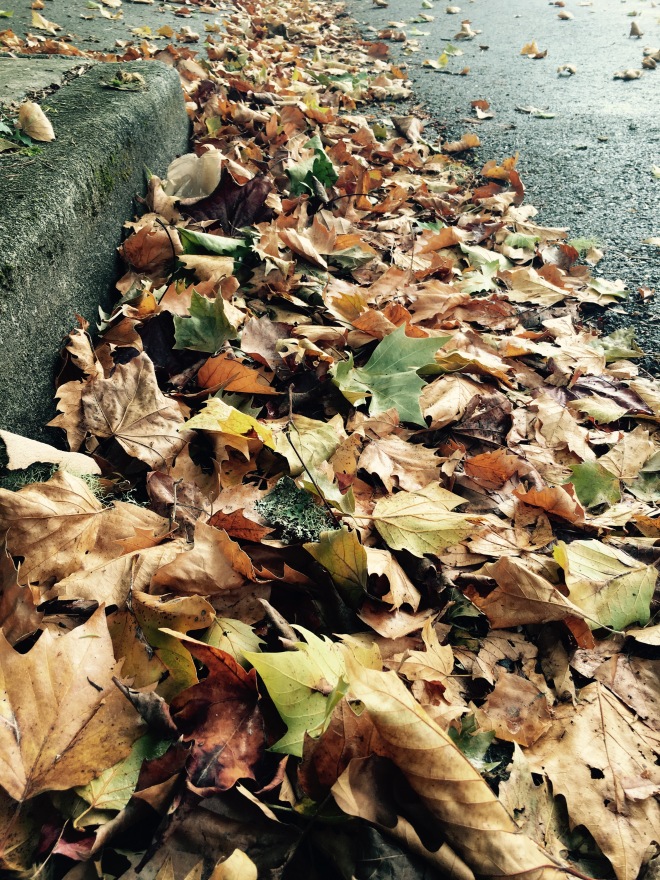
Autumn has its beauty. “Every leaf is a flower,” is a beautiful sentiment.
Bit the fall is also one of God’s great metaphors. And that makes it poignant, even as it is achingly beautiful.
“I’ll eat fried chicken and biscuits smothered in bacon gravy …”
I had a friend who once made a random observation.
He said, “You know, there comes a point when old people just stop buying clothes.” I had never thought about it before, but he had a point. I thought about that single strand of insight.
One thing led to another and it eventually led to this poem. Yet another experiment with free verse.
There’ll come a day …
There’ll come a day when I shall no longer buy clothes.
I’ll eat fried chicken and biscuits smothered in bacon gravy
And wash it down with bourbon, and smoke a cigar.
And I’ll tell the waitress a joke and she’ll blush and she’ll scold.
And it will be alright.
And on that day, I’ll cancel the newspaper,
Or maybe just stop sending them my money,
Unless they beat me to it and go out of business first.
I’ll drink strong coffee and stir in heavy cream
And if I want, I’ll stay up late and sleep ’til noon
And I’ll go outside without a hat and walk on the grass
And turn my face to feel the sun
And I’ll give my cash to bums and beggars,
And make a trip to Goodwill,
And bring my college books,
And the suits I wore for business.
But I will keep my poetry,
And my old Bible.
And my photographs of you.
To remind me of all I know,
Or ever need to know,
Of truth, of beauty, and of love.





 Poetic Champions