I choose to walk the old familiar ways,
To wend ways where I’ve put my foot before,
To gaze anew on views seen other days,
Which, though familiar, never seem to bore.
The changing light and seasons have their ways
Of making old things new: The light-laced hoar,
The first-flush, green-glow, bursting-forth spring days,
The growing tinge of gold we can’t ignore.
Each day, my dear, I choose afresh our trail,
The one we blazed so many years ago,
Eschewing other routes that might avail,
And hewing to the well-worn way we know.
Forsaking novelty need be no jail
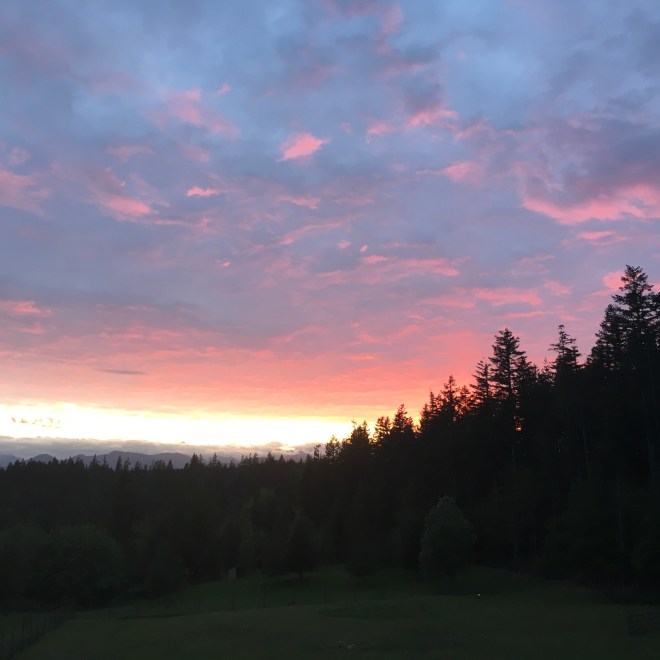
With your face bathed in sunset’s golden glow.
NOTES: Thirty-two years of marriage and never a dull moment.
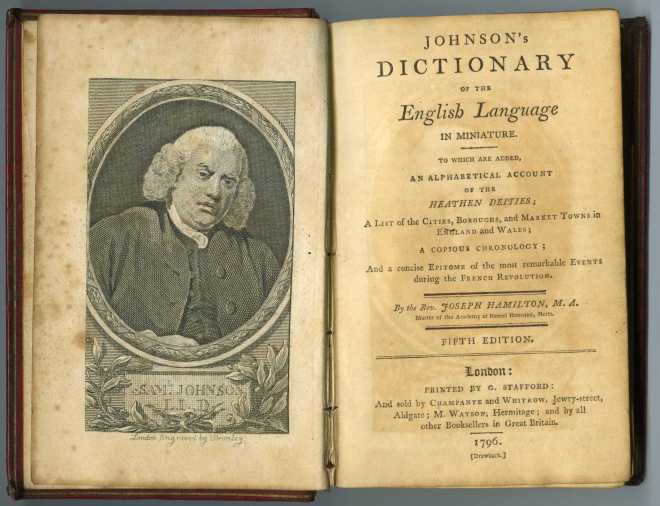
“No man but a blockhead ever wrote, except for money.” — Samuel Johnson
I Sing Not for Glory
I sing not for glory nor for bread,
Nor for the praise of the credentialed clique.
But for hire more valuable instead,
To touch the honest kindred heart I seek.
I sing for lovers when love is green,
When time stops for a solitary kiss.
When light shines anew as with new eyes seen,
I celebrate your fey and fragile bliss.
I sing for the lonely, lovelorn heart,
When light grows cold and aching will not cease,
When your enchanted world falls all apart,
I offer modest salve to give you peace.
I sing for the pilgrim searching soul
Pursuing the heart’s true cause and treasure.
May heaven’s hound, you hasten to your goal,
And propel you to your proper pleasure.
I sing for the wise who see their end,
And, too, for those who have not yet awoke.
For to a common home we all descend,
With common dirt for all our common cloak.
I sing not for money nor for art,
Nor to amuse curators of our trade.
The simple wages of the simple heart
Will satisfy when my accounts are weighed.
NOTES: Samuel Johnson was a funny guy. If his aphorism is correct, that “no man but a blockhead ever wrote, except for money,” then poets are the biggest blockheads of them all.
A few diligent writers of books and screenplays and advertising copy can manage to make a living scribbling words. But poets need another gig to pay the bills.
Most often, they teach. Gerard Manley Hopkins was a priest and a teacher. Robert Frost famously tried his hand at farming, but he also taught and lectured.
Some poets have conducted quite conventional careers during the day to support their poetry habit at night. Insurance executive Wallace Stevens and physician William Carlos Williams are a couple of well known examples.
Dylan Thomas really couldn’t do much else besides write poems, and so he waged a losing war with poverty until he drank himself to death. He probably would have perished much sooner except for the fact he was able to charm wealthy female admirers into becoming patronesses.
About the only thing I have in common with the aforementioned gentlemen is that while I sometimes commit poetry, I also need another means to make a living.
I started my professional life in the 1970s as an ink-stained wretch of a newspaperman. While chasing deadlines was exhilarating when I was still a young man, there were already storm clouds on the horizon for journalism. Afternoon dailies were going extinct, and cities that had formerly had 2, 3 or more newspapers were seeing them merge or go out of business.
Little did I know that in just a few years, the internet would come along and fatally wound the mainstream media organizations, forcing them to trim their newsrooms and close regional bureaus.
I sensed that there was a disturbing uniformity of political opinion in the newsrooms of my youth. My own political worldview was still evolving, but even back then everybody I worked with seemed to be left-leaning and Reagan-loathing. The lockstep groupthink bothered me.
In my naïve idealism, I thought journalists were supposed to be fiercely objective. I never caucused with any party, and I strove to play my own coverage right down the middle. I’d have coffee with both Democrats and Republicans, and always made sure to pay my own check because I didn’t want to owe anybody anything.
When the owner of one paper tried to pressure me to join the local Rotary Club, I refused because I didn’t want membership to influence my coverage of any organization.
If I had still been a journalist this past year I think my head would have exploded. With news organizations colluding with political campaigns, and sharing debate questions in advance with the favored candidate, it became clear that our creaky old news institutions had jumped the shark.
I would have burned my press card in protest.
I wish I could say I was smart enough to foresee the death of journalism and jump ship intentionally, but it was more random than that. I was about to get married and I needed a job in Minneapolis. The cash-strapped metropolitan dailies weren’t hiring right then, and so I took the first job I could get.
Fortunately I had stumbled my way into direct marketing. That later led me into non-profit fundraising. The bulk of my career since has been helping good causes raise money. Healing the sick, feeding the hungry, caring for widows and orphans, defending the persecuted, visiting those in prison, bringing the good news to those in bondage — that sort of thing.
I began to appreciate what I do a whole lot more when I stopped thinking about it as marketing and started thinking about it as “soul stirring.” When I’m doing it right, I touch the heart to stir people up to good works, and inspire them to be generous.
If you ask me, that’s really just a short step away from poetry. It’s all soul stirring.
I saw you first in jonquil time,
When you were bathed in grace.
You sat aglow with fire sublime,
And golden shone your face.
I loved you first in lilac time.
A bloom I plucked for you.
I wrote you verse with song and rhyme.
I hoped you loved me too.
I kissed you first in tulip time,
It must have been a sign.
The buds and we were in our prime
When your two lips met mine.
I married you in daisy time
On summer’s longest day.
We traded rings and heard bells chime.
We pledged always to stay.
Too soon we’ve come to aster time.
The days are shorter now.
Would stealing some be such a crime?
We’ll make it right somehow.
Should we endure ’til wintertime,
The time when flowers sleep,
Dreams we’ll share of a gentler clime
Where we no more shall weep.
NOTES: Today is Valentine’s Day, and it’s unseasonably warm here in the Pacific Northwest. It won’t be long before the jonquils and crocuses start poking their heads up through the mulch.
And it won’t be much longer than that before my favorite — the lilacs — grace us with their fragrance and beauty.
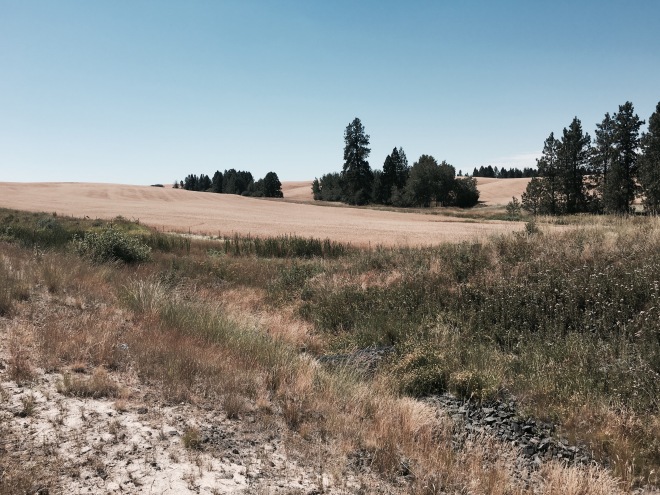
Late summer’s sun has baked the grass to brown.
The days grow shorter with each passing day,
Soon, autumn’s chill will make the leaves fall down.
All of this aching beauty will decay.
And yet I love the shadows’ slanting trace,
The once green grain gone golden in its rows,
And how I love the lines etched in your face.
It’s funny, as love ripens how it grows.
The number of our days we do not know.
No sleeper knows if he will ever wake.
So come, let’s join above, between, below.
My dear, let’s cause our fragile clay to quake.
Let us make love as if it’s our last go.
Let us embrace like dawn will never break.
Notes:
It’s that time again to haul this old one out of the vault.
Among other things, God was the first poet. The world is full of rhyme and rhythm, image and metaphor.
In our own small, imperfect way, we just catch glimpses.
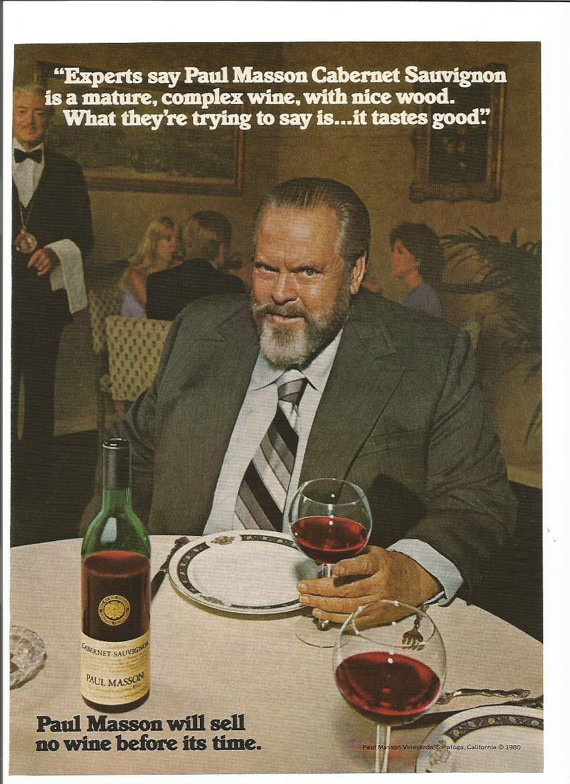
“We’ll sell no wine before its time,” we’re told.
The fat and famous spokesman made it clear,
Each vintage has its period of gold.
(You must assess the pressing and the year.)
So, likewise, for each vintage comes a time
The point past which there’s no return at all.
Decay and oxidation work their crime,
And turn your sweetest nectar into gall.
So come, my dear, what are we waiting for?
Our cellar holds a few more bottles still.
Pick one and brush away the dust before
Time turns its contents back to must — time will.
Cast off our caution and our clothes and pour,
And drink with joy until we’ve had our fill.
Notes:
I’m old enough to remember when Orson Welles became a television pitchman for a sort-of-good American wine.
Welles had been the genius who panicked the nation in 1938 with his faux-documentary radio broadcast, “War of the Worlds.” In 1941, he directed and starred in “Citizen Kane,” considered to be among the best — if not the best film of all time.
By the late 1970s, Welles was making commercials. His Paul Masson spots are still classics.
“We will sell no wine before its time,” was a magnificent slogan.
We come now to the winter of our years
(Where did the autumn with its pleasures go?)
Our roof will all too soon be cloaked with snow,
So, come, let’s stoke our fire against the fears.
It seems another life ago, my dear,
That full of grace you pilgrim sat aglow
Enkindled so this prodigal would know
That grace was free and grace was very near.
Midsummer’s eve brought more epiphanies
Of spotless bride adorned, redeemed, in white,
Too ill for customary liberties,
So wan, yet still for these sore eyes a sight.
Then! Over Lake Champlain the full moon sees
A railway sleeper car rock through the night.
Notes:
When love is good and it lasts, it can be tempting to idealize its beginnings.
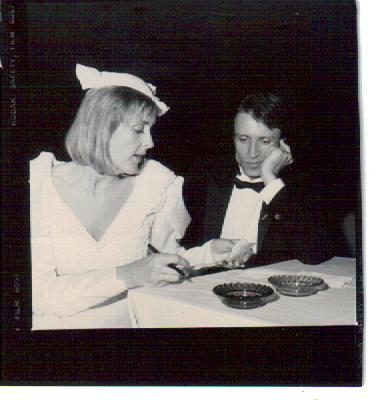
But, the very first time I saw my wife, she was glowing. I kid you not. Sitting in the second row of a darkened auditorium listening to the Chaplain of the U.S. Senate, there she was — surrounded by a golden aura.
At the time, I was a reporter for a small suburban weekly paper, and was there on assignment. I had a camera, but was so befuddled I failed to get the shot. You might argue I was imagining things, but I don’t think so. I’m not given to visions nor hallucinations. I’ve never witnessed anything like it before or since.
I kept my eye on her while I got my story. But at the end of the program, she went right up to the speaker. I figured she must be with the group of important people who had accompanied him from Washington, D.C.
So, I put The Glowing Girl out of mind and tried to forget about her.
Fortunately for me, she turned up again a couple of weeks later at church. She was a friend of a friend, who introduced us and immediately left us alone. I didn’t let her get away a second time.
I think the whole experience was a special gift for a fellow a bit slow on the uptake, who needed a sign to notice a good thing right under my nose.
That’s my story and I’m sticking to it.
We were married at Midsummer. She was sick and only made it through the festivities with the help of cold medicine. The next morning we flew out of town to New York, and the very next night, took an overnight train to Montreal.
Come live with me and be my love,
Assured before you voice your fears
That we will meld as hand to glove
With tender wearing through the years.
How could I love another more,
Or ever you abandon me?
So come, our prospects let’s explore
Assay our hopes in honesty.
I’ll write old-fashioned poems for you,
The kind that sing with foot and rhyme,
To soothe your ear and gently woo
Your cautious heart in its due time.
We’ll stay abed when springtime rains,
And care not if it’s ever done;
We’ll pedal wooded country lanes,
And bask beneath a merry sun.
In lilac-time I’ll break for you
The heart-shaped leaf and purple bloom
That flourished when our love was new,
And filled the night with strong perfume.
Like hardy husbandmen of old,
Who ploughed and tilled the fertile soil,
We’ll give ourselves to labors bold,
And harvest children for our toil.
And when the winter of our years
Bespecks our thinning hair with snow,
We’ll stoke our fire against the fear,
Companions though the chill winds blow.
Relentless time moves on apace,
Time leaves its vanquished under stone.
But we can win at time’s own race
By choosing not to run alone.
Defying reason, let’s unite
To form a sturdy three-fold cord,
A braid miraculously tight,
Of bridegroom, bride and gentle Lord.
If my proposal your love stirs,
If this be your desire for life,
If to my faith your heart avers,
Come live with me and be my wife.
Notes:
Thankfully, sometimes love DOES work out.
After some bump and bruises, I finally found the love of my life. Thirty-one years ago I wrote her a poem. Not leaving anything to chance, I shameless ripped off the first line from Christopher Marlowe’s poem “The Passionate Shepherd to his Love.” The rest was mine.
It may not have been wholly original poetry, but it did the trick. She said “yes.”
The funny thing is … soon after that I wound up practicing direct marketing copywriting as my day job.
After my experience with this poem, I should have known I was destined for direct marketing. The poem was my very first direct marketing letter.
I got a 100% response rate. Retention has been solid, and long-term value excellent.
Here comes midsummer’s milestone of our love,
Years since our selfish selves we pledged to yield,
So we’re as broken-in now as the glove,
I wore so long ago while in the field.
Fresh from the store unworn straight to my room,
Rubbed in the oil and every crease explored,
All through the night I savored the perfume,
The musky linseed leather I adored.
Come sober daylight with our job to do,
All awkward stiff not giving either way,
How many sweaty strivings’ deja vu
It took before we as one flesh could play.
Some ragged days I’d spit and pound the palm,
Or hurl the thing against the dugout wall,
But all the while a magic mute and calm
Mutated hand to glove with every ball.
The softening was gradual but sure.
Soon nerves and muscles seemed just like they spanned
From fingertips to join the glove secure,
As if I had been born with one webbed hand.
We’ve come now to the eve of middle age,
Well worn but with a lot of sport to go.
We must each for the other one assuage
Those stinging blows life certainly will throw.
We’ve held through wins and losses and through rain,
That etched new cracks not there at all before.
But loves like this were made to take the strain,
Just like that piece of cowhide that I wore.
Notes:
Not long ago, I asked my wife if she had a favorite poem. Her blink reaction was, “the one about the baseball glove.”
So, that is what she gets on the eve of our 31st anniversary. A re-run.
It was written sometime in the early 1990s. We were young and just starting a family. I had a job I absolutely hated. I would take long lunch breaks and write poems parked by the side of Lake of the Isles in Minneapolis.
Long before I discovered girls, back in Marshall, MO, my first love was baseball.
I cannot begin to total up the hours spent playing baseball, watching baseball, collecting baseball cards, sorting baseball cards, reading about baseball, and dreaming about playing in the World Series.
I knew the starting line-ups of both the St. Louis Cardinals and the Kansas City A’s by heart.
When I played one-man whiffle ball against my friend Royce, we would pick a team and go through the line up as each individual player. If the guy batted right, we batted right. If he batted left, we batted left.
(We drew the line at pitching left-handed, because neither of us was truly ambidextrous.)
Our spare time was spent searching for discarded pop bottles which we could turn into the neighborhood grocery store for two cents apiece. Every 5 bottles meant we could buy two more packs of baseball cards.
Somewhere between the ages of 12 and 13, we moved on to other interests. A long and winding path led me to the love of my life.
We were married 31 years ago today.
The inspirations for this poem are multiple. Several years ago, it was coming on to midsummer and my wedding anniversary.
I was feeling that sense of my youth slipping away. But, despite the oppressive job I was enduring, I was confident that good things still lay ahead.
I was also listening to a lot of Van Morrison. His song “Madame George” was stuck in my head. (Quite possible the most poignant song ever written.)
In particular, I was hearing the line where Van does his improvisational thing where he repeats the words “love” and “glove” over and over in an almost hypnotic chant.
My story is about a very different glove, and a very different love. But that merging of the two words was lodged in my mind.
The result of all of this ferment was this poem.
The only time I’ve ever read it in public, I was told it was “an audacious metaphor.”
I’ll take that.
Today, upon the occasion of my 31th wedding anniversary, I submit this little poem. It’s as true today as when I wrote it years ago
“The changing light and seasons have their ways …”
Familiar Ways
I choose to walk the old familiar ways,
To wend ways where I’ve put my foot before,
To gaze anew on views seen other days,
Which, though familiar, never seem to bore.
The changing light and seasons have their ways
Of making old things new: The light-laced hoar,
The first-flush, green-glow, bursting-forth spring days,
The growing tinge of gold we can’t ignore.
Each day, my dear, I choose afresh our trail,
The one we blazed so many years ago,
Eschewing other routes that might avail,
And hewing to the well-worn way we know.
Forsaking novelty need be no jail
With your face bathed in sunset’s golden glow.
Poet John Ciardi relates this story about Robert Frost, who at a lecture was asked by a woman in the audience: “Mr. Frost, surely when you write one of your beautiful poems, you are not thinking of technical tricks!”
Frost looked at the woman a while and replied, “I revel in them!”
Ciardi says Frost was like a horse trader who “would pick up an idea and whittle at it until he either wound up with a little whittled shape or a pile of shavings on the floor.”
I felt a little like a horse trader as I was writing this poem. It started with a simple, little idea. I can’t remember ever “whittling” more on a poem before. At first, this one seemed like it just never wanted to happen. I just kept whittling and whittling until something very different began to emerge from where I started.
After what seemed like an eternity, I began to see the tricks of the trade — namely rhythm, diction, image and form — coming together to embody the simple little idea.
This one did not plop, fully formed, into my lap. It was written, re-written, and re-written again. I wrote in on my phone. I copied it out by hand in a notebook. I typed it in Microsoft Word on my laptop. I read it aloud and even recorded a reading of it to hear how it sounded.
I found myself being keenly aware of assonance, alliteration and internal rhyme like never before.
I found myself unconsciously using the same sounds and rhymes over and over again as if I was consciously reinforcing the central idea. Then, I found myself breaking the pattern with lavish, flamboyant word choices in the middle of the poem to demonstrate the message.
I found myself coming around to embracing a metaphor in the final part of the poem. It was an idea that emerged only after the first part of the poem was written.
It may be a pile of shavings. Or it might be a little whittled shape.




 Poetic Champions