Sonnet inspired by a vile song

Love the one you're with ...

Illusions of Innocence

Time was, the sun stood high and corn grew green,
The juice of youth coursed through our throbbing veins.
Love easy and free as the night was keen.
The grass our bed, our bath the gentle rains.

We took up books of verse and lingered long,
Imagined we were wise as those in odes,
Took guidance from the lyrics of a song,
Cast off the quaint restraint of outworn codes.

All along, ignoring every sign:
The chill that comes and strikes the landscape dead,
The smut that spoils the corn and rots the vine,
The vulture drifting gravely overhead,
And, one subtle clue even less benign,
That not one selfless thought entered our head.


NOTES:  Reflecting back on my youth, I am chagrined.  There is an old aphorism that states, “If you stand for nothing you’ll fall for anything.”  There was a variation that went something like, “If you believe nothing, you’re liable to believe anything.”

By the late 1960s, many of us in my generation had pretty much had our beliefs in God, country and traditional morality watered down to pitifully weak broth.

Mainline churches increasingly didn’t even believe their own teachings.  Patriotism was dealt a severe blow by the national identity crisis over the Vietnam War.  The glowing reports of the sexual revolution made old fashioned morals seem not only quaint, but stupid.  If you were missing out, you were not only square, you were a chump.

It was only natural that we would adopt values from the popular culture of the time.  And the most influential popular culture of the day for the young was music.

Thankfully, there were some voices that seemed to have a moral compass.  Bob Dylan, for example, started out as a folk-protest-poet, and never stopped looking for truth, going down whatever roads it took him.

But prophets like Dylan were scare and rare.

A good part of the steady diet we heard on the radio was more on the level of “Light My Fire” or “Let’s Spend the Night Together.” Teenage libidos probably didn’t need any extra encouragement if you know what I’m talking about.

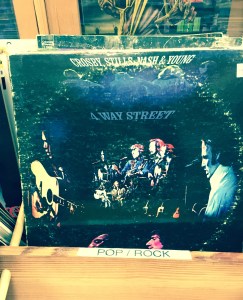
Of all the songs from those days, one stands out as especially reprehensible.  Of course, I’m referring to Stephen Stills’ paean to infidelity, “Love the One You’re With.”

Set to a catchy tune with some nice acoustic guitar licks, the song’s poison message is wrapped in layers of cotton candy lyrics.

If you’re down and confused
And you don’t remember who you’re talking to
Concentration slips away
Cause your baby is so far away

Well there’s a rose in a fisted glove
And the eagle flies with the dove
And if you can’t be with the one you love honey
Love the one you’re with, love the one you’re with
Love the one you’re with, love the one you’re with.

That there is some great relationship advice.  Just great.

Apparently, I’m not the only one who hates the song.  Even former front man of punk bands Scratch and Jesus Lizard, David Yow — an expert in vile lyrics if there ever was one — agrees with me.

He says he hates that song so much he’d like to choke Stephen Stills to death.

I wouldn’t go that far.  I’m just chagrined that I once thought it was a cool song.

Don’t get me wrong.  I don’t hate all songs by Crosby, Stills, Nash & Young.  “Our House” is a wonderful little tune about domestic tranquility.  It was written by Graham Nash when he and Joni Mitchell were in love, living at her house with “two cats in the yard.”

It’s a pity that tranquility couldn’t last.  But with the band singing “love the one you’re with” every night, how could it possibly last?

Love poem

I loved you first in lilac time

Flower Time

I saw you first in jonquil time,
When you were bathed in grace.
You sat aglow with fire sublime,
And golden shone your face.

I loved you first in lilac time.
A bloom I plucked for you.
I wrote you verse with song and rhyme.
I hoped you loved me too.

I kissed you first in tulip time,
It must have been a sign.
The buds and we were in our prime
When your two lips met mine.

I married you in daisy time
On summer’s longest day.
We traded rings and heard bells chime.
We pledged always to stay.

Too soon we’ve come to aster time.
The days are shorter now.
Would stealing some be such a crime?
We’ll make it right somehow.

Should we endure ’til wintertime,
The time when flowers sleep,
Dreams we’ll share of a gentler clime
Where we no more shall weep.


NOTES:  Today is Valentine’s Day, and it’s unseasonably warm here in the Pacific Northwest.  It won’t be long before the jonquils and crocuses start poking their heads up through the mulch.

And it won’t be much longer than that before my favorite  — the lilacs — grace us with their fragrance and beauty.

It’s a good day for a modest little love poem.

Winter sonnet

That bleak season

That Bleak Season

That bleak season the cold creek ceased to run,
Grey weeds withered beside the roadside ditch,
Flat leaden clouds obscured a sullen sun,
Winds lashed ice-lacquered leaves without a twitch.

Field stalks bowed down to winter’s weary weight,
The world conspired to pile pang upon pang,
Even the crusted snow cried, “Much too late!”
Caged by a skeleton hedge, no bird sang.

That bleak season love went the way of leaves,
Good green seeming, but poised to take the fall,
First frost stunned then assailed by windy thieves,
Some futile few sought stubborn to forestall
The impending end ’til a fell gust cleaves
Asunder with only a scrawny squall.


Notes:  If you read enough Gerard Manley Hopkins, it can mess up your iambic pentameter.  That’s because he often wrote in what he called “sprung rhythm,” which involved tossing out the sing-song metric rules that so many of his Victorian contemporaries followed.

Sprung rhythm was not free verse.  Hopkins followed his own complex set of rules, but he was wildly eccentric for those times.

I do not claim to follow Hopkins or his rules here.  This poem is more like “disjointed rhythm” than sprung rhythm.  But this seems to me to be very appropriate for the subject matter of a world and a love wrenched all out of joint.

This poem still faintly resembles a sonnet.  It still has 10 syllables to each line.  It still rhymes in a familiar pattern, close to the English sonnet, but ending in an e-f rhyme instead of g-g.

Late fall sonnet

Autumn leaves

Falling Leaves Like Lovers

The leaves, the leaves are gone except the oak,
Which cling to trees and rattle needlessly.
The others flame and fall for all to see.
They streak and sizzle, leaving only smoke.

But oak leaves hang as by some unseen yoke,
All browned and curled awaiting sympathy,
Or sap to course and lend vitality–
The leaves cannot perceive the sorry joke.

For spring will end the lie and they will drop,
To drift and rot and turn in time to dust.
As sure as buds will burst to make a crop
Of new, the old will flutter down–they must.
The falling leaves like lovers never stop.
It’s hardly gentle, but ’tis just, ’tis just.


Notes:  Some of my favorite poems compare the death that comes in the autumn to the end of a love.  Or poems that use the dying natural world when winter approaches as the backdrop for the story.

I think of Robert Frost’s Reluctance, with its heartbreaking line about it being treasonous “to bow and accept the end of a love, or a season.”

Or Thomas Hardy’s Neutral Tones, which uses a frozen landscape as the setting for the realization that a relationship has ended.

Then, there is John Crowe Ransom’s Winter Remembered, with its wonderful image comparing the forsaken lover’s cold fingers to “Ten frozen parsnips hanging in the weather.”

I may never have discovered Ransom had it not been for my 11th grade English teacher,  Paul Hagedorn, back in Marshall, Missouri.  We spent an inordinate amount of time on poetry that year.  The major assignment, as I recall it, was to select an American poet from a lengthy list, and then immerse yourself in the writer’s work, and finally write a paper.

Knowing nothing about most of the choices, I picked John Crowe Ransom solely because I liked the sound of his name.  I got lucky, because I discovered I enjoyed his work.  Had I chosen Wallace Stevens with his difficult, cerebral verse, I probably would have flunked.

Another assignment was to prepare a notebook of our favorite poems.  I remember making daring choices, including song lyrics by such radicals as Paul Simon and Bob Dylan.  Now  that Dylan as been awarded the Nobel Prize for Literature, I consider myself foresighted.

I was fortunate that Mr. Hagedorn approved of my choices.  He was the cool, young teacher back then.  He managed to fan the flames of inspiration and love for poetry.  They smoldered for years, flaming up now and then, and have finally started burning here in this blog.

Autumn haiku

Autumn sunset over the Olympic Mountains

The fragrance of leaves.
The chill that comes with evening.
Old wounds ache again.

Poem for my first poetic champion

My first poetic champion

Ice Age

Dear gentle woman grown so early old,
You’ve all but left us on our lonesome own.
Now after many years to spirit sown,
A creeping glacier scrapes your memory cold.

You, greener days ago, recited verse,
And planted hardy seeds of simple song
That rooted deep, perennial and strong,
To flourish in the shadow of the hearse.

Today your weathered hands no longer know
The jonquil from the mum, nor how to weed.
Today you prattle on without the seed
Of sense, that for so long you toiled to grow.

So now for you I pick this small bouquet
Out of the garden patch you used to tend,
Now choked with worldly weeds from end to end,
In need of hands to cultivate its clay.


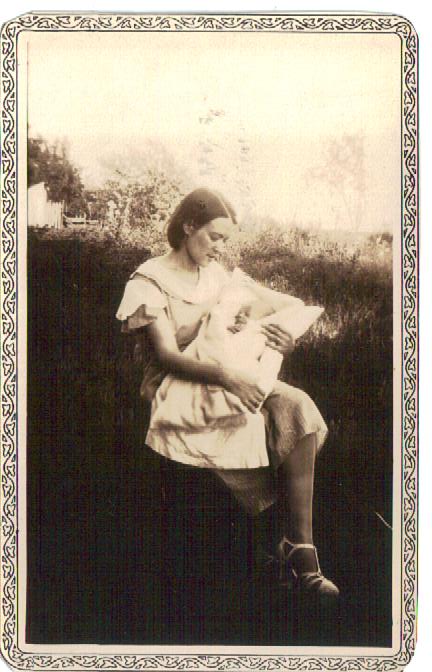
Notes:  This month, my mother would have been 105 years old.  She died nearly 30 years ago, but she began to leave us several years before that as she fell under the spell of some unnamed type of dementia.

She was my first poetic champion, instilling a love for poetry from an early age.  This poem was written back when she was still alive, but unable to communicate with us.

Mother was forced to drop out of grade school when her mother died in a flu epidemic.  She was needed at home to care for her younger brothers and sister.

Her tastes were simple and traditional, with a leaning towards folksy American poets, like James Whitcomb Riley and Eugene Field.  But she also like Robert Frost and Wordsworth.

We really only had one book of poetry in the house, a leather-bound volume entitled One Hundred and One Famous Poems, published in 1929. It contained remarkably robust collection of poems, and she read them aloud to me often.

There were selections from Shakespeare, Emerson, Poe, Kipling, Byron, Keats, and even Whitman.  In the back of the book were some bonus classics of English prose including the Gettysburg Address, the Magna Charta, the Ten Commandments, and the Declaration of Independence.

I daresay, I got a better education from that one book than I received in four years attending a semi-prestigious liberal arts college during the self-absorbed 1970s.


Hometown haiku

House on East Porter Street, Marshall, Missouri
The old hometown seems
smaller than I remember.
Once, it was magic.


Notes:

For Van Morrison, it was Cyprus Avenue in his hometown of Belfast. The fancy, tree-lined street where the upper class lived.  Where a working-class boy went to dream and catch glimpses of aspirational girlfriends.

In my hometown, that street was Eastwood.  It was a shady, tree-lined street with what passed for mansions in my little Missouri farm town of Marshall.  And there here were even a couple honest-to-Pete mansions among them.  Reminders of old money abounded.

To a Johnny-come-lately, working-class kid like myself, it seemed like the coolest place on earth.  I lived on the other side of town.  Not in the poorest section, but definitely in a different layer.  My house was brand new, but it was a plain 1950s ranch house.  Utilitarian and homely.  Decorated in the finest Late Depression.

At first I didn’t have any friends among the Eastwood society.  Unattainable, I thought.  But when all of the grade school kids graduated to junior high, we were suddenly thrown together.

I became buddies with an Eastwood kid, Clyde, who, while he didn’t live right on Eastwood, lived close enough — a long block off of it.

His home was a demonstration of exquisite interior decorating, and his family a wonder of graciousness and hospitality.  I felt lucky to have such a cool friend.

We played football, we raced slot cars, and talked about our growing interest in girls.  I heard Sgt. Pepper’s for the first time in his basement.

When my cat didn’t come home and was eventually found struck to death by a car, I went to Clyde’s to play basketball.  I played so furiously that I eventually egged him into our only physical fight.

Because that’s how 12 year old boys grieve.

In those days of flower power and Vietnam, we did find ways to wage a few political protests, and fight against what we saw was hidebound traditions at our high school.

We eventually began to drift our separate ways, spending more time with girls than with our old guy friends.

One evening, late in our high school years, we sat around a campfire out at the park, vaguely aware that our sheltered years in our old hometown were drawing to a close.  Our oh-so-enlightened conversation including a one-through-10 ranking of our female classmates.

If I remember, we did try to maintain a sense of irony about it.

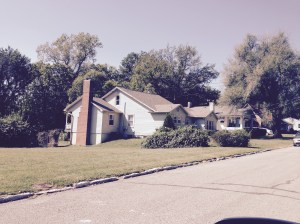
The photo atop this little poem is a recent shot of Clyde’s old house.

Late summer sonnet

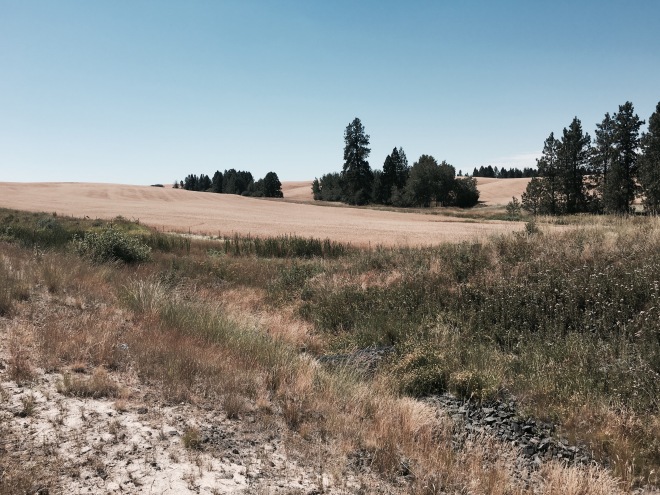
The once green grain gone golden in its rows
Late Summer’s Sun

Late summer’s sun has baked the grass to brown.
The days grow shorter with each passing day,
Soon, autumn’s chill will make the leaves fall down.
All of this aching beauty will decay.

And yet I love the shadows’ slanting trace,
The once green grain gone golden in its rows,
And how I love the lines etched in your face.
It’s funny, as love ripens how it grows.

The number of our days we do not know.
No sleeper knows if he will ever wake.
So come, let’s join above, between, below.
My dear, let’s cause our fragile clay to quake.
Let us make love as if it’s our last go.
Let us embrace like dawn will never break.


Notes:

It’s that time again to haul this old one out of the vault.

Among other things, God was the first poet.  The world is full of rhyme and rhythm, image and metaphor.

In our own small, imperfect way, we just catch glimpses.


Hot car haiku

Raymond Ball and Ralph Ball

Strategic brothers,
knew the key to a girl’s heart
involved a hot car.


Notes:

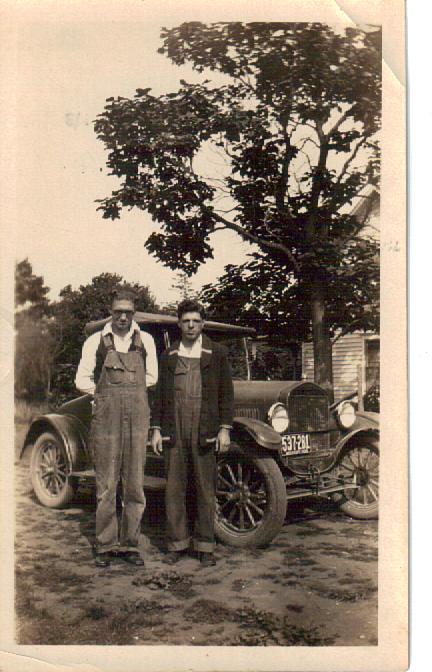
My father  got in on the ground floor of the automobile revolution.  He learned auto  mechanics by hanging around the only garage in his small Missouri farm town.  He cut his teeth fixing Ford Model Ts, and kept learning from there.

Although he spent years trying to make a living as a farmer, and then as a businessman, he ultimately returned to mechanic work.  It was really his true calling.

He could fix things, and make them run. He didn’t buy new cars.  He bought old cars in need of work and fixed them up.

When it became clear to him that he was going to be a mechanic for the rest of his life he went out in his back yard, and proceeded to build himself a proper workspace.  It looked just like a barn, because that is what he had built before during his days on the farm.

But he built it himself from scratch when he was well past 60 years old.  Of course, he used reclaimed lumber scavenged from various tear-downs.

In his later years he ran a mechanic repair business out of his new garage.  He was the only mechanic for miles around who would make house calls.  The farmers all over Saline County knew that he could be depended on to fix their tractor, hay baler, or corn picker.

The photo at the top of this post shows my father, left, and his brother, Ralph, in front of one of the hot cars of the day.

Love sonnet

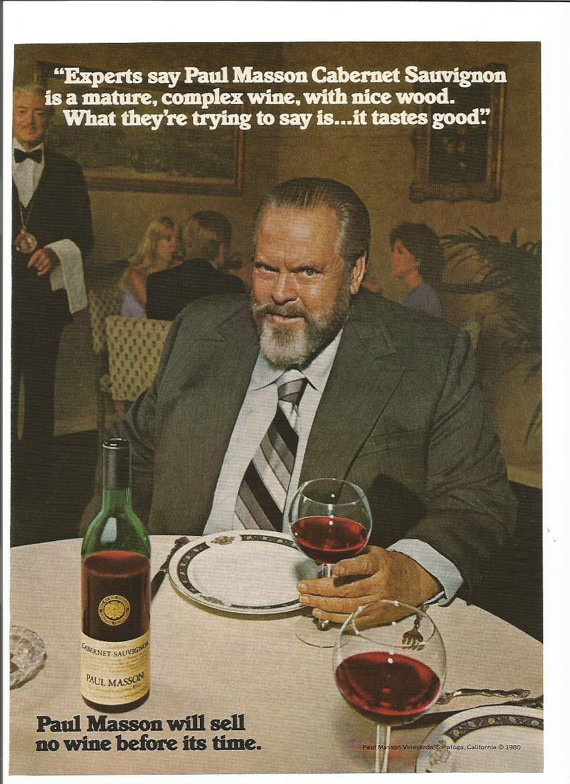
Orson Welles, fat and famous wine spokesman
“We’ll Sell No Wine”

“We’ll sell no wine before its time,” we’re told.
The fat and famous spokesman made it clear,
Each vintage has its period of gold.
(You must assess the pressing and the year.)

So, likewise, for each vintage comes a time
The point past which there’s no return at all.
Decay and oxidation work their crime,
And turn your sweetest nectar into gall.

So come, my dear, what are we waiting for?
Our cellar holds a few more bottles still.
Pick one and brush away the dust before
Time turns its contents back to must — time will.
Cast off our caution and our clothes and pour,
And drink with joy until we’ve had our fill.


Notes:

I’m old enough to remember when Orson Welles became a television pitchman for a sort-of-good American wine.

Welles had been the genius who panicked the nation in 1938 with his faux-documentary radio broadcast, “War of the Worlds.”  In 1941, he directed and starred in “Citizen Kane,” considered to be among the best — if not the best film of all time.

By the late 1970s, Welles was making commercials.  His Paul Masson spots are still classics.

“We will sell no wine before its time,” was a magnificent slogan.