Sonnet Upon Seeing a Photograph

Doing what brides' mothers always do

Please Tell Me

Tell me the photograph I lately spied
While idly searching round the internet,
One of a greying woman and a bride,
A common scene of longing and regret,

She’s fussing with the buttons and the dress,
Just doing what brides’ mothers often do
To stall the creeping sense of uselessness …
Please tell me that this woman isn’t you.

Her eyes are heavy-lidded widow’s eyes,
Not wide and worshipful how I recall.
Her weary face with sorrow etched likewise,
Not fresh and freckled tempting me to fall.
Her lips so tightly clenched that I surmise
These can’t be lips that once held me in thrall.


Notes:  Not that I need any more reminders, but time is moving on.  I — and those I have known and loved and lost — are getting older.  And life is not always kind.

Robert Frost said, “Nothing gold can stay.”

Robert Herrick said, “Gather ye rosebuds while ye may.”

Gerard Manley Hopkins said, “It is the blight man was born for.”

I say … well, you can read the poem …

©Bobby Ball 2018 (written 2018)

Madeleine L’Engle, also a Poet

Madeleine L'Engle and

With the release of the new move, “A Wrinkle in Time,” writer Madeleine L’Engle has come back into the cultural consciousness. Her Newbery award-winning book was first published when I was at an impressionable age, and helped fuel both my imagination and love of reading.

I haven’t seen the movie, but I understand that despite a strong cast headed by Oprah Winfrey, it is not doing particularly well at the box office. As I write this it has a long way to go to earn back the more than $100 million it took to produce.

L’Engle’s book was criticized for its liberal treatment of religious themes back in the 1960s. Ironically, this year’s movie has been criticized for not sticking closely enough to the book and watering it down its Christian references even further.

But I digress.

Today, in one of my used bookstore haunts, I was intrigued to discover a slender book of verse by L’Engle, entitled “The Weather of the Heart.” I hadn’t realized she also had written poetry.

And what a discovery! Chock full of verse about wonder and love and death and faith.

But the one that really jumped out at me was all too human, and startling in its honesty. Written to her husband while they were apart, it recounted an affair averted. It’s hard to say just how close she came, but because the poem is so honest, it results in a reaffirmation and celebration of fidelity.

It helps to understand the poem to know that L’Engle’s husband, Hugh Franklin, was a stage and television actor.

L’Engle’s poem doesn’t seem to be published on the internet, so I will set it down for you here. It is inspiring on many levels.

Lovers Apart

In what, love, does fidelity consist?
I will be true to you of course.
My body’s needs I can resist,
Come back to you without remorse.

And you, behind the footlight’s lure,
Kissing an actress on the stage,
Will leave her presence there, I’m sure,
As I my people on the page.

And yet–I love you, darling, yet
I sat with someone at a table
And gloried in our minds that met
As sometimes stranger’ minds are able

To leap the bounds of times and spaces
And find, in sharing wine and bread
And light in one another’s faces
And in the words that each has said

An intercourse so intimate
It shook me deeply, to the core,
I said good-night, for it was late,
We parted at my hotel door

And I went in, turned down the bed
And took my bath and thought of you
Leaving the theatre with light tread
And going off, as you should do,

To rest, relax, and eat and talk–
And I lie there and wonder who
Will wander with you as you walk
and what you both will say and do …

We may not love in emptiness,
We married in a peopled place;
The vows we made enrich and bless
The smile on every stranger’s face.

And all the years that we have spent
Give the joy that makes me able
To love and laugh with sacrament
Across a strange and distant table.

No matter where I am, you are,
We two are one and bread is broken
And laughter shared both near and far
Deepens the promises once spoken

And strengthens our fidelity
Although I cannot tell you how,
But I rejoice in mystery
And rest upon our marriage vow.

Why Poetry?

A philosophical poet

I Sing Not for Glory

I sing not for glory nor for bread,
Nor for the praise of the credentialed clique.
But for hire more valuable instead,
To touch the honest kindred heart I seek.

I sing for lovers when love is green,
When time stops for a solitary kiss.
When light shines anew as with new eyes seen,
I celebrate your fey and fragile bliss.

I sing for the lonely, lovelorn heart,
When light grows cold and aching will not cease,
When your enchanted world falls all apart,
I offer modest salve to give you peace.

I sing for the pilgrim searching soul
Pursuing the heart’s true cause and treasure.
May heaven’s hound, you hasten to your goal,
And propel you to your proper pleasure.

I sing for the wise who see their end,
And, too, for those who have not yet awoke.
For to a common home we all descend,
With common dirt for all our common cloak.

I sing not for money nor for art,
Nor to amuse curators of our trade.
The simple wages of the simple heart
Will satisfy when my accounts are weighed.


NOTES:  I understand April is Poetry Month.  In keeping with this solemn occasion, here’s a poem about poetry.

Late Winter Haiku

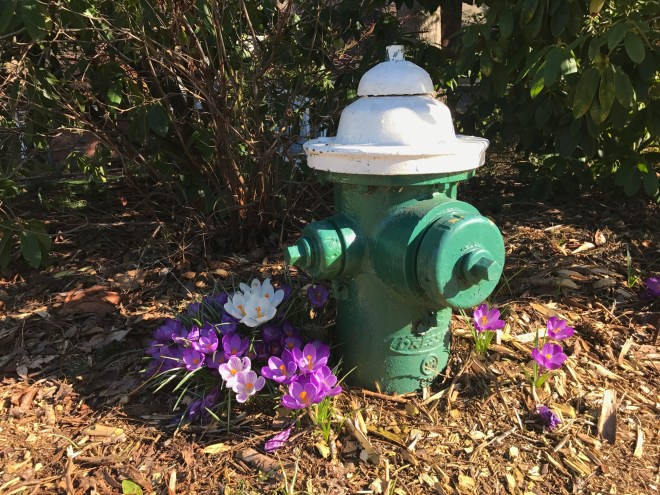
Crocus blooming in late winter

Late winter warm spell,
tree frogs in love calling out
“Cro-cro-cro-crocus!”


NOTES: Unseasonably warm weather this weekend in the Pacific Northwest.  When I went to the mailbox I heard the tree frogs for the first time this year.  They are awake and most certainly in love.

Poem in protest of spring

Late snowfall

COME GENTLE SNOW

Come gentle snow and cloak the ground,
Shroud budding branches all around,
Let not one scent of spring be found,
Make flowers wait.

Come frost and freeze the throbbing juice,
Break March’s short and shaky truce,
No sprout nor songbird yet aloose,
Let spring be late.

Come wind and make the oak leaves hiss,
When they descend no one will miss
Their brittle shade — no artifice
Can bring them back.

Come night and steal the season’s gain;
The verdure will begin to wane
Despite the wealth of easy rain
If it stays black.

Come sleep and shield me from the past,
Help me forget her I loved last,
Wrap safely me in sanctums vast,
Away from pain.


NOTES: We haven’t had that wonderful March snowstorm here in Western Washington yet this year.  So I’ll have to settle for a photo from last year.

We had some snow in late February, but I’m still pulling for a blizzard in March.

You see, I’m allergic to March here — the alder and cedar pollen are not kind to me.

Nearly 40 years ago when I wrote this poem protesting spring, I was an unrequited, tragic romantic. O woe was me!  I thought I’d never be happy again.  Of course, I was wrong.

If I can just make it through March to April, I should be fine.

Winter Haiku

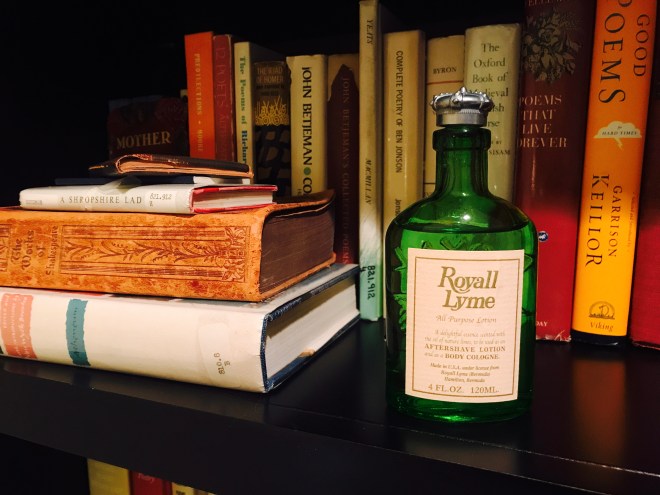
Royall Lyme after shave

Even in winter
one whiff stirs a remembrance
of spring long ago.


Notes: I’ve heard that the sense of smell is the strongest trigger of memories. I’m not sure that is a scientific fact, but anecdotally it sure seems so.

The odor of a particular janitorial product can transport me back to the polished hallways of Southeast Grade School. A hint of Lily of the Valley can put me right back in the shoes of the little boy who was me tending a flower garden with my mother.

The smell of fresh baked bread lands me in my grandmother’s house, playing with my cousins, anticipating the first bite of that still-hot bread, smeared with homemade butter and smothered in honey from the comb.

And the smell need not be pleasant. Step into a campground outhouse, and I’m right back on my childhood farm.  We weren’t the poorest farmers in the county — we had a two-seater.

And that reminds me. The smell of burning paper brings back the recollection of the out-of-date Sears & Roebuck catalogs, kept along with a box of kitchen matches in that old outhouse as a sort of forerunner to the modern room deodorizer.  You just rip out a page, roll it tight, and light it.  Everything smells much better than before!

Last month while on vacation, I was delighted to find a fragrance from the past at an Brooks Brothers outlet mall store. The bright green of the Royall Lyme bottle caught my eye almost immediately.

The heavy metal crown-shaped lid felt the same.  The faux-Old English font looked the same. And when I sprayed on a bit of the fragrance, I was taken back to the mid 1960s again.

The high school speech and debate club had boarded a school bus and driven to Kansas City for a weekend field trip.  The stated educational rationale was to take in a film or two that were not available in my rural hometown. But it was really pretty much a junket, a good excuse to get out of town and hang out in the big city.

Some of the details are fuzzy, but I think we stayed at an old Howard Johnson’s out on I-70 and Noland Road. Then the next day, with our teacher, Mr. Washburn, driving the bus, we ventured into the city.  I think the big movie most people wanted to see was Cat Ballou, which would most likely date this event in the spring of ’67.

We had no way of knowing it, but that summer in San Francisco would see the “Summer of Love,” with the full flowering of the hippie subculture. This was the era of “be-ins,” sex, drugs, and rock & roll.

But that was all to come later. Back in Kansas City, we caught a matinee, which I remember nothing about.  We ate at the Italian Gardens, at its old location on Baltimore Avenue, my first experience with ethnic food. The spumoni was redolent. It must have been soaked in some type of booze, which I had also never tasted before. A classic spumoni in an old school Italian restaurant can sometimes take me back in time.

But the most memorable experience happened when we stopped into a fancy men’s clothing store. I didn’t have a lot of spending money, so I couldn’t afford the clothes. But I found a bottle of Royall Lyme cologne in my price range and bought it.

I had a crush on a girl, and there were signs she liked me too. We sat next to each other on the bus ride back home. I wore the lime-scented fragrance.

As I walked home from the school building by myself, I recall humming Simon and Garfunkle’s 59th Street Bridge Song, with its signature line, “Feelin’ groovy.”  (From the first album I would buy for myself, incidentally.)

The sun was warm. The birds were chirping. My feet floated above the sidewalk. God was in His heaven. Everything was right with the world.

And all was infused with lime.

Speaking strictly for me, I could have died then and there.

As for peak experiences, this may seem fairly tame. But when you think about it, how many times in your life seem absolutely perfect?

I can only think of a handful.

The perfection was fleeting, of course. It always is. We went back to classes on Monday. The school year ended soon. The puppy-love romance fizzled. The summer was spent detasseling corn and bucking hay. Come mid-August and we had to endure the grueling two-a-day football practices. School started up again. I caught a cold. The entire football season I sat on the ice-cold aluminum bench as a third stringer.

Everything was not groovy.

But that one springtime, lime-soaked day was a glimpse. A foretaste of something pure and good and innocent and perfect.

My generation would try, just a couple of years later to take the Summer of Love to the next level and seize that innocence by force.  At Woodstock, half a million young people would head to Yasgur’s Farm and try to “get back to the garden,” but would wind up wallowing in trash and mud instead.

I read about Woodstock in TIME magazine. I wanted to believe in it. But I had just been blessed with indoor plumbing and central heating a few years before. Something about the filth and the litter and the discomfort just didn’t jibe with what paradise was supposed to be like for me.

Then, in December of 1969, all the false hope of the Summer of Love and Woodstock would be slammed shut at the Altamont Raceway Festival Free Concert. While the Rolling Stones played Sympathy for the Devil, a fight broke out.  And while they played Under My Thumb, a Hells Angels security guard stabbed a stoned-out and unruly concert-goer to death.

Although I didn’t realize it at the time, the counterculture had peaked, and I had pretty much missed it.

We were a long way from “all  is groovy.”

By the time I would head  off to college in 1970, eager to plunge into the counterculture, it had already been exposed as a false hope and an empty dream. I felt vaguely cheated, like I’d arrived late at the party.

In 1973, Van Morrison would capture the contradictions and the corruption of the hippie movement in his song The Great Deception on the album Hard Nose the Highway:

Did you ever hear about the great deception
Well the plastic revolutionaries take the money and run
Have you ever been down to love city
Where they rip you off with a smile
And it don’t take a gun

— by Van Morrison

But the idea of paradise persists. And the scent of limes still brings it back.


Autumn Sonnet

Autumn scene

FALLING LEAVES LIKE LOVERS

The leaves, the leaves are gone except the oak,
Which cling to trees and rattle needlessly.
The others flame and fall for all to see.
They streak and sizzle, leaving only smoke.
But oak leaves hang as by some unseen yoke,
All browned and curled awaiting sympathy,
Or sap to course and lend vitality —
The leaves cannot perceive the sorry joke.
For spring will end the lie and they will drop,
To drift and rot and turn in time to dust.
As sure as buds will burst to make a crop
Of new, the old will flutter down — they must.
The falling leaves like lovers never stop.
It’s hardly gentle, but ’tis just, ’tis just.


NOTES: It was a mild and beautiful and extended autumn here in the Pacific Northwest, but the rains and winds have returned, knocking most of the remaining leaves off the trees over the Thanksgiving weekend.

Oak trees are not as plentiful here as they are back in the Midwest, where this poem was written some 35 years ago. But if there is an oak around, you can bet it will be hanging onto its leaves long after all the other trees have shed theirs.

Philosophy and Poetry

The poet in a philosophical mood

A Short Philosophical Love Note

Of what does missing consist?
(But first, know this, you are missed.)
It could be the lack of tender attack –
You see, I’ve missed getting kissed.

It might be like a disease
That only your treatment can ease.
The symptoms persist and although I resist
I wind up down on my knees.

It’s metaphysical tricks –
That’s strange, I know, but it sticks –
What else could explain the internal pain
When my heart my law contradicts.

It could be all in the mind,
If mental’s the way we’re designed.
But wishing you were does not make you here –
That’s truth of a different kind.

Who plumbs the depths of the soul?
And who knows the depth of the hole
Gouged when a lover heads for safe cover,
Exacting outrageous toll?


NOTES: When I headed off to college, my long-suffering father advised me to study “something practical.”  He suspected that I was likely to squander my opportunity at getting the education he never had the chance to acquire.

It might have been my hair, which had not been cut since the end of football season.  It might have been his knowledge that I was not the type of kid who listened to his elders.

So, of course, I went straight ahead and majored in philosophy with a minor in Greek and Latin.

And, also of course, the universe proved my father right.  Upon graduation I entered the job market and landed a coveted job as fry cook at a pancake house.

It was the only job I could get.

I had gravitated towards philosophy because I wanted to find answers to the big questions of life. I wanted to find Truth, Beauty and Love, and thought that philosophy was the route.

I didn’t find the answers I sought in philosophy. Instead, I grew weary of hairsplitting arguments and arcane debates about the meaning of language.

By my senior year, I was tired of the whole enterprise.

But I did find truth in a most unsuspected place. Not in the heavy and thick books of philosophical and impenetrable prose.  But in a dusty old Bible, the same Bible my father had been pointing me towards all my life.

Ironically, not only was my father right about studying something practical, he turned out to be right about where to find truth as well.

But off at college, I experienced my own personal John Newton/Saul of Tarsus moment.

Like the notorious English slave trader, I realized I had been blind about my own wretchedness.

Like the self-righteous Pharisee, I was knocked to the ground and scales fell from my eyes.

Like both of them, I was touched by grace and set on a new path with a completely fresh start.

After searching for truth in the ancient writings of Socrates and Plato, and seeking power in the seductive teachings of the East, I discovered that the truth I sought had been under my nose all the time.

But now that I had found truth, I still had to figure out what to do with my life. I was a decent short order cook, but I was pretty sure it wasn’t my calling.

I finally hit on the idea that I needed to do something that involved writing. And in those days in the afterglow of Watergate, this meant journalism.  So I went back to school to take just enough classes to land a newspaper job.

We all wanted to be the next Woodward and Bernstein.

I was delighted when I landed my first freelance stringer assignment. I drove to City Hall, spent 3 hours at a city council meeting, drove back home and then spent another 4 or 5 hours writing up as many stories as I could. The next morning, I drove the finished copy to the office.

I was delighted that for this they’d pay me a whole 15 bucks! And if one of the stories was decent, I might get a treasured byline.

What I didn’t realize was that the newspaper business had already started its long, slow decline. By the early 1980s, afternoon dailies were already going out of business all across the U.S.

Newsrooms were shrinking and it was tough to get on with a major metropolitan paper. And this was all before the internet cut the legs out from under newspapers’ business model.

Impatient with the career prospects at the big papers, I took a job as the editor of a financial newsletter.

(Had I been a better investigative journalist, I would have discovered that this publication had nothing to do with reporting objective truth. Instead, it was the front-end lead generator for a rare coin and precious metals dealer. It was really a direct marketing enterprise.)

But things worked out, and that first direct marketing job eventually led me to doing fundraising for good causes, which has been my career for the past quarter century.

But for several years — before I found the love of my life and the mother of my children — my love life followed the same tragic-comic early trajectory as my circuitous career path.

Full of false starts and spectacular missteps.

After one of these disasters, many years ago, I wrote the poem posted today.

It’s about the only thing I have to show today for my philosophy major.

Love Sonnet

Orson Welles pitching Paul Masson wine

“We’ll Sell No Wine”

“We’ll sell no wine before its time,” we’re told.
The fat and famous spokesman made it clear,
Each vintage has its period of gold.
(You must assess the pressing and the year.)

So, likewise, for each vintage comes a time
The point past which there’s no return at all.
Decay and oxidation work their crime,
And turn your sweetest nectar into gall.

So come, my dear, what are we waiting for?
Our cellar holds a few more bottles still.
Pick one and brush away the dust before
Time turns its contents back to must — time will.
Cast off our caution and our clothes and pour,
And drink with joy until we’ve had our fill.


Notes:  The news lately has been filled with dreadful reports:  mass shootings in Las Vegas, bombings in far-away lands, vile behavior by the powerful of Hollywood.

Because I know that mankind is fallen, I have no confidence in “human nature.”  But my innate positive outlook this week has been shaken.

When the week began, I learned that the son of a friend and former colleague had been one of the wounded in the Las Vegas mass shooting.  He had been a law enforcement officer for over 20 years and had never been shot, nor shot anyone in the line of duty.

And then he was shot in the neck and shoulder while he was attending a country music concert.

Thankfully, he survived and is on the mend today, and should be okay.

Then, the news about the Hollywood sexual abuse scandal broke.  My Facebook feed has been filled not only lurid stories of the rich and famous, but heartbreaking firsthand accounts from women I know who have suffered in silence from heinous actions of abusers.

The sheer amount of #me too is overwhelming.

Evil is real and more common than we want to admit.

One particularly poignant series of posts has made me reassess my own hometown experience.

I’ve written glowingly about my childhood and my hometown and my education.

As I have processed the new information, I must admit that — depending on where you stood — my hometown could have been more Twin Peaks than Mayberry RFD.

There was stuff going on back there that I had no idea about.

So, in the face of horror and dread, I will resort to a place of solace and peace.

I will celebrate love, and marriage, and monogamy.

I will seek to find meaning and comfort in order and rhyme and meter.

When the society and the culture seems to be disintegrating, I will look to the good examples I have in my life and celebrate faithfulness and honor and love.

I really don’t know what else to do.

Historical note:

I’m old enough to remember when Orson Welles became a television pitchman for a sort-of-good American wine.

Welles had been the genius who panicked the nation in 1938 with his faux-documentary radio broadcast, “War of the Worlds.” In 1941, he directed and starred in “Citizen Kane,” considered to be among the best — if not the best film of all time.

By the late 1970s, Welles was making commercials. His Paul Masson spots are still classics.

“We will sell no wine before its time,” was a magnificent slogan.