Hot car haiku

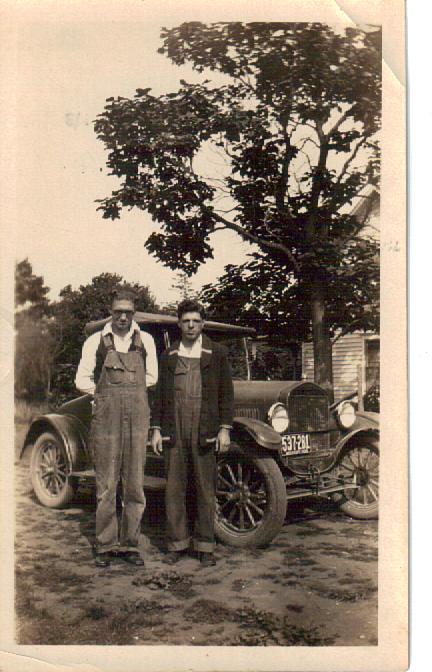
Raymond Ball and Ralph Ball

Strategic brothers,
knew the key to a girl’s heart
involved a hot car.


Notes:

My father  got in on the ground floor of the automobile revolution.  He learned auto  mechanics by hanging around the only garage in his small Missouri farm town.  He cut his teeth fixing Ford Model Ts, and kept learning from there.

Although he spent years trying to make a living as a farmer, and then as a businessman, he ultimately returned to mechanic work.  It was really his true calling.

He could fix things, and make them run. He didn’t buy new cars.  He bought old cars in need of work and fixed them up.

When it became clear to him that he was going to be a mechanic for the rest of his life he went out in his back yard, and proceeded to build himself a proper workspace.  It looked just like a barn, because that is what he had built before during his days on the farm.

But he built it himself from scratch when he was well past 60 years old.  Of course, he used reclaimed lumber scavenged from various tear-downs.

In his later years he ran a mechanic repair business out of his new garage.  He was the only mechanic for miles around who would make house calls.  The farmers all over Saline County knew that he could be depended on to fix their tractor, hay baler, or corn picker.

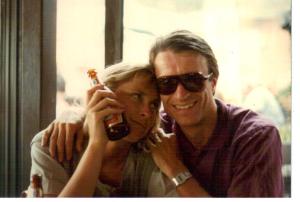
The photo at the top of this post shows my father, left, and his brother, Ralph, in front of one of the hot cars of the day.

Love sonnet

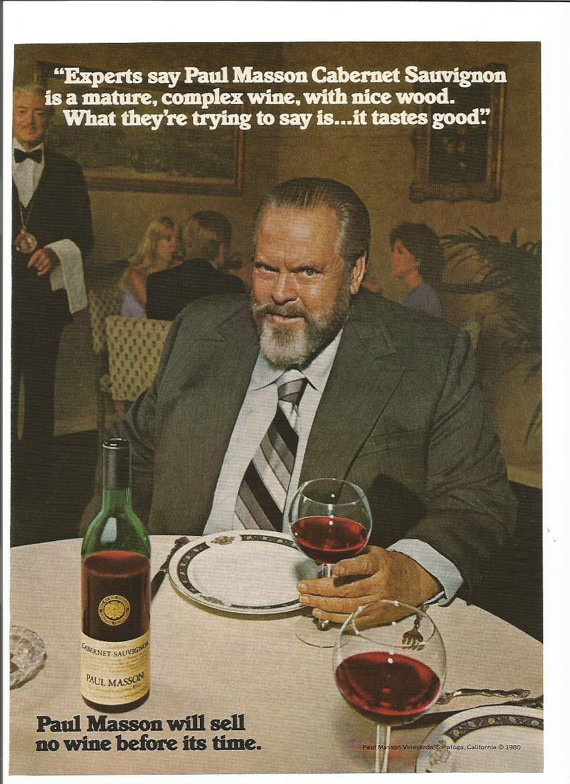
Orson Welles, fat and famous wine spokesman
“We’ll Sell No Wine”

“We’ll sell no wine before its time,” we’re told.
The fat and famous spokesman made it clear,
Each vintage has its period of gold.
(You must assess the pressing and the year.)

So, likewise, for each vintage comes a time
The point past which there’s no return at all.
Decay and oxidation work their crime,
And turn your sweetest nectar into gall.

So come, my dear, what are we waiting for?
Our cellar holds a few more bottles still.
Pick one and brush away the dust before
Time turns its contents back to must — time will.
Cast off our caution and our clothes and pour,
And drink with joy until we’ve had our fill.


Notes:

I’m old enough to remember when Orson Welles became a television pitchman for a sort-of-good American wine.

Welles had been the genius who panicked the nation in 1938 with his faux-documentary radio broadcast, “War of the Worlds.”  In 1941, he directed and starred in “Citizen Kane,” considered to be among the best — if not the best film of all time.

By the late 1970s, Welles was making commercials.  His Paul Masson spots are still classics.

“We will sell no wine before its time,” was a magnificent slogan.


Love poem for the Fourth of July

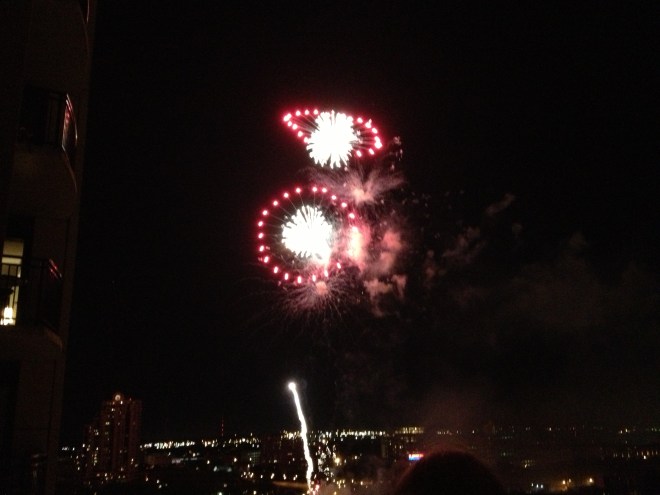
July 4th fireworks in Minneapolis, Minnesota
INDEPENDENCE DAY

The wind and you played in my hair,
You lambent in the moon,
The night arranged as by design,
Mysteriously boon.

Afresh the breeze and warm our hands,
So lately introduced,
Traced so gently new found lands,
From tyranny aloosed.

While all around with fire and bang
Our freedom was proclaimed,
A nation’s liberty was meant,
To us, two hearts unchained.


Notes

July Fourth holds special meaning for me.  I’m patriotic in the old fashioned way.  I still believe that America is exceptional, and has been an exceptional blessing to the world.

Our founding documents are exceptional in the history of mankind, and the men who wrote them were inspired by truly great ideas.

The big idea: That rights are given by God, and not some king or the government. That’s important, because what government gives, government can take away.  But the genius of the Founding Fathers was to see that our rights are granted by God, and thus “inalienable.”

I still get a lump in the throat when the national anthem is played.

But beyond this, my personal affection for July Fourth goes back to 1982, when a young couple snuck to the roof of the Calhoun Beach Club in Minneapolis to watch the fireworks.  This perch, high above Lake Calhoun, offered a 360 degree view of the entire Twin Cities area.  You could see several fireworks displays from there, both near and far away.

It was rather romantic.

Love poem for July 3rd

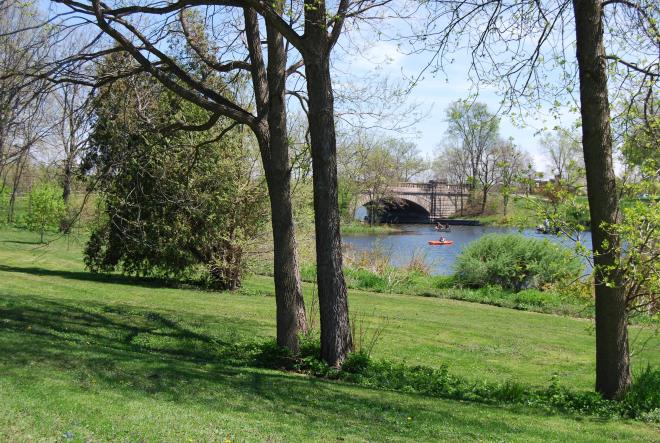
Lake of the Isles, Minneapolis
Lake of the Isles, Minneapolis … long ago

That Day We Lay Upon the Grass

That day we lay upon the grass,
A luminescent green.
The sparks that arced from arm to arm
Across the space between.

Our bodies quickened by the sun,
The willow leaves aflush,
The sunlight sparkling on the lake,
Our blood bestirred to rush.

Up and down the parkway, flowers
Enticing with their blooms,
Our loveless winter ended there,
Emerging from our tombs.

For we had slept as sleepers sleep,
Unmindful of the world,
Astonishingly we awoke,
Much like a rose unfurled.


Notes:

July 3rd — for me — will always be associated with the discovery of enduring love.

When love does not work out, it can painful, and the source of much poetry.  But when it DOES work out, it can inspire as well.

The events in this little poem date back to 1982. I know because I kept a little, old pocket calendar that proves it.

I’ve posted this little love poem before, but here it is again in honor of one of my favorite personal holidays.

Honeymoon sonnet

The happy couple honeymooning in Montreal
Epiphanies

We come now to the winter of our years
(Where did the autumn with its pleasures go?)
Our roof will all too soon be cloaked with snow,
So, come, let’s stoke our fire against the fears.

It seems another life ago, my dear,
That full of grace you pilgrim sat aglow
Enkindled so this prodigal would know
That grace was free and grace was very near.

Midsummer’s eve brought more epiphanies
Of spotless bride adorned, redeemed, in white,
Too ill for customary liberties,
So wan, yet still for these sore eyes a sight.
Then! Over Lake Champlain the full moon sees
A railway sleeper car rock through the night.


Notes:

When love is good and it lasts, it can be tempting to idealize its beginnings.

But, the very first time I saw my wife, she was glowing. I kid you not. Sitting in the second row of a darkened auditorium listening to the Chaplain of the U.S. Senate, there she was —  surrounded by a golden aura.

At the time, I was a reporter for a small suburban weekly paper, and was there on assignment.  I had a camera, but was so befuddled I failed to get the shot. You might argue I was imagining things, but I don’t think so. I’m not given to visions nor hallucinations. I’ve never witnessed anything like it before or since.

I kept my eye on her while I got my story.  But at the end of the program, she went right up to the speaker.  I figured she must be with the group of important people who had accompanied him from Washington, D.C.

So, I put The Glowing Girl out of mind and tried to forget about her.

Fortunately for me, she turned up again a couple of weeks later at church.  She was a friend of a friend, who introduced us and immediately left us alone.  I didn’t let her get away a second time.

I think the whole experience was a special gift for a fellow a bit slow on the uptake, who needed a sign to notice a good thing right under my nose.

That’s my story and I’m sticking to it.

We were married at Midsummer.  She was sick and only made it through the festivities with the help of cold medicine.  The next morning we flew out of town to New York, and the very next night, took an overnight train to Montreal.

I’ve been a fan of railway travel ever since.

She said “Yes!”

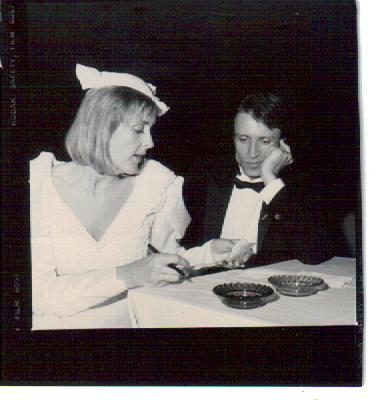
Wedding candid, 1985. Not sure precisely what is going on, but she's got a list and is checking it twice.
Wedding candid, 1985.

THE PASSIONATE WRITER TO HIS LOVE

Come live with me and be my love,
Assured before you voice your fears
That we will meld as hand to glove
With tender wearing through the years.

How could I love another more,
Or ever you abandon me?
So come, our prospects let’s explore
Assay our hopes in honesty.

I’ll write old-fashioned poems for you,
The kind that sing with foot and rhyme,
To soothe your ear and gently woo
Your cautious heart in its due time.

We’ll stay abed when springtime rains,
And care not if it’s ever done;
We’ll pedal wooded country lanes,
And bask beneath a merry sun.

In lilac-time I’ll break for you
The heart-shaped leaf and purple bloom
That flourished when our love was new,
And filled the night with strong perfume.

Like hardy husbandmen of old,
Who ploughed and tilled the fertile soil,
We’ll give ourselves to labors bold,
And harvest children for our toil.

And when the winter of our years
Bespecks our thinning hair with snow,
We’ll stoke our fire against the fear,
Companions though the chill winds blow.

Relentless time moves on apace,
Time leaves its vanquished under stone.
But we can win at time’s own race
By choosing not to run alone.

Defying reason, let’s unite
To form a sturdy three-fold cord,
A braid miraculously tight,
Of bridegroom, bride and gentle Lord.

If my proposal your love stirs,
If this be your desire for life,
If to my faith your heart avers,
Come live with me and be my wife.


Notes:

Thankfully, sometimes love DOES work out.

After some bump and bruises, I finally found the love of my life. Thirty-one years ago I wrote her a poem. Not leaving anything to chance, I shameless ripped off the first line from Christopher Marlowe’s poem “The Passionate Shepherd to his Love.” The rest was mine.

It may not have been wholly original poetry, but it did the trick. She said “yes.”

The funny thing is … soon after that I wound up practicing direct marketing copywriting as my day job.

After my experience with this poem, I should have known I was destined for direct marketing. The poem was my very first direct marketing letter.

I got a 100% response rate. Retention has been solid, and long-term value excellent.

Thank you, Christopher Marlow.

Midsummer Anniversary Poem

Here comes midsummer's milestone of our love
Here Comes Midsummer’s Milestone

Here comes midsummer’s milestone of our love,
Years since our selfish selves we pledged to yield,
So we’re as broken-in now as the glove,
I wore so long ago while in the field.

Fresh from the store unworn straight to my room,
Rubbed in the oil and every crease explored,
All through the night I savored the perfume,
The musky linseed leather I adored.

Come sober daylight with our job to do,
All awkward stiff not giving either way,
How many sweaty strivings’ deja vu
It took before we as one flesh could play.

Some ragged days I’d spit and pound the palm,
Or hurl the thing against the dugout wall,
But all the while a magic mute and calm
Mutated hand to glove with every ball.

The softening was gradual but sure.
Soon nerves and muscles seemed just like they spanned
From fingertips to join the glove secure,
As if I had been born with one webbed hand.

We’ve come now to the eve of middle age,
Well worn but with a lot of sport to go.
We must each for the other one assuage
Those stinging blows life certainly will throw.

We’ve held through wins and losses and through rain,
That etched new cracks not there at all before.
But loves like this were made to take the strain,
Just like that piece of cowhide that I wore.


Notes:

Not long ago, I asked my wife if she had a favorite poem.  Her blink reaction was, “the one about the baseball glove.”

So, that is what she gets on the eve of  our 31st anniversary.  A re-run.

It was written sometime in the early 1990s.  We were young and just starting a family.  I had a job I absolutely hated.  I would take long lunch breaks and write poems parked by the side of Lake of the Isles in Minneapolis.

Long before I discovered girls, back in Marshall, MO, my first love was baseball.

I cannot begin to total up the hours spent playing baseball, watching baseball, collecting baseball cards, sorting baseball cards, reading about baseball, and dreaming about playing in the World Series.

I knew the starting line-ups of both the St. Louis Cardinals and the Kansas City A’s by heart.

When I played one-man whiffle ball against my friend Royce, we would pick a team and go through the line up as each individual player. If the guy batted right, we batted right. If he batted left, we batted left.

(We drew the line at pitching left-handed, because neither of us was truly ambidextrous.)

Our spare time was spent searching for discarded pop bottles which we could turn into the neighborhood grocery store for two cents apiece. Every 5 bottles meant we could buy two more packs of baseball cards.

Somewhere between the ages of 12 and 13, we moved on to other interests. A long and winding path led me to the love of my life.

We were married 31 years ago today.

The inspirations for this poem are multiple. Several years ago, it was coming on to midsummer and my wedding anniversary.

I was feeling that sense of my youth slipping away. But, despite the oppressive job I was enduring, I was confident that good things still lay ahead.

I was also listening to a lot of Van Morrison. His song “Madame George” was stuck in my head. (Quite possible the most poignant song ever written.)

In particular, I was hearing the line where Van does his improvisational thing where he repeats the words “love” and “glove” over and over in an almost hypnotic chant.

My story is about a very different glove, and a very different love. But that merging of the two words was lodged in my mind.

The result of all of this ferment was this poem.

The only time I’ve ever read it in public, I was told it was “an audacious metaphor.”

I’ll take that.

Today, upon the occasion of my 31th wedding anniversary, I submit this little poem. It’s as true today as when I wrote it years ago
Love Sonnet

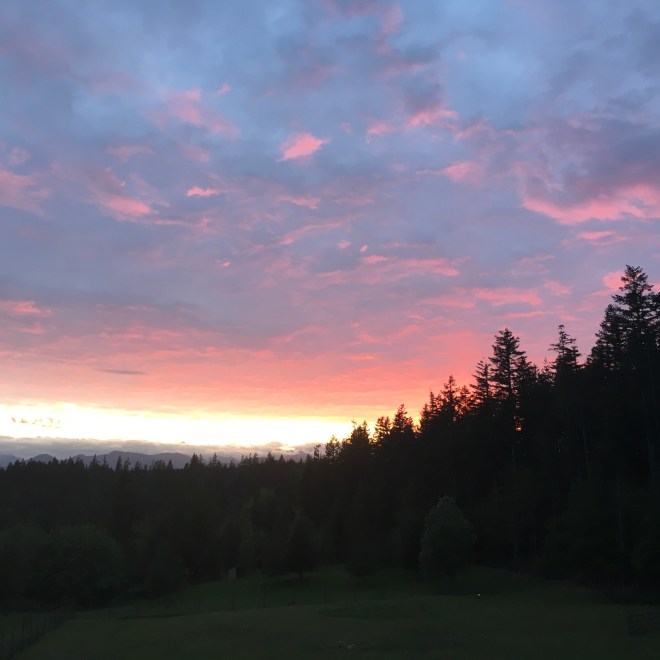
Sunset over the Olympic Mountains
“The changing light and seasons have their ways …”

Familiar Ways

I choose to walk the old familiar ways,
To wend ways where I’ve put my foot before,
To gaze anew on views seen other days,
Which, though familiar, never seem to bore.

The changing light and seasons have their ways
Of making old things new: The light-laced hoar,
The first-flush, green-glow, bursting-forth spring days,
The growing tinge of gold we can’t ignore.

Each day, my dear, I choose afresh our trail,
The one we blazed so many years ago,
Eschewing other routes that might avail,
And hewing to the well-worn way we know.
Forsaking novelty need be no jail
With your face bathed in sunset’s golden glow.


Poet John Ciardi relates this story about Robert Frost, who at a lecture was asked by  a woman in the audience: “Mr. Frost, surely when you write one of your beautiful poems, you are not thinking of technical tricks!”

Frost looked at the woman a while and replied, “I revel in them!”

Ciardi says Frost was like a horse trader who “would pick up an idea and whittle at it until he either wound up with a little whittled shape or a pile of shavings on the floor.”

I felt a little like a horse trader as I was writing this poem.  It started with a simple, little idea.  I can’t remember ever “whittling” more on a poem before.  At first, this one seemed like it just never wanted to happen. I just kept whittling and whittling until something very different began to emerge from where I started.

After what seemed like an eternity, I began to see the tricks of the trade — namely rhythm, diction, image and form — coming together to embody the simple little idea.

This one did not plop, fully formed, into my lap.  It was written, re-written, and re-written again.  I wrote in on my phone.  I copied it out by hand in a notebook.  I typed it in Microsoft Word on my laptop.  I read it aloud and even recorded a reading of it to hear how it sounded.

I found myself being keenly aware of assonance, alliteration and internal rhyme like never before.

I found myself unconsciously using the same sounds and rhymes over and over again as if I was consciously reinforcing the central idea.  Then, I found myself breaking the pattern with lavish, flamboyant word choices in the middle of the poem to demonstrate the message.

I found myself coming around to embracing a metaphor in the final part of the poem.  It was an idea that emerged only after the first part of the poem was written.

It may be a pile of shavings.  Or it might be a little whittled shape.

You can be the judge.


When spring starts to fade

"When the dizzy petal peak is past"

PASSION LIKE A FLOWER

Passion like a flower must expire.
Nothing can be rigged to spare desire
From life’s rigors — magic nor petitions.
Petals fall to various conditions.

When the dizzy petal-peak is past,
Some folks act as if the bloom could last,
Pick some wilting lilacs for their table,
Haul them homeward just to show they’re able,

Plunk them in a fruit jar lately washed
Clean of last fall’s bounty, cooked and squashed —
Like they thought the glass itself had power
To delay the spoiling of the flower.

It may work a day, two days, or so,
Then the smell and color start to go.
Nothing glassy can preserve desire;
Passion like a flower must expire.


Spring comes early in the Northwest.  By this time, many flowering trees are spent.  the blooms that were so intense in late March and April are brown and gone.

As I walked through town tonight, I couldn’t miss the signs of the season moving on.  Trees that a week or two before were full and fragrant were now brown and empty.  Flower petals were scattered across the grass.  The heady first-flush of spring was long gone.

Here’s an old poem that seemed right for the season.


Love Haiku

Your pillow

While you are away
thank God I have your pillow …
your fragrance lingers.