Hometown haiku

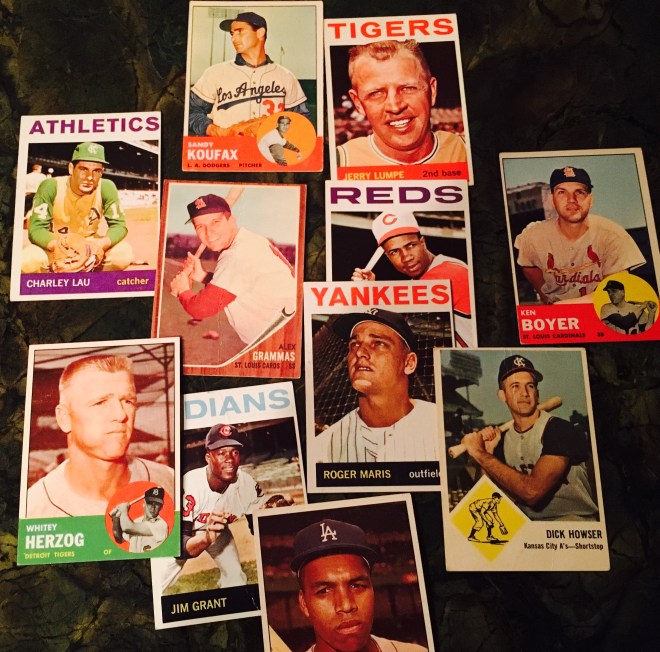
Baseball cards from the early 1960s
When I was a child
my heroes were immortal.
Now, they’re mostly gone.


Notes:

If you had talked to me when I was 9 or 10 years old, I would have told you I was sure I was going to be a baseball player when I grew up.  Many a long summer day was spent playing sandlot games in the vacant lot behind Fitzgibbon Memorial Hospital in what was universally known as “The Hospital Yard.”

No adult supervised.  A wide range of ages played.  There was Tommy Fox, with his wicked left-handed batting.  Big Wayne Halsey, an older kid, who once hit a ball over the huge trees at the far end of the lot.  Steve Cunningham, God rest his soul, played, and so did the Mounts brothers, Paul and Steve.  And many more long forgotten.

Somehow, we just figured it out, negotiating disputes and triangulating our way to make games fair.  When we didn’t have enough players to form respectable teams, we played games designed for smaller numbers like “Work-Up,” or “Five Hundred.”  These games might not have been as exciting as full-fledged baseball, but they enabled us to keep playing long after most of the other kids had to go home.

So we played until we wore ourselves out, until darkness fell, or until our mothers hollered for us to come in for supper.

To be sure, there was an organized baseball league out at the municipal park, but it was a pretty low-key affair, with maybe one or two games a week.  Not nearly enough to satisfy.

In between these baseball games, I would hang out with my buddy Royce Kincaid and play 2-man whiffle ball.  We had devised elaborate rules that enabled us to play entire games against each other all by ourselves.  We would each pick one of our favorite professional teams, and pretend to be each of the starting players.  We were such fanatics that — even though neither of were ambidextrous — we would bat right-handed if the player batted right, and bat left-handed if the player batted left.

We were pretty evenly matched and the competition was fierce.  We could argue close calls, and learned how to give and take for the sake of the game.  Neither of us wanted to push any argument to the point of risking the continuation of play.

We knew our information about the professional players because were also fanatical baseball card collectors.  For a stretch that spanned about 3 or 4 years, we devoted a very large percentage of our meager kid income to buying baseball cards at 5 cents a pack.  Back then, the cards came with a pink slab of bubblegum dusted with white powered sugar.

We didn’t really care about the gum.  We wanted the cards.  We would beg our parents for cards on every trip to the A&P, IGA, or MFA grocery store.  We would haunt the small neighborhood grocery stores that served our little town back in the days before convenience stores looking for good cards.

We figured out that the Topps Baseball Card Company would release the cards in flights over the course of a baseball season.  We would start the year with every pack full of unique new treasures.  But soon we would start finding our purchased packs full of cards we already had — “doubles,” we called them.

We would still cautiously buy packs here and there, sometimes prying the packs open to sneak a peak inside to increase our chances of getting a card we didn’t already have.

Then, when  we  discovered that a new series had been released, we rush out with our nickels in our hands ready to splurge again.  I remember riding my bike all the way to the west end of town to buy “fresh” cards at a little store that had gotten them  before anywhere else.

We would get together with other guys and trade cards, and show off our collections.  But mostly we looked at the cards and studied them.  I arranged them by team, and position. I studied the statistics on the back and memorized the trivia about each player.  When the St. Louis Cardinals or Kansas City A’s were on the radio, I would pull out the cards of each team and follow along as each player batted.

Back in those days, the Cardinals came in loud and strong on KMOX, and the games were called by Jack Buck and Harry Caray before Harry defected to Chicago.

I got to taste both victory and defeat.  The Cards were in one of their many periods of greatness. The A’s were pitiful losers, more of a backwater club that seemed to always sell its most promising players to the hated N.Y. Yankees just before they hit their prime.

In those days the A’s were owned by impresario Charlie Finley, who pushed the boundaries of good taste and good sense.  He introduced garish the  garish Kelly Green and Gold uniforms, and brought a mule named Charlie O into the stadium.  When Finley moved the team to Oakland in 1968, I washed my hands of them.  The fact that they soon started winning in their new city only made me hate them more.

But, did I  ever have some great cards!  Bob Gibson.  Mickey Mantle.  Hank Aaron.  Roberto Clemente.  Sandy Koufax.  Don Drysdale.  Ernie Banks.  Yogi Berra.  Willie Mays.  Tim McCarver.  All of the greats from the early 60s.

I was sure someday my face would be on one of those cards.

But life has a way of going in unanticipated directions.  I grew up and developed more of an interest in girls than baseball.

In just a few years the cardboard box of baseball cards was shoved back under my bed and largely forgotten.

It was not until I had kids of my own and came back to visit my parents that I inquired about the baseball cards.  They had disappeared, and my mother, who had guarded my old room like a museum shine, had gradually lost her memory.

I had pretty much given up ever seeing the old keepsakes again, when my father remembered that my mother had stashed some of my items in an old dresser drawer in her bedroom.

Sure enough, behind some old blouses I found a small box of baseball cards!  They were not the full set.  It was my old box of doubles.

But it was like a reunion with old friends.  There was Roger Maris and Sandy Koufax.  And Duke Snider and Kenny Boyer.  There was even an old Jerry Lumpe card.  A good player, but never a big star, Jerry was notable at least in our neighborhood because he played for the Kansas City A’s and Freddie Mueschke, the neighbor kid who lived on the corner, claimed to be Jerry Lumpe’s nephew.

We never verified Freddie’s story, but he got a lot of mileage from that claim to fame.

(I was gratified to learn that Lumpe has his own entry in Wikipedia.  He even managed to have such a good season in 1964 that he was named to the American League All Star Team.  That happened the year right after he was traded from the A’s, of course.)

A lot of my best cards were missing.  No Mickey Mantles or Hank Aarons.  But it was still like finding a treasure trove nonetheless.

Mom had reached through the years and through her senility to bless her little boy with one last small gift.  By this time she was lying in a nursing home without a  memory.  But  her gift to me had restored a whole storehouse of memories.

Hometown sonnet

Arrow Street, leading into the square of Marshall, Missouri
Hometown Sonnet

The old hometown is aging, as am I,
The once wide streets grow narrow with the years,
As night descends, you all but hear a sigh,
For what once was has gone, and twilight nears.

Now friends and kinsmen number fewer, too,
And memories fade like the painted sign
Proclaiming that the city “Welcomes You!”
Strange how one’s soul and place so intertwine.

Life used to bustle round our stately square
‘Til commerce shifted to the edge of town.
The grand facades are now much worse for wear,
Some landmarks have been torn completely down.
The business of my life took me elsewhere,
Cracks grew in walkways of both man and town.


Notes:

Thomas Wolfe wrote “You Can’t Go Home Again,” but last year I made a couple of trips back to my childhood hometown. My high school class held a reunion, and there was the lingering matter of tidying up my late parents’ estate, which seemed like it would never get resolved.

I thoroughly enjoyed seeing my old classmates, and re-igniting long dormant memories. But, not all my classmates are doing well.  Not all of them made it back.  Not all are still alive.

The visits led to reflection, and that led to poetry.


Late summer sonnet

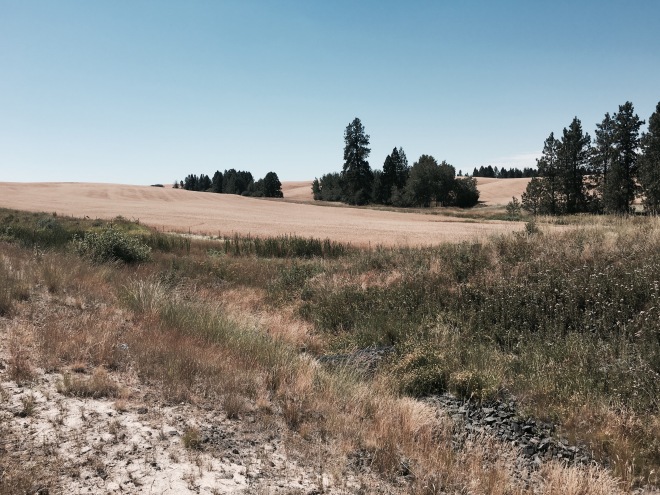
The once green grain gone golden in its rows
Late Summer’s Sun

Late summer’s sun has baked the grass to brown.
The days grow shorter with each passing day,
Soon, autumn’s chill will make the leaves fall down.
All of this aching beauty will decay.

And yet I love the shadows’ slanting trace,
The once green grain gone golden in its rows,
And how I love the lines etched in your face.
It’s funny, as love ripens how it grows.

The number of our days we do not know.
No sleeper knows if he will ever wake.
So come, let’s join above, between, below.
My dear, let’s cause our fragile clay to quake.
Let us make love as if it’s our last go.
Let us embrace like dawn will never break.


Notes:

It’s that time again to haul this old one out of the vault.

Among other things, God was the first poet.  The world is full of rhyme and rhythm, image and metaphor.

In our own small, imperfect way, we just catch glimpses.


R.I.P. Geoffrey Hill

Geoffrey Hill
Geoffrey Hill (1932-2016)

I just learned a month late that poet Geoffrey Hill has died.

I was paging through an issue of the Economist, and just about to toss it when the story of Hill’s death caught my eye.

“The Discomfort of Words. Geoffrey Hill, an English poet, died on June 30th at 84” the headline read.

The story filled an entire page.

I did not know much about his work, but the first line of the story told me I needed to get to know him.

Hill was given a book of Victorian verse at age 10.

“It was, he said, like falling in love.”

He had the reputation of being different and difficult.  A poet who scorned the modern trend towards confessional poetry, and who tackled age-old moral concerns.

You knew Hill was bound to make a stir from the opening lines of his first book.  In For the Unfallen, he wrote,

Against the burly air I strode,
Crying the miracles of God.

My favorite poem of Hill’s — so far — is In Memory of Jane Fraser. It’s wonderful elegy in just four haunting verses.

I’m looking forward to discovering more of his jewels.

Hometown haiku

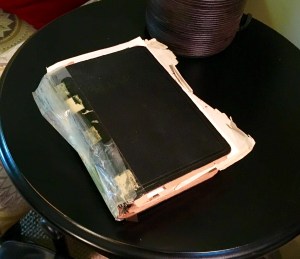
Mother's old Bible
Mother’s old Bible,
Worn out from years of long use.
Much like its owner.

Father’s Day Haiku

IMG_1601

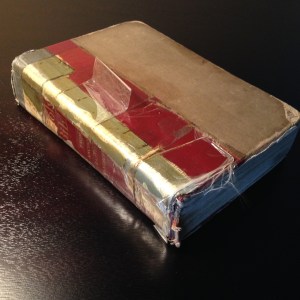
Father’s old Bible
held together with duct tape.
Now he’s face to face.

Father’s Day Haiku

Raymond Ball outstanding in his garden
How to explain Dad?
Outstanding in his field, he
lived a simple life.

Haiku for my father

Well over sixty, Dad built a barn by himself ...
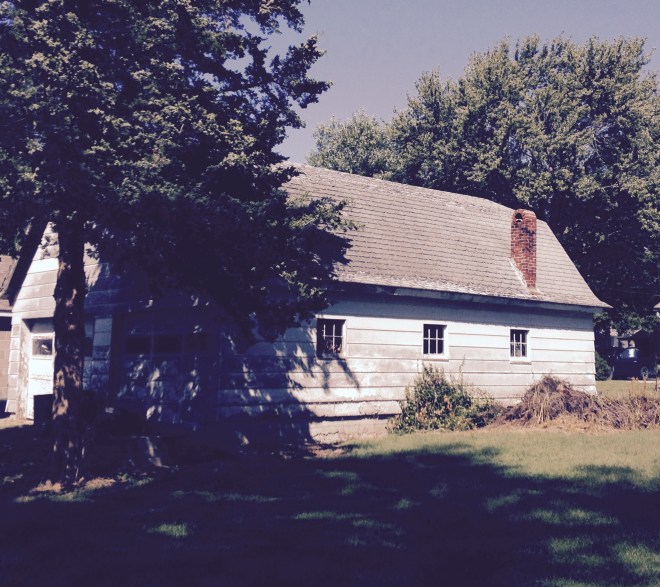
Well over sixty,
Dad built a barn by himself.
Now it, too, molders.

Haiku for Memorial Day

My great grandfather the Civil War veteran.
Yankee ancestor,
Had Reb been a better shot
I wouldn’t be here.


I’ll pull out an old poem in honor of my last direct ancestor to be wounded fighting to defend our freedom.

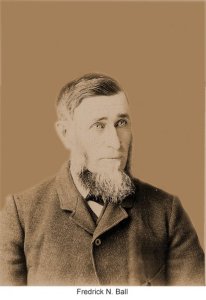
In my case, we must go back a bit.  All the way to the Civil War.  My great grandfather, Frederick N. Ball, was serving in General Sheridan’s Army in the campaign to take the Shenandoah Valley in Virginia.  When the Battle of Cedar Creek broke out, Sheridan was several miles away in Winchester.

As Sheridan was riding furiously back to rally his troops to victory, my ancestor was crawling back to safety after having been shot through the side early in the campaign.

The family story relates that he stuffed a rag in the hole in his side and made it to safety.

Thankfully, he survived.  Otherwise, this blog would be sadly empty today.

Hometown Haiku

The gravestone of Jim the Wonder Dog.

My town’s motto states:
“Smart dog, nice folks ….” Pretty sure
the dog, too, was nice.


The most famous resident of my hometown was a dog

When I moved to the central Missouri town of Marshall in the late 1950s, I was six years old.  My father had literally sold the farm and was setting out on a bold attempt to pursue the American dream by going into the farm implement business. After spending the first six years of my life on a farm in northwest part of the state, Marshall, with its 12,000-plus inhabitants, seemed like a big city to me, full of potential and possibilities. For the first time in my life I had a room of my own and indoor plumbing.

One of the first things I heard about my new hometown was that it was that it had been the home of Jim the Wonder Dog.  It had been just a little over 20 years since Jim’s death, and many of my new neighbors had seen Jim while he was alive.  Someone gave us a book about Jim, which I eagerly devoured.  We were told to be sure and visit Jim’s grave out at the end of Yerby Street at Ridge Park Cemetery.  He was the only animal buried in the human graveyard, we were told, and he deserved to be there more than a lot of the people, one added.  We visited Jim’s grave with my mother, who brought flowers, because that’s what you did when you visited cemeteries in those days.

Everyone we talked to accepted the story of Jim at face value.  To them, Jim had been a true walking miracle.  He was a dog who could understand human speech, and follow instructions to the letter.  But more than that, he knew things that humans could not possibly know.  He was not only highly intelligent.  Jim was also clairvoyant, we were told.  Jim could predict the future.  He could accurately predict the gender of babies before they were born and he knew who would win elections and sporting events.

To a six-year-old boy with an active imagination, this was a fascinating story.  But I grew up and forgot about Jim.  I went away to college, and started a career and a family, and got involved with my life.

Years later, I returned to Marshall, and I discovered that Jim was enjoying a revival of popularity.  The Viking Hotel (formerly the Ruff Hotel) just off the town square, where Jim and his owner had lived, had burned down.  A civic group had raised some money, and convinced the city fathers allow a memorial park to be created on the site.

Jim was becoming a full-fledged tourist attraction.

Then someone (bless their hearts!), persuaded the city to adopt a town motto.  It reads, and I kid you not: “Smart dog, nice folks ….”

I admire the humility and sense of humor that animated that motto.  It is in the same spirit that I wrote this little haiku.