Why write poetry?

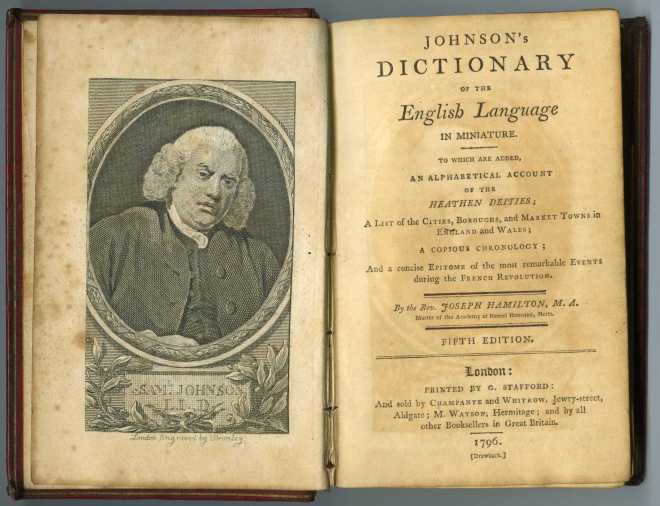
Samuel Johnson had things to say about writing.
“No man but a blockhead ever wrote, except for money.” — Samuel Johnson

I Sing Not for Glory

I sing not for glory nor for bread,
Nor for the praise of the credentialed clique.
But for hire more valuable instead,
To touch the honest kindred heart I seek.

I sing for lovers when love is green,
When time stops for a solitary kiss.
When light shines anew as with new eyes seen,
I celebrate your fey and fragile bliss.

I sing for the lonely, lovelorn heart,
When light grows cold and aching will not cease,
When your enchanted world falls all apart,
I offer modest salve to give you peace.

I sing for the pilgrim searching soul
Pursuing the heart’s true cause and treasure.
May heaven’s hound, you hasten to your goal,
And propel you to your proper pleasure.

I sing for the wise who see their end,
And, too, for those who have not yet awoke.
For to a common home we all descend,
With common dirt for all our common cloak.

I sing not for money nor for art,
Nor to amuse curators of our trade.
The simple wages of the simple heart
Will satisfy when my accounts are weighed.


©Bobby Ball 2017


NOTES:  Samuel Johnson was a funny guy.  If his aphorism is correct, that “no man but a blockhead ever wrote, except for money,” then poets are the biggest blockheads of them all.

A few diligent writers of books and screenplays and advertising copy can manage to make a living scribbling words.  But poets need another gig to pay the bills.

Most often, they teach.  Gerard Manley Hopkins was a priest and a teacher.  Robert Frost famously tried his hand at farming, but he also taught and lectured.

Some poets have conducted quite conventional careers during the day to support their poetry habit at night.  Insurance executive Wallace Stevens and physician William Carlos Williams are a couple of well known examples.

Englishman Philip Larkin earned his living as a librarian.  American Charles Bukowski was a postal clerk.

Dylan Thomas really couldn’t do much else besides write poems, and so he waged a losing war with poverty until he drank himself to death.  He probably would have perished much sooner except for the fact he was able to charm wealthy female admirers into becoming patronesses.

About the only thing I have in common with the aforementioned gentlemen is that while I sometimes commit poetry, I also need another means to make a living.

I started my professional life in the 1970s as an ink-stained wretch of a newspaperman.  While chasing deadlines was exhilarating when I was still a young man, there were already storm clouds on the horizon for journalism.  Afternoon dailies were going extinct, and cities that had formerly had 2, 3 or more newspapers were seeing them merge or go out of business.

Little did I know that in just a few years, the internet would come along and fatally wound the mainstream media organizations, forcing them to trim their newsrooms and close  regional bureaus.

I sensed that there was a disturbing uniformity of political opinion in the newsrooms of my youth.  My own political worldview was still evolving, but even back then everybody I worked with seemed to be left-leaning and Reagan-loathing.  The lockstep groupthink bothered me.

In my naïve idealism, I thought journalists were supposed to be fiercely objective.  I never caucused with any party, and I strove to play my own coverage right down the middle.  I’d have coffee with both Democrats and Republicans, and always made sure to pay my own check because I didn’t want to owe anybody anything.

When the owner of one paper tried to pressure me to join the local Rotary Club, I refused because I didn’t want membership to influence my coverage of any organization.

If I had still been a journalist this past year I think my head would have exploded.  With news organizations colluding with political campaigns, and sharing debate questions in advance with the favored candidate, it became clear that our creaky old news institutions had jumped the shark.

I would have burned my press card in protest.

I wish I could say I was smart enough to foresee the death of journalism and jump ship intentionally, but it was more random than that.  I was about to get married and I needed a job in Minneapolis.  The cash-strapped metropolitan dailies weren’t hiring right then, and so I took the first job I could get.

Fortunately I had stumbled my way into direct marketing. That later led me into non-profit fundraising.  The bulk of my career since has been helping good causes raise money.  Healing the sick, feeding the hungry, caring for widows and orphans, defending the persecuted, visiting those in prison, bringing the good news to those in bondage — that sort of thing.

I began to appreciate what I do a whole lot more when I stopped thinking about it as marketing and started thinking about it as “soul stirring.”  When I’m doing it right, I touch the heart to stir people up to good works, and inspire them to be generous.

If you ask me, that’s really just a short step away from poetry.  It’s all soul stirring.

 

Vertigo haiku

Zion National Park as seen from Angel's Landing

As one who mostly
dwells at or near sea level,
heights make me dizzy.

Sonnet inspired by a vile song

Love the one you're with ...

Illusions of Innocence

Time was, the sun stood high and corn grew green,
The juice of youth coursed through our throbbing veins.
Love easy and free as the night was keen.
The grass our bed, our bath the gentle rains.

We took up books of verse and lingered long,
Imagined we were wise as those in odes,
Took guidance from the lyrics of a song,
Cast off the quaint restraint of outworn codes.

All along, ignoring every sign:
The chill that comes and strikes the landscape dead,
The smut that spoils the corn and rots the vine,
The vulture drifting gravely overhead,
And, one subtle clue even less benign,
That not one selfless thought entered our head.


NOTES:  Reflecting back on my youth, I am chagrined.  There is an old aphorism that states, “If you stand for nothing you’ll fall for anything.”  There was a variation that went something like, “If you believe nothing, you’re liable to believe anything.”

By the late 1960s, many of us in my generation had pretty much had our beliefs in God, country and traditional morality watered down to pitifully weak broth.

Mainline churches increasingly didn’t even believe their own teachings.  Patriotism was dealt a severe blow by the national identity crisis over the Vietnam War.  The glowing reports of the sexual revolution made old fashioned morals seem not only quaint, but stupid.  If you were missing out, you were not only square, you were a chump.

It was only natural that we would adopt values from the popular culture of the time.  And the most influential popular culture of the day for the young was music.

Thankfully, there were some voices that seemed to have a moral compass.  Bob Dylan, for example, started out as a folk-protest-poet, and never stopped looking for truth, going down whatever roads it took him.

But prophets like Dylan were scare and rare.

A good part of the steady diet we heard on the radio was more on the level of “Light My Fire” or “Let’s Spend the Night Together.” Teenage libidos probably didn’t need any extra encouragement if you know what I’m talking about.

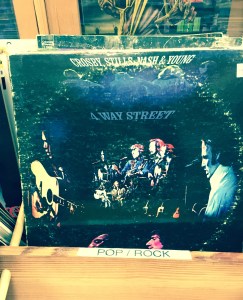
Of all the songs from those days, one stands out as especially reprehensible.  Of course, I’m referring to Stephen Stills’ paean to infidelity, “Love the One You’re With.”

Set to a catchy tune with some nice acoustic guitar licks, the song’s poison message is wrapped in layers of cotton candy lyrics.

If you’re down and confused
And you don’t remember who you’re talking to
Concentration slips away
Cause your baby is so far away

Well there’s a rose in a fisted glove
And the eagle flies with the dove
And if you can’t be with the one you love honey
Love the one you’re with, love the one you’re with
Love the one you’re with, love the one you’re with.

That there is some great relationship advice.  Just great.

Apparently, I’m not the only one who hates the song.  Even former front man of punk bands Scratch and Jesus Lizard, David Yow — an expert in vile lyrics if there ever was one — agrees with me.

He says he hates that song so much he’d like to choke Stephen Stills to death.

I wouldn’t go that far.  I’m just chagrined that I once thought it was a cool song.

Don’t get me wrong.  I don’t hate all songs by Crosby, Stills, Nash & Young.  “Our House” is a wonderful little tune about domestic tranquility.  It was written by Graham Nash when he and Joni Mitchell were in love, living at her house with “two cats in the yard.”

It’s a pity that tranquility couldn’t last.  But with the band singing “love the one you’re with” every night, how could it possibly last?

Midwinter haiku

Midwinter warm spell

Midwinter warm spell,
Evening mist, tree frog calling,
“Cro-cro-cro-crocus!”


NOTES: Took a walk yesterday and heard a tree frog for the first time this winter.  It reminded me of this haiku from awhile back.

Love poem

I loved you first in lilac time

Flower Time

I saw you first in jonquil time,
When you were bathed in grace.
You sat aglow with fire sublime,
And golden shone your face.

I loved you first in lilac time.
A bloom I plucked for you.
I wrote you verse with song and rhyme.
I hoped you loved me too.

I kissed you first in tulip time,
It must have been a sign.
The buds and we were in our prime
When your two lips met mine.

I married you in daisy time
On summer’s longest day.
We traded rings and heard bells chime.
We pledged always to stay.

Too soon we’ve come to aster time.
The days are shorter now.
Would stealing some be such a crime?
We’ll make it right somehow.

Should we endure ’til wintertime,
The time when flowers sleep,
Dreams we’ll share of a gentler clime
Where we no more shall weep.


NOTES:  Today is Valentine’s Day, and it’s unseasonably warm here in the Pacific Northwest.  It won’t be long before the jonquils and crocuses start poking their heads up through the mulch.

And it won’t be much longer than that before my favorite  — the lilacs — grace us with their fragrance and beauty.

It’s a good day for a modest little love poem.

Hometown haiku

Raymond Ball with a 1940 Ford

Father, when you spoke
I believed you, for you spoke
with authority.


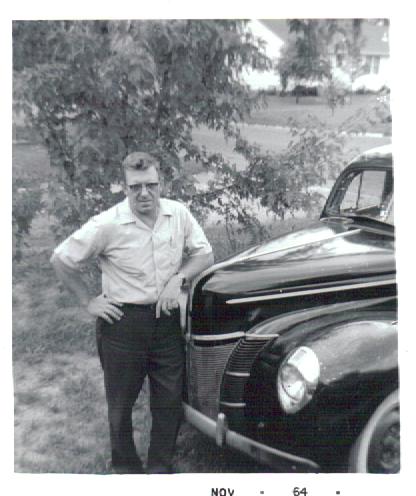
NOTES:  In many ways, my dad was a simple man.  Farmer.  Mechanic.  Forced to drop out of high school to work during the Great Depression, he never had the opportunity go back to school to pick up his education again.

He never travelled to Europe or learned a foreign language.  He never made a lot of money, or tasted the luxuries of life.

But he knew what he thought and what he believed.  And when he talked about his beliefs, his strength of conviction came through his voice.

Often he was expressing his belief in the products of the Ford Motor Company.  He was a confirmed Ford man.  He claimed he had seen the insides of enough cars and tractors to know how each one held up, and which ones were made out of cheap materials.

He would just utter a phrase like, “The Ford Model T …” and let it hang there and resonate in the air.  He said it with such reverence that those who heard it just knew that the Ford Model T had not only been a great automobile, but a miraculous product of a genius.

He could inspire similar feelings of reverence with exclamations like, “President Abraham Lincoln,” or “Old Thomas Edison.”  You just knew these were great men.

We  didn’t have pastors or full-time clergy in our tiny little Church of Christ congregation.   The leadership was handled by laymen like himself.  When he would stand up on Sunday mornings to “wait on the communion table,” he would recite the words by heart from the King James Version of Paul’s first letter to the Corinthians:

“That the Lord Jesus, on the night he was betrayed took bread, And when he had given thanks, he brake it, and said, Take it, eat: this is my body which is broken for you.  This do in remembrance of me.”

Hearing him say it, you had no doubt that this was just the way it had happened.

Perhaps the most convincing and poignant expression of his conviction came many years later, as his wife lay in a nursing home, long lost to dementia.  “Your mother,” he said, “was the best.  I never met another women like your mother. Never.”

And you just knew it was true.

Ancestor haiku

Charlie Barlow and his team

Generations tilled
to eke out a meager life. Now I
scribble in comfort.


Notes:  I have to go all the way back to England in the 1600s to find an ancestor who had a desk job.  To the best of our family research, my great-great-great (etc.) grandfather was a clergyman back in the old country, who had the poor judgment to raise the ire of the Archbishop of Canterbury.

In those days it didn’t take much to get your head separated from the rest of you.  Heretics and troublesome free thinkers could easily meet the same fate.

My forebear wised up in the nick of time and caught one of next boats after the Mayflower to the New World.  We are not sure if he stayed in the preaching business in his new surroundings in the Connecticut Colony, but as far as we can tell, all of those who followed him were dirt farmers.  (Which probably seemed like a safer line of work back then.)

Several generations later, after my great grandfather Frederick Ball narrowly survived the Civil War, he came back  home to find Connecticut getting crowded.  So, he headed west for the promise of cheap land and opportunity.  He wound up in southern Iowa, got married, acquired some land, and raised a family.

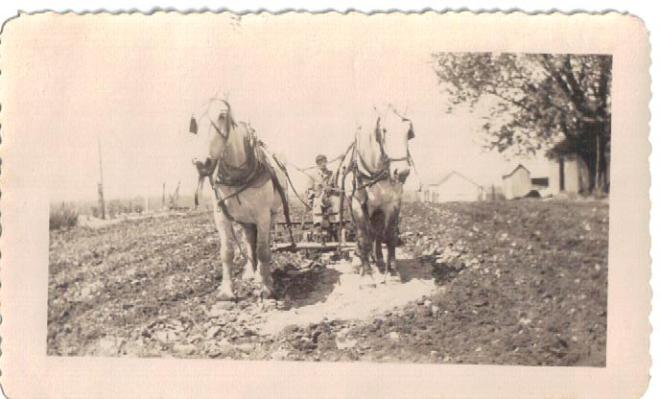
One of his sons was my grandfather, and he, too became a farmer, moving to Missouri to chase opportunity.  When my father came along, he showed considerable mechanical aptitude and had hopes of going to school to study engineering.  But the Great Depression dashed those dreams.  Dad had to drop out of school before he finished high school.  To  help support the family he became a farmer.

And  who knows, except for a twist  of fate or two, I might have followed right along and farmed myself.

But  my father had a bit of a mid-life crisis in his 40s.  When I was in first grade, he sold the farm and went in with his brother-in-law and a neighbor to buy a Ford Tractor dealership.  It was his one big entrepreneurial gamble in life.  And for a few years, it looked like it might pay off.

But some lean times for farm prices and some skullduggery by the neighbor-turned-business-partner, and the operation went broke.  They had to sell out cheap, and Dad was forced to fall back on his mechanical skills to make a living.

What this meant for me was that I spent most of my formative years in the town rather than on the farm.  So, while there were centuries of agrarian instincts bred into me, it didn’t take me long to adapt to indoor plumbing, central heating, and really close next-door neighbors.

And I certainly didn’t miss getting up early to gather eggs, milk the cow, or slop the pigs.

Oh sure, I still hoed beans, bucked bales, and detasseled corn as a hired hand in the summer.  But that was a job — not a way of life.

Even if my father had never left the farm, odds are I would have eventually left anyway.  That was the demographic trend during the whole last half of the last century.  The kids went away to school or to a big city for work, and tended never to move back.

It’s been hard on the farming communities.  And I know it was hard on the old folks left behind as their kids fanned out across the country.

When I stop to think about how much different my life has been from the generations before I marvel.  I have no explanation for why my entire adult career has been all inside work with no heavy lifting.

My father’s body bore the marks of a hard life in harder times.  He was kicked in the head by an ornery horse, and had headaches for the rest of his life.  His leg was caught between a hay wagon and a wall, and he walked with a limp.  He even had a few scars from surviving what he believed to be a mild case of small pox.

If the American Dream involves working hard and ensuring your children have a better life, then my parents and their generation certainly did their part.

Hometown haiku

Teachers can have a profound effect on the lives of their students

Thank you, my teachers.
You endeavored alchemy
on our feckless minds.


Notes:  When I was growing up in my small Missouri farm town, we were blessed with an amazing collection of teachers in  our public schools.  So many of them were serious educators who saw teaching as a calling.

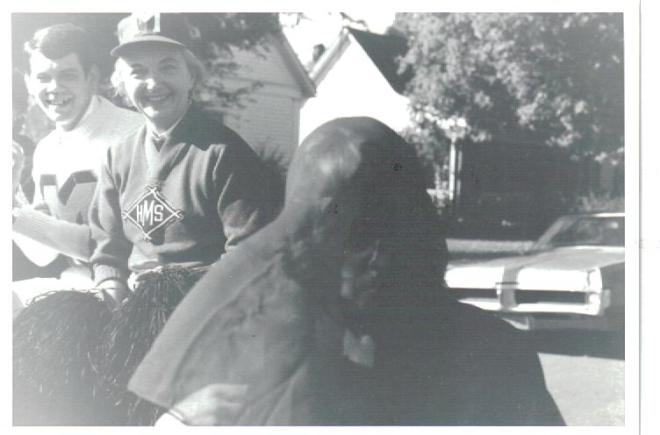
Just the other day, as I was flipping through an old high school yearbook, I found a loose print of this photo stuck in between the pages.  I’m sure I had seen it before, but it must have been more than 45 years ago.

It’s the only photo I have of two of the most influential teachers in my life.

John Hudnall and Dorothy Van Meter are riding in the 1969 Marshall High School Homecoming Parade as part of the Faculty Pep Squad.  They were good sports.  (I have no recollection what the deathlike character in the foreground is supposed to represent.  Possibly the defeat of our football opponent, perhaps.)

Finding that photo prompted a little meditation about what those two teachers meant to me.

John must have seen some very well hidden potential in me and named me editor of the high school year book.  He sent my fellow editor, Marilyn Doyle Crawford, and I to a journalism summer camp at the University of Missouri, where I got my first taste using good design to tell a story in print.

We came back from that camp and proceeded to lead a great yearbook team in publishing a book that told the story of our schoolmates during our turbulent senior year.

Little did I know that, years later, I would earn my living doing pretty much the same thing.  For my entire career, I’ve been a professional story-teller.  First as a journalist, then as a writer and creative director, with a little poetry on the side.

Dorothy also had a profound effect on my life — not in the professional arena, but in my personal life.  She was the type of teacher who seemed to be always looking for ways to inspire her students to think deeper, push harder, and become better human beings.  She would hold intellectual salons in her living rooms where past and present students would gather to discuss ideas, art, and literature, and debate philosophy.

It was heady stuff for a hayseed kid like myself, just a few years removed from the farm.

She took an interest in me and recommended two books, which I think she prescribed to correct what she diagnosed as deficiencies in my soul.

First, she said I should get a book on yoga and do the exercises.  This may have partly been because I was a bit of a muscle-bound jock, with no sense of the mystical.

Then, she handed me her own hardback copy of Screwtape Letters by C.S. Lewis.  She also likely sensed that I was spiritually ignorant and morally vulnerable.  And she would have been correct.

By age 17, I had pretty much sloughed off the simple Christian faith of my parents.  I had embraced the ideas that Freud and Darwin had rendered faith obsolete, and I thought God was dead, whatever that meant.

Dorothy could probably tell I was headed for treacherous moral waters when I left home for college.  The counterculture was peaking right at that time.  The siren call of sex, drugs, and rock & roll was beckoning.

At first, I paid far more attention to paperback book on hatha yoga I purchased off the rack at the local Red Cross Drug Store.  I stretched my muscles, did the poses, and read other books about the masters.  When I went to college, I signed up for meditation classes, studied Eastern philosophy, and tried my best to become a Hindu.  Alas, it was much too difficult.

It turned out that Screwtape Letters would play a more profound role in my life.  I read it right away, and then promptly tried to forget it.  But Lewis’s vivid fictional portrayal of correspondence between a senior devil and his nephew, a junior tempter, stuck with me.

All that stuff about a spiritual world with an ancient foe seeking to work us ill couldn’t be true.  Could it??!

But sure enough, after a year and a half of dissipation at college, I faced a spiritual crisis.  I had the distinct impression God was after me like a coon hound hot on the trail.  When I hit bottom, the first thought I had was to turn to Lewis for help in trying to figure out what was happening to me.  So I reread Screwtape, and it scared the willies out of me.  Then, I ran to the library and started devouring Lewis’s other books.

Here was a guy who was as smart — actually smarter — than my professors.  His Mere Christianity all of a sudden made perfect sense to me, and made faith intellectually acceptable.  Though as providential series of events, I came to faith in Jesus.  And that has been the most important event in my life.

Needless to say, I’ll always have a soft spot in my heart for Screwtape Letters.

These were just two of the influential teachers.  I’ve written before about some of the others:  Paul Hagedorn for fanning the flames of poetry back in 11th grade English class.  Coaches Cecil Naylor and Wayne O’Neal for teaching us how to win.  Mary Lou Porter and Marie Connell for turning us on to Shakespeare.

Margaret Buie for opening up the ancient world through Latin.  David Washburn for inspiring creativity through theater.  And Billy Bob Stith and Catherine Kennedy for making math and science interesting even to a right-brain guy like myself.

I’m not sure if these wonderful educators have been replaced by teachers equally as dedicated or not.  My hope is that kids today would have the chance to be taught by such as the likes of them.

Winter sonnet

That bleak season

That Bleak Season

That bleak season the cold creek ceased to run,
Grey weeds withered beside the roadside ditch,
Flat leaden clouds obscured a sullen sun,
Winds lashed ice-lacquered leaves without a twitch.

Field stalks bowed down to winter’s weary weight,
The world conspired to pile pang upon pang,
Even the crusted snow cried, “Much too late!”
Caged by a skeleton hedge, no bird sang.

That bleak season love went the way of leaves,
Good green seeming, but poised to take the fall,
First frost stunned then assailed by windy thieves,
Some futile few sought stubborn to forestall
The impending end ’til a fell gust cleaves
Asunder with only a scrawny squall.


Notes:  If you read enough Gerard Manley Hopkins, it can mess up your iambic pentameter.  That’s because he often wrote in what he called “sprung rhythm,” which involved tossing out the sing-song metric rules that so many of his Victorian contemporaries followed.

Sprung rhythm was not free verse.  Hopkins followed his own complex set of rules, but he was wildly eccentric for those times.

I do not claim to follow Hopkins or his rules here.  This poem is more like “disjointed rhythm” than sprung rhythm.  But this seems to me to be very appropriate for the subject matter of a world and a love wrenched all out of joint.

This poem still faintly resembles a sonnet.  It still has 10 syllables to each line.  It still rhymes in a familiar pattern, close to the English sonnet, but ending in an e-f rhyme instead of g-g.

Christmas haiku

Nativity scene

Inexplicable.
That the author casts himself
In such a small role.