
The fragrance of leaves.
The chill that comes with evening.
Old wounds ache again.
The fragrance of leaves.
The chill that comes with evening.
Old wounds ache again.

Last night of summer
highway hum and jets muffle
the coyote’s cry.
The old hometown seems
smaller than I remember.
Once, it was magic.
Notes:
For Van Morrison, it was Cyprus Avenue in his hometown of Belfast. The fancy, tree-lined street where the upper class lived. Where a working-class boy went to dream and catch glimpses of aspirational girlfriends.
In my hometown, that street was Eastwood. It was a shady, tree-lined street with what passed for mansions in my little Missouri farm town of Marshall. And there here were even a couple honest-to-Pete mansions among them. Reminders of old money abounded.
To a Johnny-come-lately, working-class kid like myself, it seemed like the coolest place on earth. I lived on the other side of town. Not in the poorest section, but definitely in a different layer. My house was brand new, but it was a plain 1950s ranch house. Utilitarian and homely. Decorated in the finest Late Depression.
At first I didn’t have any friends among the Eastwood society. Unattainable, I thought. But when all of the grade school kids graduated to junior high, we were suddenly thrown together.
I became buddies with an Eastwood kid, Clyde, who, while he didn’t live right on Eastwood, lived close enough — a long block off of it.
His home was a demonstration of exquisite interior decorating, and his family a wonder of graciousness and hospitality. I felt lucky to have such a cool friend.
We played football, we raced slot cars, and talked about our growing interest in girls. I heard Sgt. Pepper’s for the first time in his basement.
When my cat didn’t come home and was eventually found struck to death by a car, I went to Clyde’s to play basketball. I played so furiously that I eventually egged him into our only physical fight.
Because that’s how 12 year old boys grieve.
In those days of flower power and Vietnam, we did find ways to wage a few political protests, and fight against what we saw was hidebound traditions at our high school.
We eventually began to drift our separate ways, spending more time with girls than with our old guy friends.
One evening, late in our high school years, we sat around a campfire out at the park, vaguely aware that our sheltered years in our old hometown were drawing to a close. Our oh-so-enlightened conversation including a one-through-10 ranking of our female classmates.
If I remember, we did try to maintain a sense of irony about it.
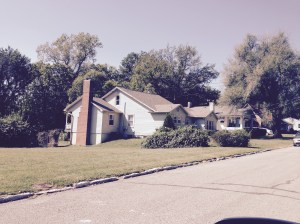
The photo atop this little poem is a recent shot of Clyde’s old house.

Hometown Sonnet
The old hometown is aging, as am I,
The once wide streets grow narrow with the years,
As night descends, you all but hear a sigh,
For what once was has gone, and twilight nears.
Now friends and kinsmen number fewer, too,
And memories fade like the painted sign
Proclaiming that the city “Welcomes You!”
Strange how one’s soul and place so intertwine.
Life used to bustle round our stately square
‘Til commerce shifted to the edge of town.
The grand facades are now much worse for wear,
Some landmarks have been torn completely down.
The business of my life took me elsewhere,
Cracks grew in walkways of both man and town.
Notes:
Thomas Wolfe wrote “You Can’t Go Home Again,” but last year I made a couple of trips back to my childhood hometown. My high school class held a reunion, and there was the lingering matter of tidying up my late parents’ estate, which seemed like it would never get resolved.
I thoroughly enjoyed seeing my old classmates, and re-igniting long dormant memories. But, not all my classmates are doing well. Not all of them made it back. Not all are still alive.
The visits led to reflection, and that led to poetry.
Late Summer’s Sun
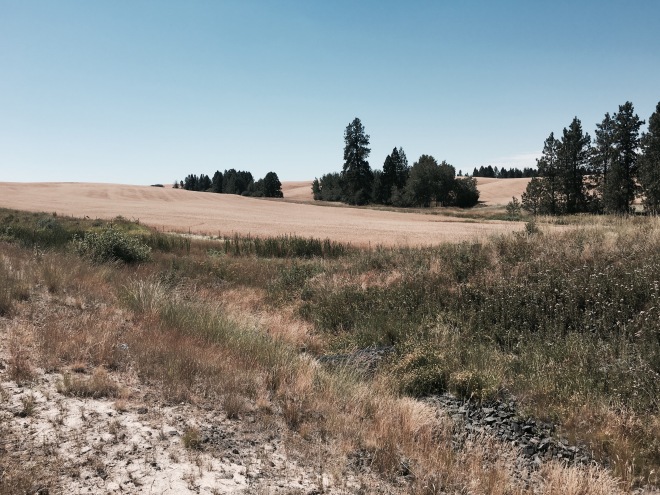
Late summer’s sun has baked the grass to brown.
The days grow shorter with each passing day,
Soon, autumn’s chill will make the leaves fall down.
All of this aching beauty will decay.
And yet I love the shadows’ slanting trace,
The once green grain gone golden in its rows,
And how I love the lines etched in your face.
It’s funny, as love ripens how it grows.
The number of our days we do not know.
No sleeper knows if he will ever wake.
So come, let’s join above, between, below.
My dear, let’s cause our fragile clay to quake.
Let us make love as if it’s our last go.
Let us embrace like dawn will never break.
Notes:
It’s that time again to haul this old one out of the vault.
Among other things, God was the first poet. The world is full of rhyme and rhythm, image and metaphor.
In our own small, imperfect way, we just catch glimpses.
Strategic brothers,
knew the key to a girl’s heart
involved a hot car.
Notes:
My father got in on the ground floor of the automobile revolution. He learned auto mechanics by hanging around the only garage in his small Missouri farm town. He cut his teeth fixing Ford Model Ts, and kept learning from there.
Although he spent years trying to make a living as a farmer, and then as a businessman, he ultimately returned to mechanic work. It was really his true calling.
He could fix things, and make them run. He didn’t buy new cars. He bought old cars in need of work and fixed them up.
When it became clear to him that he was going to be a mechanic for the rest of his life he went out in his back yard, and proceeded to build himself a proper workspace. It looked just like a barn, because that is what he had built before during his days on the farm.
But he built it himself from scratch when he was well past 60 years old. Of course, he used reclaimed lumber scavenged from various tear-downs.
In his later years he ran a mechanic repair business out of his new garage. He was the only mechanic for miles around who would make house calls. The farmers all over Saline County knew that he could be depended on to fix their tractor, hay baler, or corn picker.
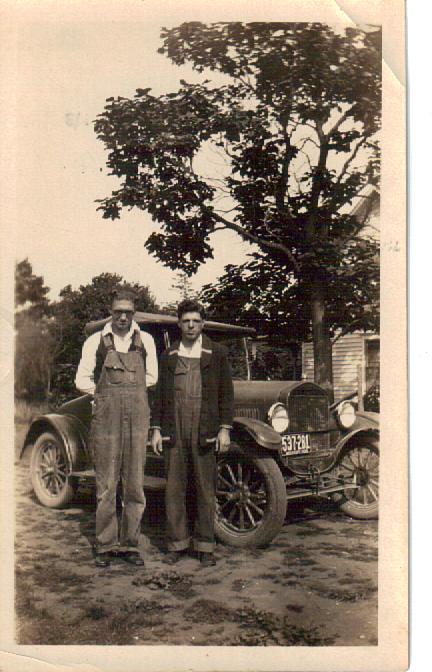
The photo at the top of this post shows my father, left, and his brother, Ralph, in front of one of the hot cars of the day.
“We’ll Sell No Wine”
“We’ll sell no wine before its time,” we’re told.
The fat and famous spokesman made it clear,
Each vintage has its period of gold.
(You must assess the pressing and the year.)
So, likewise, for each vintage comes a time
The point past which there’s no return at all.
Decay and oxidation work their crime,
And turn your sweetest nectar into gall.
So come, my dear, what are we waiting for?
Our cellar holds a few more bottles still.
Pick one and brush away the dust before
Time turns its contents back to must — time will.
Cast off our caution and our clothes and pour,
And drink with joy until we’ve had our fill.
Notes:
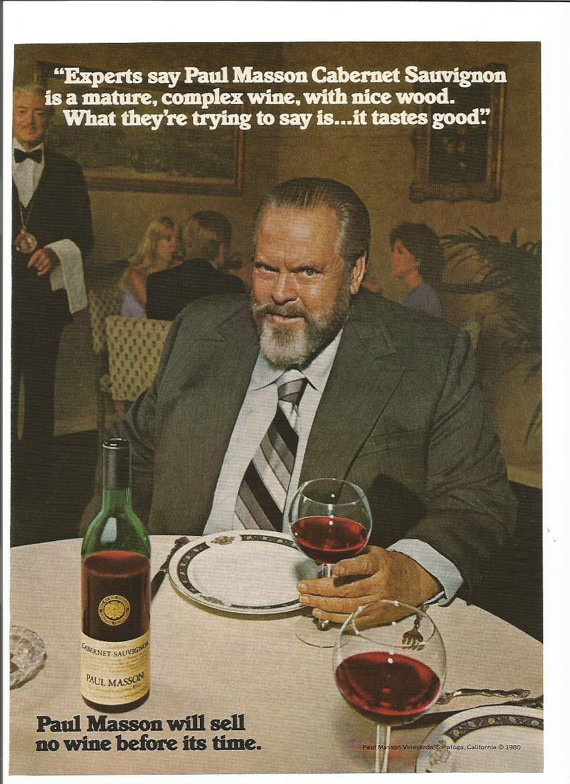
I’m old enough to remember when Orson Welles became a television pitchman for a sort-of-good American wine.
Welles had been the genius who panicked the nation in 1938 with his faux-documentary radio broadcast, “War of the Worlds.” In 1941, he directed and starred in “Citizen Kane,” considered to be among the best — if not the best film of all time.
By the late 1970s, Welles was making commercials. His Paul Masson spots are still classics.
“We will sell no wine before its time,” was a magnificent slogan.
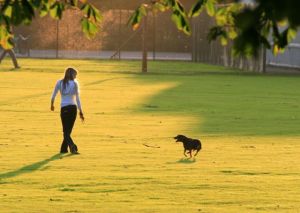
Ah! Midsummer sun.
Blonde girl walking a black dog.
All downhill from here.
Notes: Something about the light and smell in the air this afternoon made me think of this little poem from last year.
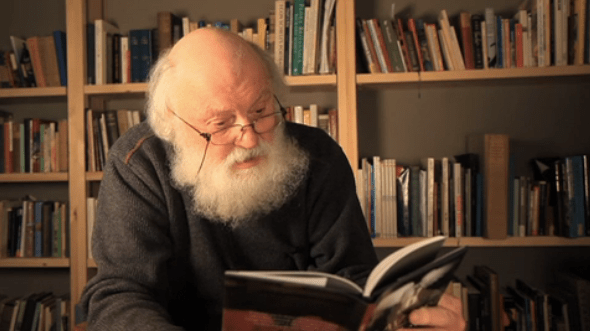
I just learned a month late that poet Geoffrey Hill has died.
I was paging through an issue of the Economist, and just about to toss it when the story of Hill’s death caught my eye.
“The Discomfort of Words. Geoffrey Hill, an English poet, died on June 30th at 84” the headline read.
The story filled an entire page.
I did not know much about his work, but the first line of the story told me I needed to get to know him.
Hill was given a book of Victorian verse at age 10.
“It was, he said, like falling in love.”
He had the reputation of being different and difficult. A poet who scorned the modern trend towards confessional poetry, and who tackled age-old moral concerns.
You knew Hill was bound to make a stir from the opening lines of his first book. In For the Unfallen, he wrote,
Against the burly air I strode,
Crying the miracles of God.
My favorite poem of Hill’s — so far — is In Memory of Jane Fraser. It’s wonderful elegy in just four haunting verses.
I’m looking forward to discovering more of his jewels.

When I can’t take another newscast, another politician, another argument about Brexit, or another protest march, I’m so happy that we have poetry.
And when I seek solace in poetry, I’m so happy that poetry has Gerard Manley Hopkins.
He’s truly a treasure. Virtually unpublished during his own lifetime, he left behind a small but rich collection of stunning poems.
A complete original, he labored in obscurity, writing poetry in his spare time when not occupied with his vocation as a Roman Catholic priest.
He took his poetry — like his religion — seriously, developing his own philosophy of poetry. And he innovated style and form, as well, creating his own form he called “sprung rhythm.”
Check out his poem, “Inversnaid.” The poem is a description of a steam rushing down a hillside emptying into Loch Lomond in Scotland.
The description is wonderful, and well worth clicking away to read the whole poem. But the last stanza is amazing. It’s four lines that form a prayer, seemingly beseeching God to preserve nature from the depredations of mankind:
What would the world be, once bereft
Of wet and of wildness? Let them be left
O let them be left, wildness and wet;
Long live the weeds and the wilderness yet.
When I read that out loud, I forget about what’s blaring on television, and I smile a little smile, and I find myself drawn back to the heart and center. Actually drawn back to God.
That’s what John Ciardi must have meant when he said, “Enrich language, and you cannot fail to enrich our experience. Whenever we have let great language into our heads, we have been richer for it.”
 Poetic Champions