Hometown tradition haiku

Marshall High School had long marked the end of the school year by naming students to the esteemed positions of Honor Stations.
Marshall High School Honor Stations 1969. (Photo courtesy of Susumu Wakana)

So blithely we scrapped
our outmoded traditions.
But what did we know?


NOTES: My high school had long observed a set of traditions at graduation time.  While probably only a few decades old, to us callow kids, those customs may just as well have  been prehistoric.

For as long as we could remember, our school had marked the end of the school year with a Baccalaureate service, a Commencement ceremony, and Honor’s Night. The first was inspirational, and still carried a whiff of religion.  Commencement was more perfunctory, and mainly served to get your tassel turned and your diploma into your eager, waiting hands.

But the real ceremony happened at Honor’s Night.  That was where academic achievement and athletic prowess were feted.  Scholarships were announced.  Awards and certificates of all types were handed out.  But while the awards were many, there was still a good measure of exclusivity. Not everyone got a trophy. It was the merit system on steroids.

The pinnacle of Honor’s Night was–as it had always been–the presentation of the Honor Stations.  Four couples from the senior class had been selected, each meant to represent one of the four cardinal virtues of our school.  They were to be arrayed on the stage of the auditorium beneath solemnly lit candelabras dressed in formal gowns and white dinner jackets.  They personified:

  • Most Industrious
  • Best Sport
  • Most Courteous
  • Best Citizen

(Historical note by way of full disclosure:  My brother Larry had been named Most Courteous in 1960, coasting to the honor on his winning smile and prodigious gift of gab.)

At the center of the stage sat Miss Fair Marshall, complete with a tiara.  We were not sure, but we suspected she represented all the good and pure and gracious qualities of Missouri womanhood.

I forget exactly how the Honor Stations were nominated and selected, but I seem to remember some sort of balloting by the student body.

THE DEMISE OF MISS FAIR MARSHALL

Miss Fair Marshall had a male escort, but he was merely unelected arm-candy.  The star of the evening and the center of attention was the fair maiden.

I should add one more fact, especially for those too young to remember.  The late 1960s were a time of upheaval and ferment.  Across the country, kids were growing their hair, listening to loud music and protesting the Vietnam War.

The times were a’changing, and although change might have come more slowly to our Missouri farm town than other places, we were not immune.

When I was a junior, the senior class of 1969 did a bold and daring thing.  (Many of my classmates and I admired our elders in the class of ’69.  We saw them as smart and sophisticated and worldly.)

The dramatic move they made was to vote to eliminate Miss Fair Marshall. It was a shocking move.

I’m not sure if there was ever a cogent explanation made why this was a good idea.  I suspect it had something to do with an unconscious awareness that having a “princess” without an equivalent prince was somehow unfair or sexist.  Or perhaps it was a rejection of the whole patriarchal-vestal-virgin vibe given off by the institution

I dunno.   But the hippies and the intellectual artsy kids rejoiced that year over the demise of Miss Fair Marshall.  And, I suspect that many would-be beauty queens wept.

THE NEXT YEAR, OUR CLASS HAD ITS TURN

I recall sitting the next year in our snoozy all-senior-class meeting called for the sole purpose of deciding whether we would bestow a clock or a plaque as our senior gift to the school.

At some point in the proceedings, I turned to my friend Clyde Smith and joked, “Wouldn’t if be funny if we abolished Honor Stations?”

He replied that that was a great idea, and that I should propose it.  I told him to do it.  He looked directly at me and said, “No, it’d be better if you did it.”

Thinking back, I do recall that there had been some earlier joking about how ridiculous the Honor Stations had become. The year before, the position of male Most Industrious had been filled by our older friend John Swisher.  Now John was one of the smartest, funniest and cleverest guys you’d ever want to meet.  But he was the first to admit that he was nowhere close to being the most industrious member of his class.

John had even made many a hilarious joke about his lackluster work ethic and the irony of him being named Most Industrious.

So, I had already concluded that the Honor Stations were hypocritical. And, with no more forethought than that, I popped out of my seat, walked to the front and made a motion to abolish Honor Stations.

I think I heard what you might call an audible silence.

I’m not sure exactly what happened next.  I thought I detected murmuring from the gaggle of popular girls.  Probably looking forward to wearing formal dresses up on the stage, I thought.

There may have been a person or two who spoke in opposition.  But I distinctly remember the debate ending after Tom Nicholas stood up.  Tom was the most rock ‘n’ roll member of our senior class.  He had long hair before anyone else.  He played guitar in a real band, and he exuded rebel cool.

Tom strode forward, leaned into the microphone, and pronounced with authority, “We have a word for this.  It’s called ‘ego-trip.'”

That pretty much sealed the deal.  Honor Stations were ego trips.  The question was called, and the motion overwhelmingly carried.

The Class of 1970 had finished the work of our predecessors.  We had killed off the Honor Stations and drained the pomp from “Pomp and Circumstance.”

I was exhilarated and pretty darn proud of myself–for a short time.

A UNEXPECTED LESSON

Later that day, I was pulled aside by Mrs. Van Meter for a brief, one-way conversation.  Dorothy Van Meter taught English, and was pretty much universally regarded as one of the “cool teachers.”  She conducted discussion nights at her apartment for students and former students.  These were heady salons where heady subjects like philosophy, truth and beauty were seriously discussed.

Mrs. Van Meter had hung a small peace symbol over the door to her classroom, and on the day of the Vietnam War Moratorium, she came to school dressed in black.  So, she had credibility with the free-thinking, progressive students.  She was actually the last teacher I suspected would hector me for my blow against hidebound tradition.

She was also known to take an interest in the character formation of her students. She was known to prescribe books or disciplines she thought would round out a particular student’s soul.  I was a muscle-bound jock and she told me to pick up a book on yoga.  And when I was flirting with the moral perils of agnosticism she gave me her copy of Screwtape Letters by C.S. Lewis.  She even recommended weight-lifting for one of my classmates who was musical and brilliant, but soft and plump.

Her word to me on this day was matter of fact and brief.

“You know,” said Mrs. Van Meter, “some ideals are worth preserving whether they are fully lived out or not.”

That was it, and she wheeled around and left.

Her words took a while to sink in.  But that simple truth just might have been the most important thing I learned in high school.

Dorothy Van Meter was considered one of the
Mrs. Dorothy Van Meter (Photo courtesy of Susumu Wakana)

Vertigo haiku

Zion National Park as seen from Angel's Landing

As one who mostly
dwells at or near sea level,
heights make me dizzy.

Midwinter haiku

Midwinter warm spell

Midwinter warm spell,
Evening mist, tree frog calling,
“Cro-cro-cro-crocus!”


NOTES: Took a walk yesterday and heard a tree frog for the first time this winter.  It reminded me of this haiku from awhile back.

Hometown haiku

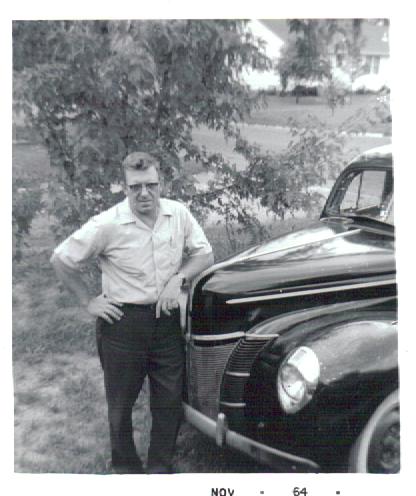
Raymond Ball with a 1940 Ford

Father, when you spoke
I believed you, for you spoke
with authority.


NOTES:  In many ways, my dad was a simple man.  Farmer.  Mechanic.  Forced to drop out of high school to work during the Great Depression, he never had the opportunity go back to school to pick up his education again.

He never travelled to Europe or learned a foreign language.  He never made a lot of money, or tasted the luxuries of life.

But he knew what he thought and what he believed.  And when he talked about his beliefs, his strength of conviction came through his voice.

Often he was expressing his belief in the products of the Ford Motor Company.  He was a confirmed Ford man.  He claimed he had seen the insides of enough cars and tractors to know how each one held up, and which ones were made out of cheap materials.

He would just utter a phrase like, “The Ford Model T …” and let it hang there and resonate in the air.  He said it with such reverence that those who heard it just knew that the Ford Model T had not only been a great automobile, but a miraculous product of a genius.

He could inspire similar feelings of reverence with exclamations like, “President Abraham Lincoln,” or “Old Thomas Edison.”  You just knew these were great men.

We  didn’t have pastors or full-time clergy in our tiny little Church of Christ congregation.   The leadership was handled by laymen like himself.  When he would stand up on Sunday mornings to “wait on the communion table,” he would recite the words by heart from the King James Version of Paul’s first letter to the Corinthians:

“That the Lord Jesus, on the night he was betrayed took bread, And when he had given thanks, he brake it, and said, Take it, eat: this is my body which is broken for you.  This do in remembrance of me.”

Hearing him say it, you had no doubt that this was just the way it had happened.

Perhaps the most convincing and poignant expression of his conviction came many years later, as his wife lay in a nursing home, long lost to dementia.  “Your mother,” he said, “was the best.  I never met another women like your mother. Never.”

And you just knew it was true.

Hometown haiku

Teachers can have a profound effect on the lives of their students

Thank you, my teachers.
You endeavored alchemy
on our feckless minds.


Notes:  When I was growing up in my small Missouri farm town, we were blessed with an amazing collection of teachers in  our public schools.  So many of them were serious educators who saw teaching as a calling.

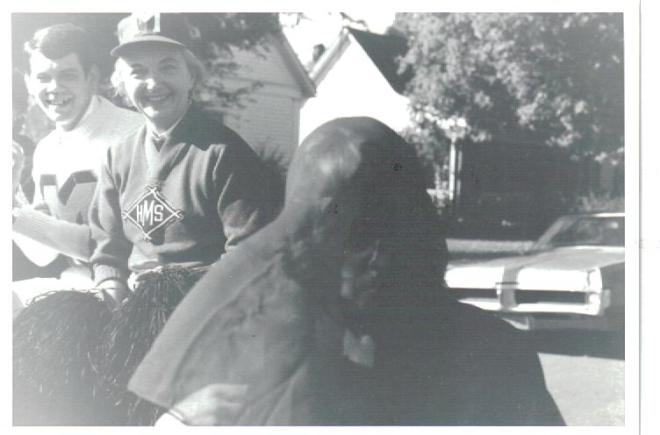
Just the other day, as I was flipping through an old high school yearbook, I found a loose print of this photo stuck in between the pages.  I’m sure I had seen it before, but it must have been more than 45 years ago.

It’s the only photo I have of two of the most influential teachers in my life.

John Hudnall and Dorothy Van Meter are riding in the 1969 Marshall High School Homecoming Parade as part of the Faculty Pep Squad.  They were good sports.  (I have no recollection what the deathlike character in the foreground is supposed to represent.  Possibly the defeat of our football opponent, perhaps.)

Finding that photo prompted a little meditation about what those two teachers meant to me.

John must have seen some very well hidden potential in me and named me editor of the high school year book.  He sent my fellow editor, Marilyn Doyle Crawford, and I to a journalism summer camp at the University of Missouri, where I got my first taste using good design to tell a story in print.

We came back from that camp and proceeded to lead a great yearbook team in publishing a book that told the story of our schoolmates during our turbulent senior year.

Little did I know that, years later, I would earn my living doing pretty much the same thing.  For my entire career, I’ve been a professional story-teller.  First as a journalist, then as a writer and creative director, with a little poetry on the side.

Dorothy also had a profound effect on my life — not in the professional arena, but in my personal life.  She was the type of teacher who seemed to be always looking for ways to inspire her students to think deeper, push harder, and become better human beings.  She would hold intellectual salons in her living rooms where past and present students would gather to discuss ideas, art, and literature, and debate philosophy.

It was heady stuff for a hayseed kid like myself, just a few years removed from the farm.

She took an interest in me and recommended two books, which I think she prescribed to correct what she diagnosed as deficiencies in my soul.

First, she said I should get a book on yoga and do the exercises.  This may have partly been because I was a bit of a muscle-bound jock, with no sense of the mystical.

Then, she handed me her own hardback copy of Screwtape Letters by C.S. Lewis.  She also likely sensed that I was spiritually ignorant and morally vulnerable.  And she would have been correct.

By age 17, I had pretty much sloughed off the simple Christian faith of my parents.  I had embraced the ideas that Freud and Darwin had rendered faith obsolete, and I thought God was dead, whatever that meant.

Dorothy could probably tell I was headed for treacherous moral waters when I left home for college.  The counterculture was peaking right at that time.  The siren call of sex, drugs, and rock & roll was beckoning.

At first, I paid far more attention to paperback book on hatha yoga I purchased off the rack at the local Red Cross Drug Store.  I stretched my muscles, did the poses, and read other books about the masters.  When I went to college, I signed up for meditation classes, studied Eastern philosophy, and tried my best to become a Hindu.  Alas, it was much too difficult.

It turned out that Screwtape Letters would play a more profound role in my life.  I read it right away, and then promptly tried to forget it.  But Lewis’s vivid fictional portrayal of correspondence between a senior devil and his nephew, a junior tempter, stuck with me.

All that stuff about a spiritual world with an ancient foe seeking to work us ill couldn’t be true.  Could it??!

But sure enough, after a year and a half of dissipation at college, I faced a spiritual crisis.  I had the distinct impression God was after me like a coon hound hot on the trail.  When I hit bottom, the first thought I had was to turn to Lewis for help in trying to figure out what was happening to me.  So I reread Screwtape, and it scared the willies out of me.  Then, I ran to the library and started devouring Lewis’s other books.

Here was a guy who was as smart — actually smarter — than my professors.  His Mere Christianity all of a sudden made perfect sense to me, and made faith intellectually acceptable.  Though as providential series of events, I came to faith in Jesus.  And that has been the most important event in my life.

Needless to say, I’ll always have a soft spot in my heart for Screwtape Letters.

These were just two of the influential teachers.  I’ve written before about some of the others:  Paul Hagedorn for fanning the flames of poetry back in 11th grade English class.  Coaches Cecil Naylor and Wayne O’Neal for teaching us how to win.  Mary Lou Porter and Marie Connell for turning us on to Shakespeare.

Margaret Buie for opening up the ancient world through Latin.  David Washburn for inspiring creativity through theater.  And Billy Bob Stith and Catherine Kennedy for making math and science interesting even to a right-brain guy like myself.

I’m not sure if these wonderful educators have been replaced by teachers equally as dedicated or not.  My hope is that kids today would have the chance to be taught by such as the likes of them.

Crow haiku

hewise crow seeks shelter
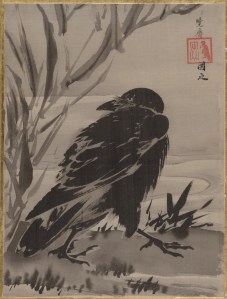
Kawanabe Kyosai, “A Crow and Reeds on the Bank of a Stream.”

Far wiser than I,
the crow knows to seek shelter
from cold autumn rain.

First snow haiku

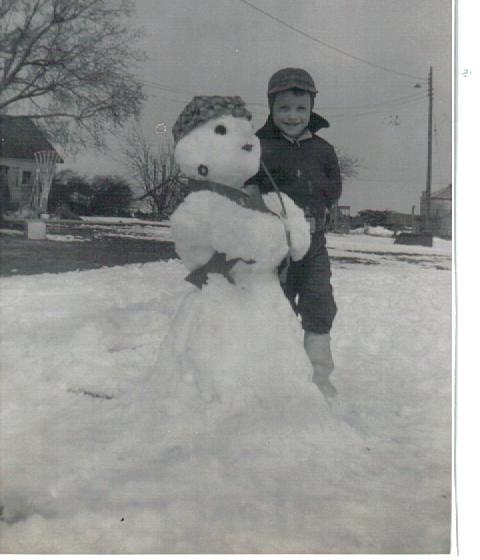
Me with a snow-woman
The year’s first snowfall
always makes me feel just like
I’m a kid again.


Notes:  Western Washington goes a little crazy over snow, especially when it’s the first one of the season.

I saw a lots of weather posts today from friends and colleagues.  I must admit, like Robert Frost, I’m a bit of a sucker for “a dust of snow.”

December haiku

Late autumn gloom
Crow all you want, cock.
You can’t make the sun pierce through
this late autumn gloom.


Notes:  I often stay at a bed & breakfast high on a hill on the Kitsap Peninsula.  To the east are the Cascades.  To the west are the Olympics.  When you can see them, it’s spectacular.

This time of year, however, they are usually hidden by the fog and clouds.

The hosts keep chickens to produce eggs for the breakfast part of the business.  This is not a sure thing, however.  The coyotes are thick in the woods.  We’ve had a bumper crop of rabbits this year, so the coyotes seem to be leaving the chickens alone.

Last year, however, the farmer lost his entire brood to a bald eagle.  Our proud national bird is so plentiful out here in the Pacific Northwest that they’ve become a bit of a pest.  For a couple of days after the massacre, I saw the eagle perched on a tall tree looming over the henhouse, hoping the farmer would make a quick replacement.

He repopulated the henhouse with baby chicks, and redesigned the pen to be eagle-proof.  So far this year, we’ve had a steady supply of eggs.

Thanksgiving haiku

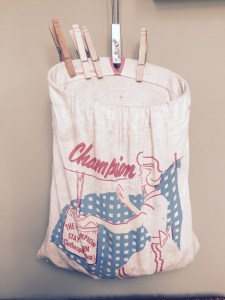
clothes-pin-bag
We may have been poor
but we always had clean clothes.
Our mother made sure.


Notes:

I hadn’t seen a clothes pin bag like this is decades.  But, recently, in Sonoma of all places, in the laundry room of a little house my family had rented, I found this item from the past.  It was identical to the one my mother used all through the 1960s.

It seemed to be just another part of the retro-nostalgia vibe of the décor.  It took me back in time.  Back to that little house on East Mitchell Street, where a Missouri farm family found their slice of the American Dream.

My mother used to wash our clothes in an electric wringer washing machine that was more wash tub than machine. I’m pretty sure my dad must have proudly ordered it back in the 1950s from the Montgomery Ward catalog to make life easier for his wife, our mother.

The modern feature was the wringer that squeezed the excess water out of the clothes to speed up the line drying.

I suppose it was a big step up from the washboard down by the stream, but it still required considerable manual labor.

One day, my mother absentmindedly fed some clothes through the wringer and got her left hand caught.  I remember blood and crying and a bent wedding ring.

But, all in all, that was a minor event in the grand scheme of things.  We knew more than one farmer who had lost a whole arm in a disagreement with a stubborn corn picker.

When it became apparent that the first location of the clothesline in the back yard was interfering with the natural layout of the whiffle ball diamond, my dad relocated the clothesline, even though uprooting and transplanting the poles amounted to considerable work.

Is it my imagination, but is there nothing like the smell of clothes dried on the line in the July Missouri sun?  It’s a fragrance Proctor & Gamble can only wish they could duplicate.

Bounce just doesn’t cut it.

Civics Haiku

First Presyterian Church, Marshall, MO
Let me not forget
my dual citizenship,
and which one will last.


Notes:  Pictured is the First Presbyterian Church of Marshall, Missouri.  Known as “The Rock Church,” it is the most beautiful church building in my hometown.