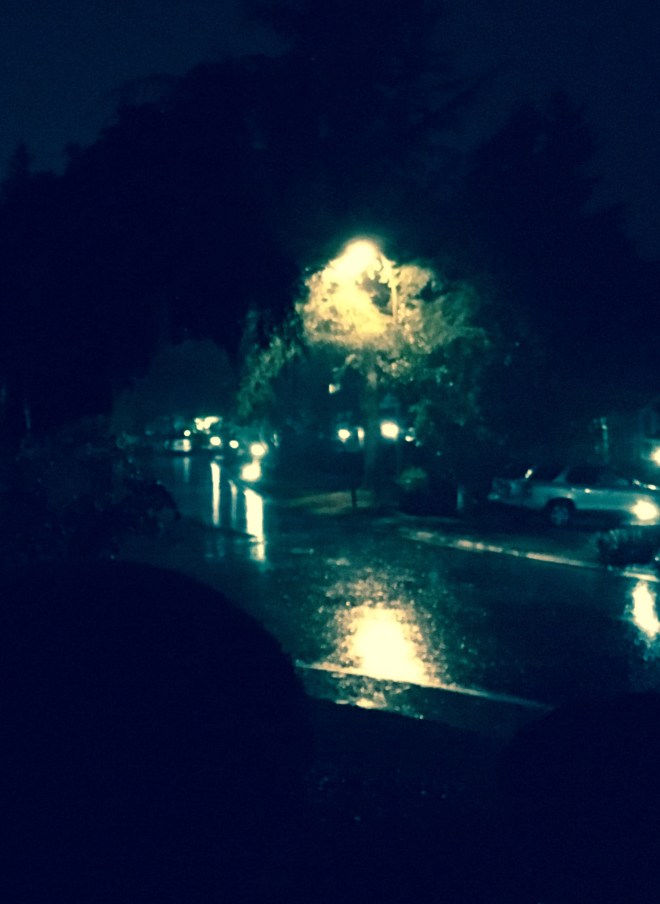
In the autumn night
the rains return, much louder
than I remember.
Tag: autumn
Autumn haiku
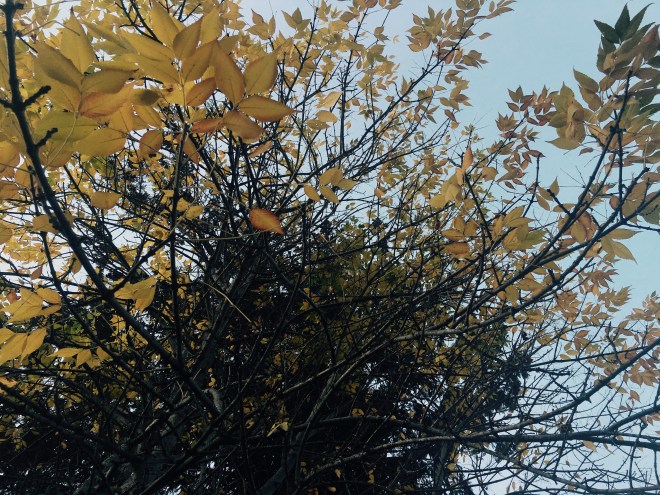
I’ve never been one,
For wallowing in the past,
But, the falling leaves …
Autumn poem
Autumn Song
Afternoon in late September
Shows us signs we both can follow,
Shadows where there were no shadows
Days before, encroach on meadows,
Turning brittle brown and yellow.
Six o’clock’s a dying ember
Causing grown men to remember
Another fall’s disturbing echo.
When, unnoticed, fell the first leaves,
Yellow elm leave tired of sunshine?
Who suspected seeing such ease
When the first chill stunned the green vine?
Is embarrassment the reason
Sumac’s crimson hides its poison?
When was foliage last so supine?
Rainy night in mid-October
Brings the icy confirmation —
Twigs encased in shiny coffins
Clenched in cold that never softens.
Even daylight’s ministration
Alters no repose so sober
As the sleep of mid-October,
Sleep of spreading desolation.
Notes: Written years ago and far away, when I lived in a much different climate. My Puget Sound friends and neighbors might find it hard to relate to an autumn that leaves twigs encased in icy coffins, but my friends back in Minnesota understand all to well.
I recall one Halloween when my son and I set out at dusk to trick or treat in Minneapolis. We made our way about two blocks as it began to snow hard, then harder. We almost didn’t make it back home as we trudged through calf-deep drifts.
Autumn has its beauty. “Every leaf is a flower,” is a beautiful sentiment.
Bit the fall is also one of God’s great metaphors. And that makes it poignant, even as it is achingly beautiful.
Late summer haiku

Last night of summer
highway hum and jets muffle
the coyote’s cry.
Late summer sonnet
Late Summer’s Sun
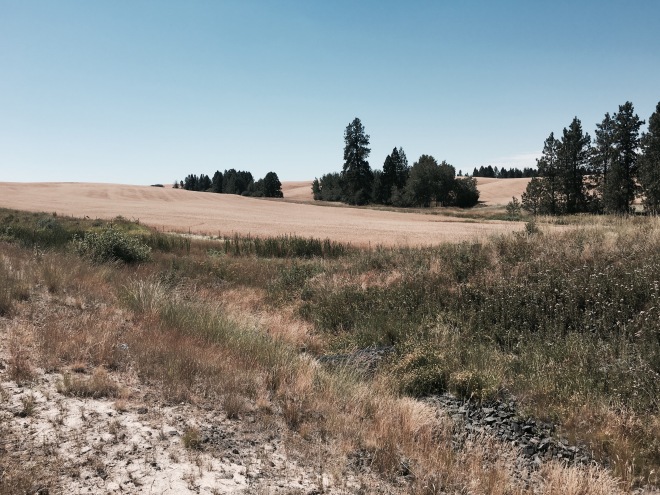
Late summer’s sun has baked the grass to brown.
The days grow shorter with each passing day,
Soon, autumn’s chill will make the leaves fall down.
All of this aching beauty will decay.
And yet I love the shadows’ slanting trace,
The once green grain gone golden in its rows,
And how I love the lines etched in your face.
It’s funny, as love ripens how it grows.
The number of our days we do not know.
No sleeper knows if he will ever wake.
So come, let’s join above, between, below.
My dear, let’s cause our fragile clay to quake.
Let us make love as if it’s our last go.
Let us embrace like dawn will never break.
Notes:
It’s that time again to haul this old one out of the vault.
Among other things, God was the first poet. The world is full of rhyme and rhythm, image and metaphor.
In our own small, imperfect way, we just catch glimpses.
A favorite midsummer poem
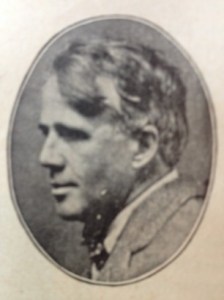
I don’t know about you, but I’ve always seen the July 4th holiday as the turning point for summer.
The days have just started to get shorter. The foliage starts to brown, and even though it’s two full months before September, there is a sense that the glorious hurrah of summer will all come to an end all too soon.
“The Oven Bird” by Robert Frost says all this and more to me.
It’s just a little sonnet. Fourteen lines in all.
It’s worth a look to read the whole poem, but several of the lines are little gems that stand alone. Writing about the song of the little oven bird, Frost says:
He says the early petal-fall is past
When pear and cherry bloom went down in showers,
And, just a couple of lines later,
He says the highway dust is over all.
That is a poignant, dusty image, familiar to anyone who has lived in the country. It signals that the spring rains are definitely over, and you’ve entered that long, hot stretch that ends with the on-coming fall. Time is moving ahead.
The poem wraps up with a wonderful final two lines:
The question that he frames in all but words
Is what to make of a diminished thing.
A good question to ask any time of year, or at any time of life.
Honeymoon sonnet
Epiphanies
We come now to the winter of our years
(Where did the autumn with its pleasures go?)
Our roof will all too soon be cloaked with snow,
So, come, let’s stoke our fire against the fears.
It seems another life ago, my dear,
That full of grace you pilgrim sat aglow
Enkindled so this prodigal would know
That grace was free and grace was very near.
Midsummer’s eve brought more epiphanies
Of spotless bride adorned, redeemed, in white,
Too ill for customary liberties,
So wan, yet still for these sore eyes a sight.
Then! Over Lake Champlain the full moon sees
A railway sleeper car rock through the night.
Notes:
When love is good and it lasts, it can be tempting to idealize its beginnings.
But, the very first time I saw my wife, she was glowing. I kid you not. Sitting in the second row of a darkened auditorium listening to the Chaplain of the U.S. Senate, there she was — surrounded by a golden aura.
At the time, I was a reporter for a small suburban weekly paper, and was there on assignment. I had a camera, but was so befuddled I failed to get the shot. You might argue I was imagining things, but I don’t think so. I’m not given to visions nor hallucinations. I’ve never witnessed anything like it before or since.
I kept my eye on her while I got my story. But at the end of the program, she went right up to the speaker. I figured she must be with the group of important people who had accompanied him from Washington, D.C.
So, I put The Glowing Girl out of mind and tried to forget about her.
Fortunately for me, she turned up again a couple of weeks later at church. She was a friend of a friend, who introduced us and immediately left us alone. I didn’t let her get away a second time.
I think the whole experience was a special gift for a fellow a bit slow on the uptake, who needed a sign to notice a good thing right under my nose.
That’s my story and I’m sticking to it.
We were married at Midsummer. She was sick and only made it through the festivities with the help of cold medicine. The next morning we flew out of town to New York, and the very next night, took an overnight train to Montreal.
I’ve been a fan of railway travel ever since.
Love haiku

Before I met you
I thought I was so darned cool.
Clueless, more like it.
Love Haiku
What was it really
that overcame your heart’s fear
when you fell for me?
Farm Life Free Verse
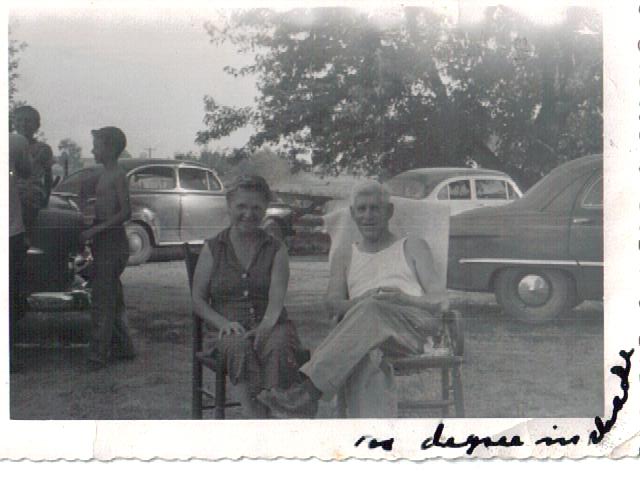
Back in the 1950s on the farm, we didn’t have air conditioning. Shoot, we had just gotten electricity a few years before.
So when the long Missouri summers dragged on and the humidity rose, folks headed outdoors to keep cool. When the nights were really hot, we’d sleep outdoors.
The following poem is about a day pretty much like the one documented in this photo. In fact, the events took place not too many days after this photo was shot.
The Day the Call Came
The day the call came
We had just dished up the ice cream.
A special treat for a Friday farm dinner,
(Not to be confused with supper.)
Mother had made it early that morning in ice cube trays.
“Freezer ice cream,” she called it,
Vanilla, made with Junket tablets to keep it creamy,
Even as it froze.
Not as good as the real, homemade ice cream cranked by hand,
But a whole lot easier.
And America was just starting its long affair with convenience.
The call came over the telephone
Mounted on the farmhouse wall.
With two bells for eyes,
You spoke into its honking, beaklike nose.
The earpiece cradled appropriately
Where the right ear should be,
While a hand crank made a poor excuse
For a drooping left ear.
It was a party line,
So the snoopy widow woman down the road
Knew as soon as we did.
The call came, and the man on the phone
Said Grandpa had just keeled over dead
At the auction over in Poosey.
So, we all got up—Mom, Dad, Big Brother and me,
And climbed into the ’50 Ford sedan
Dad was so proud to own.
The first car he’d ever bought brand new.
By the time we got to the auction –
It was a farm sale, really —
Where the worldly possessions of one farm family
Were being sold off.
One at a time.
By the hypnotically fast-talking auctioneer.
Not as depressing as the foreclosure sales
That were all too common
Just a few years before in the Depression.
This was a voluntary sale,
But a little sad nonetheless.
Some farmer was getting too old to run the place,
And didn’t have kids—or leastwise kids who wanted to farm.
A lot of boys joined the service in those days,
Or headed to Kansas City to find work, and a little excitement,
Rather than stay and try to coax a living
Out of that hilly, rocky dirt.
The man at the auction told us
Grandpa had been standing there in the sun with everybody else.
They were just about to start the bidding on the John Deere hay rake
When he grabbed his chest and fell right over.
Years later, they told me when he was a grown man
Grandpa had gone down to the river,
And been baptized, and filled with the Holy Ghost,
With the evidence of no longer speaking in profane tongues.
For, it was well known Grandpa had been gifted
In the art of colorful language.
“He used to could cuss by note,” was how Mother put it.
But after the washing with water and the Word,
Grandpa was never heard to swear again.
I only knew him as a white-haired old man
With a merry smile, and infinite patience
With Grandma, who required it.
And that was it, really.
Nothing more to say,
Except for the understated condolences
Of the country folk.
Nothing more to do,
Except for my father,
Now lately promoted to the role of the family’s eldest male,
Who assumed the duties and made the necessary arrangements.
Although I didn’t know quite what had happened,
I felt a lurch … as something shifted beneath me …
And I was yanked one more notch forward.
By the time we got back to the house,
The ice cream had long since melted
And now was returning back to solid state,
As it curdled in the September heat.
 Poetic Champions