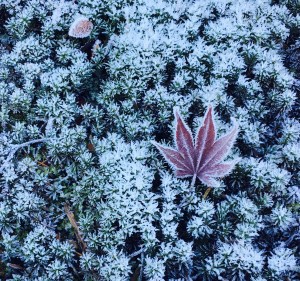
Winter echo

Hoarfrost

FROST IN MORNING

When the willow world is with hoarfrost hung,
And the white fog lifts leaving trees bright new,
The foliage flashes with a crystal clue
Of how the world looked when light first leaped young.

Before man’s weight and weakness had begun
To break the branch or bruise the sodden slough,
The garden grew unburdened, bathed in dew,
Grew like a canticle, perfectly sung.


NOTES: Many years ago and many miles away, I awoke one Minnesota winter morning to the most astounding display of hoarfrost I had ever seen.  The world was completely coated, clothed in white.

This was approximately 35  years ago.  Garrison Keillor was just getting traction with his Prairie Home Companion show.  He still had a day job on the local public radio station, and that morning, he celebrated the frosty morning by reading a poem.

I regret that I do not remember the name, or author of the poem he read that day.  Perhaps it could have been this poem, Hoarfrost and Fog, by Barton Sutter.  But I don’t think so.

It might have been his own work.  But his efforts inspired the modest 8 lines I’ve posted above.

This fall, I’ve been writing a lot about how the death of summer is a metaphor for the inevitable death we all as humans face.  This might be the single most-used image in all of literature.

Gerard Manley Hopkins wrote a marvelous poem along these lines, Spring and Fall.  It’s one of my most beloved poems of all time.

Hopkins also wrote a 2-part poem, The Leaden Echo and the Golden Echo, that gets at something even more.  The first part, The Leaden Echo, sets up the problem of the decline and decay of beauty.  It ends with despair.

But, in The Golden Echo, we come back to hope for redemption, for eternal life, and for the love of a Heavenly Father who restores.

“When the thing we forfeit is kept with fonder a care
Fonder a care kept than we could have kept it ….”

(For a real treat, listen to Richard Burton read this poem.  He reads poetry as it should be read, not with whiny, tinny detachment, but with passion.)

So, as I look at nature, there are signs of both despair and hope.   Leaden echoes and golden echoes alike.

When I see the world covered in frost, I think of a more perfect world.  A world like what may have been before sin and death entered into it.  Or the world that is to come.
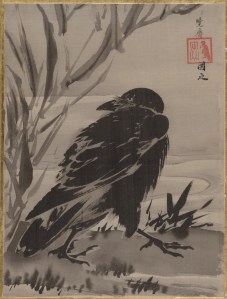
Crow haiku

hewise crow seeks shelter
Kawanabe Kyosai, “A Crow and Reeds on the Bank of a Stream.”

Far wiser than I,
the crow knows to seek shelter
from cold autumn rain.

Late fall sonnet

Autumn leaves

Falling Leaves Like Lovers

The leaves, the leaves are gone except the oak,
Which cling to trees and rattle needlessly.
The others flame and fall for all to see.
They streak and sizzle, leaving only smoke.

But oak leaves hang as by some unseen yoke,
All browned and curled awaiting sympathy,
Or sap to course and lend vitality–
The leaves cannot perceive the sorry joke.

For spring will end the lie and they will drop,
To drift and rot and turn in time to dust.
As sure as buds will burst to make a crop
Of new, the old will flutter down–they must.
The falling leaves like lovers never stop.
It’s hardly gentle, but ’tis just, ’tis just.


Notes:  Some of my favorite poems compare the death that comes in the autumn to the end of a love.  Or poems that use the dying natural world when winter approaches as the backdrop for the story.

I think of Robert Frost’s Reluctance, with its heartbreaking line about it being treasonous “to bow and accept the end of a love, or a season.”

Or Thomas Hardy’s Neutral Tones, which uses a frozen landscape as the setting for the realization that a relationship has ended.

Then, there is John Crowe Ransom’s Winter Remembered, with its wonderful image comparing the forsaken lover’s cold fingers to “Ten frozen parsnips hanging in the weather.”

I may never have discovered Ransom had it not been for my 11th grade English teacher,  Paul Hagedorn, back in Marshall, Missouri.  We spent an inordinate amount of time on poetry that year.  The major assignment, as I recall it, was to select an American poet from a lengthy list, and then immerse yourself in the writer’s work, and finally write a paper.

Knowing nothing about most of the choices, I picked John Crowe Ransom solely because I liked the sound of his name.  I got lucky, because I discovered I enjoyed his work.  Had I chosen Wallace Stevens with his difficult, cerebral verse, I probably would have flunked.

Another assignment was to prepare a notebook of our favorite poems.  I remember making daring choices, including song lyrics by such radicals as Paul Simon and Bob Dylan.  Now  that Dylan as been awarded the Nobel Prize for Literature, I consider myself foresighted.

I was fortunate that Mr. Hagedorn approved of my choices.  He was the cool, young teacher back then.  He managed to fan the flames of inspiration and love for poetry.  They smoldered for years, flaming up now and then, and have finally started burning here in this blog.

First snow haiku

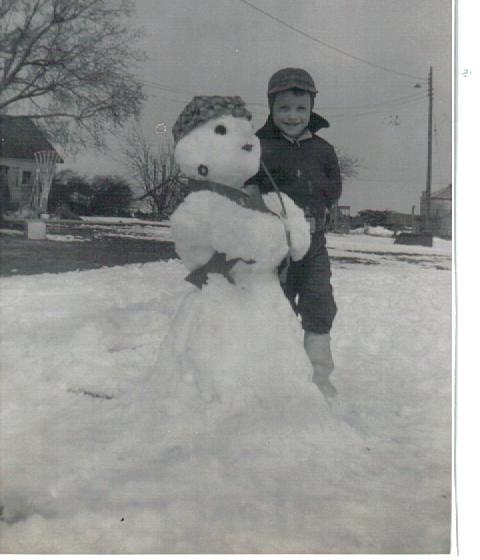
Me with a snow-woman
The year’s first snowfall
always makes me feel just like
I’m a kid again.


Notes:  Western Washington goes a little crazy over snow, especially when it’s the first one of the season.

I saw a lots of weather posts today from friends and colleagues.  I must admit, like Robert Frost, I’m a bit of a sucker for “a dust of snow.”

December haiku

Late autumn gloom
Crow all you want, cock.
You can’t make the sun pierce through
this late autumn gloom.


Notes:  I often stay at a bed & breakfast high on a hill on the Kitsap Peninsula.  To the east are the Cascades.  To the west are the Olympics.  When you can see them, it’s spectacular.

This time of year, however, they are usually hidden by the fog and clouds.

The hosts keep chickens to produce eggs for the breakfast part of the business.  This is not a sure thing, however.  The coyotes are thick in the woods.  We’ve had a bumper crop of rabbits this year, so the coyotes seem to be leaving the chickens alone.

Last year, however, the farmer lost his entire brood to a bald eagle.  Our proud national bird is so plentiful out here in the Pacific Northwest that they’ve become a bit of a pest.  For a couple of days after the massacre, I saw the eagle perched on a tall tree looming over the henhouse, hoping the farmer would make a quick replacement.

He repopulated the henhouse with baby chicks, and redesigned the pen to be eagle-proof.  So far this year, we’ve had a steady supply of eggs.

Night walk poem

I have walked now and then in rain.
EXPERIENCE

I have walked now and then in rain,
Walked until the road gave way to stones.
I have known a thing or two of pain.

I’ve returned home alone at night
To rooms that don’t speak back to me at all.
I have stayed up late without a light.

I have watched the half-moon disappear,
Watched until the frost benumbed my face.
I have seen the seasons of the year.

I have left warm, pleasant rooms for plain,
Left without a word explaining why.
I have known a thing or two of pain.


NOTES:  It’s a cold, rainy night in the Pacific Northwest, and I’m stuck miles away from my honey.  It seemed like a good occasion to dust off this old poem.

Thanksgiving haiku

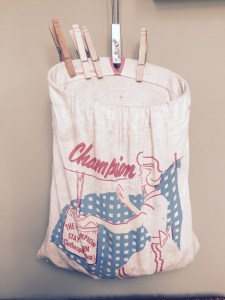
clothes-pin-bag
We may have been poor
but we always had clean clothes.
Our mother made sure.


Notes:

I hadn’t seen a clothes pin bag like this is decades.  But, recently, in Sonoma of all places, in the laundry room of a little house my family had rented, I found this item from the past.  It was identical to the one my mother used all through the 1960s.

It seemed to be just another part of the retro-nostalgia vibe of the décor.  It took me back in time.  Back to that little house on East Mitchell Street, where a Missouri farm family found their slice of the American Dream.

My mother used to wash our clothes in an electric wringer washing machine that was more wash tub than machine. I’m pretty sure my dad must have proudly ordered it back in the 1950s from the Montgomery Ward catalog to make life easier for his wife, our mother.

The modern feature was the wringer that squeezed the excess water out of the clothes to speed up the line drying.

I suppose it was a big step up from the washboard down by the stream, but it still required considerable manual labor.

One day, my mother absentmindedly fed some clothes through the wringer and got her left hand caught.  I remember blood and crying and a bent wedding ring.

But, all in all, that was a minor event in the grand scheme of things.  We knew more than one farmer who had lost a whole arm in a disagreement with a stubborn corn picker.

When it became apparent that the first location of the clothesline in the back yard was interfering with the natural layout of the whiffle ball diamond, my dad relocated the clothesline, even though uprooting and transplanting the poles amounted to considerable work.

Is it my imagination, but is there nothing like the smell of clothes dried on the line in the July Missouri sun?  It’s a fragrance Proctor & Gamble can only wish they could duplicate.

Bounce just doesn’t cut it.

Civics Haiku

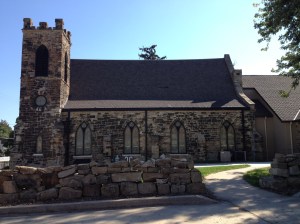
First Presyterian Church, Marshall, MO
Let me not forget
my dual citizenship,
and which one will last.


Notes:  Pictured is the First Presbyterian Church of Marshall, Missouri.  Known as “The Rock Church,” it is the most beautiful church building in my hometown.

Autumn haiku

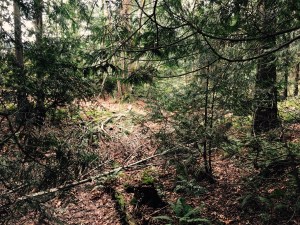
Felled brances, fragrance of cedar
Autumn squall moves through
felling branches and needles.
Fragrance of cedar.


Cat haiku

Cat crouching in lush autumn grass
The grey cat crouches
in the lush October grass,
wary and alert.


Notes:

I’ve been a bit busy lately so this one is getting posted a few days after the photo was taken and the poem written.  But here in the Pacific Northwest, the grass stays green all winter, so that hasn’t changed much.  The grass is even greener now than in the peak of summer, when things often get a bit dry.

Funny thing, I can go for weeks without seeing a cat on my evening walks, but one day in October, it seemed like every cat in town was outside, either lurking in the foliage or dozing in the fast-departing patches of late afternoon sun.

They seemed to sense, like I, that the autumn rains would be coming soon.  We all were taking advantage of the last dry days of Indian Summer.