Winter Haiku

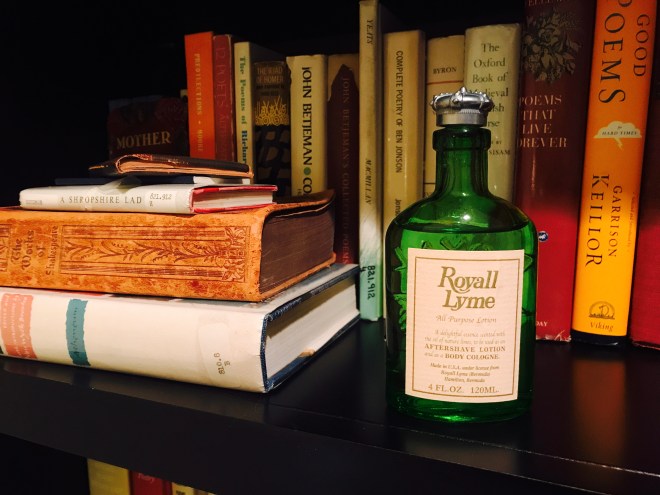
Royall Lyme after shave

Even in winter
one whiff stirs a remembrance
of spring long ago.


Notes: I’ve heard that the sense of smell is the strongest trigger of memories. I’m not sure that is a scientific fact, but anecdotally it sure seems so.

The odor of a particular janitorial product can transport me back to the polished hallways of Southeast Grade School. A hint of Lily of the Valley can put me right back in the shoes of the little boy who was me tending a flower garden with my mother.

The smell of fresh baked bread lands me in my grandmother’s house, playing with my cousins, anticipating the first bite of that still-hot bread, smeared with homemade butter and smothered in honey from the comb.

And the smell need not be pleasant. Step into a campground outhouse, and I’m right back on my childhood farm.  We weren’t the poorest farmers in the county — we had a two-seater.

And that reminds me. The smell of burning paper brings back the recollection of the out-of-date Sears & Roebuck catalogs, kept along with a box of kitchen matches in that old outhouse as a sort of forerunner to the modern room deodorizer.  You just rip out a page, roll it tight, and light it.  Everything smells much better than before!

Last month while on vacation, I was delighted to find a fragrance from the past at an Brooks Brothers outlet mall store. The bright green of the Royall Lyme bottle caught my eye almost immediately.

The heavy metal crown-shaped lid felt the same.  The faux-Old English font looked the same. And when I sprayed on a bit of the fragrance, I was taken back to the mid 1960s again.

The high school speech and debate club had boarded a school bus and driven to Kansas City for a weekend field trip.  The stated educational rationale was to take in a film or two that were not available in my rural hometown. But it was really pretty much a junket, a good excuse to get out of town and hang out in the big city.

Some of the details are fuzzy, but I think we stayed at an old Howard Johnson’s out on I-70 and Noland Road. Then the next day, with our teacher, Mr. Washburn, driving the bus, we ventured into the city.  I think the big movie most people wanted to see was Cat Ballou, which would most likely date this event in the spring of ’67.

We had no way of knowing it, but that summer in San Francisco would see the “Summer of Love,” with the full flowering of the hippie subculture. This was the era of “be-ins,” sex, drugs, and rock & roll.

But that was all to come later. Back in Kansas City, we caught a matinee, which I remember nothing about.  We ate at the Italian Gardens, at its old location on Baltimore Avenue, my first experience with ethnic food. The spumoni was redolent. It must have been soaked in some type of booze, which I had also never tasted before. A classic spumoni in an old school Italian restaurant can sometimes take me back in time.

But the most memorable experience happened when we stopped into a fancy men’s clothing store. I didn’t have a lot of spending money, so I couldn’t afford the clothes. But I found a bottle of Royall Lyme cologne in my price range and bought it.

I had a crush on a girl, and there were signs she liked me too. We sat next to each other on the bus ride back home. I wore the lime-scented fragrance.

As I walked home from the school building by myself, I recall humming Simon and Garfunkle’s 59th Street Bridge Song, with its signature line, “Feelin’ groovy.”  (From the first album I would buy for myself, incidentally.)

The sun was warm. The birds were chirping. My feet floated above the sidewalk. God was in His heaven. Everything was right with the world.

And all was infused with lime.

Speaking strictly for me, I could have died then and there.

As for peak experiences, this may seem fairly tame. But when you think about it, how many times in your life seem absolutely perfect?

I can only think of a handful.

The perfection was fleeting, of course. It always is. We went back to classes on Monday. The school year ended soon. The puppy-love romance fizzled. The summer was spent detasseling corn and bucking hay. Come mid-August and we had to endure the grueling two-a-day football practices. School started up again. I caught a cold. The entire football season I sat on the ice-cold aluminum bench as a third stringer.

Everything was not groovy.

But that one springtime, lime-soaked day was a glimpse. A foretaste of something pure and good and innocent and perfect.

My generation would try, just a couple of years later to take the Summer of Love to the next level and seize that innocence by force.  At Woodstock, half a million young people would head to Yasgur’s Farm and try to “get back to the garden,” but would wind up wallowing in trash and mud instead.

I read about Woodstock in TIME magazine. I wanted to believe in it. But I had just been blessed with indoor plumbing and central heating a few years before. Something about the filth and the litter and the discomfort just didn’t jibe with what paradise was supposed to be like for me.

Then, in December of 1969, all the false hope of the Summer of Love and Woodstock would be slammed shut at the Altamont Raceway Festival Free Concert. While the Rolling Stones played Sympathy for the Devil, a fight broke out.  And while they played Under My Thumb, a Hells Angels security guard stabbed a stoned-out and unruly concert-goer to death.

Although I didn’t realize it at the time, the counterculture had peaked, and I had pretty much missed it.

We were a long way from “all  is groovy.”

By the time I would head  off to college in 1970, eager to plunge into the counterculture, it had already been exposed as a false hope and an empty dream. I felt vaguely cheated, like I’d arrived late at the party.

In 1973, Van Morrison would capture the contradictions and the corruption of the hippie movement in his song The Great Deception on the album Hard Nose the Highway:

Did you ever hear about the great deception
Well the plastic revolutionaries take the money and run
Have you ever been down to love city
Where they rip you off with a smile
And it don’t take a gun

— by Van Morrison

But the idea of paradise persists. And the scent of limes still brings it back.


Autumn Sonnet

Autumn scene

FALLING LEAVES LIKE LOVERS

The leaves, the leaves are gone except the oak,
Which cling to trees and rattle needlessly.
The others flame and fall for all to see.
They streak and sizzle, leaving only smoke.
But oak leaves hang as by some unseen yoke,
All browned and curled awaiting sympathy,
Or sap to course and lend vitality —
The leaves cannot perceive the sorry joke.
For spring will end the lie and they will drop,
To drift and rot and turn in time to dust.
As sure as buds will burst to make a crop
Of new, the old will flutter down — they must.
The falling leaves like lovers never stop.
It’s hardly gentle, but ’tis just, ’tis just.


NOTES: It was a mild and beautiful and extended autumn here in the Pacific Northwest, but the rains and winds have returned, knocking most of the remaining leaves off the trees over the Thanksgiving weekend.

Oak trees are not as plentiful here as they are back in the Midwest, where this poem was written some 35 years ago. But if there is an oak around, you can bet it will be hanging onto its leaves long after all the other trees have shed theirs.

Spring haiku

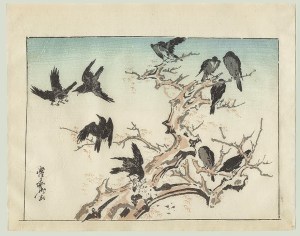
Japanese Woodblock Print by Kyosai (1831-1889)

Relax noisy crows,
I mean your babies no harm.
The cat, however …

Spring haiku

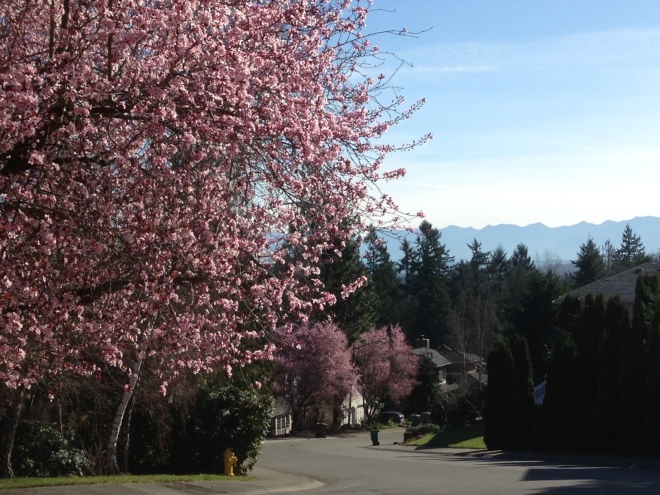
Early spring -- a great day for a walk ... and poetry

Pink trees everywhere,
So perfect, what could go wrong?
Uh oh … wait … a-choo!


NOTES:  We’re having a late spring here in western Washington.  Cold weather and rain has suppressed the buds and tree pollen that usually afflict me from March 1 to March 30 like clockwork.

I thought, perhaps, I was going to somehow avoid my alder and cedar tormentors this spring.  Silly me.  This week, the rain paused, the temperature rose, and the pollen bloomed.

Spring haiku

Mostly obstructed view of the Cascades

Such a great view here.
The Cascades are breathtaking.
You’ll need to trust me.

Spring haiku

Bobby Ball standing in the DuBois' driveway, late 1960s. on Rea Street.
Courtesy of Susumu Wakana

There once was a time
when blossoms and I were both
fresh and unabashed.


NOTES: When I was a junior, my high school hosted a foreign exchange student from Japan.  Susumu stayed with the DuBois family, who lived a few blocks away.

A couple of years ago, through the miracle of Facebook, I reconnected with Susumu.  When I discovered he had taken several photos of his days in my hometown, I was excited.  He very kindly shared them with me, and I have been lovingly looking through them and rekindling old memories.

Those photos include precious images of teachers long since gone.  Of friends and classmates not seen for decades.  And simple scenes of my hometown, a town that has changed so much since I walked its streets.

One of the photos was of me.  I don’t remember it being taken.  All evidence points to it being the spring of 1969.  I am outfitted in what passed for a tennis uniform in those days.  I must have just finished practicing with Susumu’s host brother, Dave DuBois.  We were teammates on the Marshall High School tennis team, and we practiced out on the new hard surface courts at Missouri Valley College.

From the foliage, it was early spring.  The tulip tree was in full bloom, but the other trees had not leafed out.  I wore a leather bracelet on my right wrist, which was the cool, hippie thing to do.

My hair was growing out and would need to be cut before football practice started in August.  (Coach Cecil Naylor really didn’t like long hair!)

Ah.  If I only knew then what I know now.

Poem against spring

Late snowfall

COME GENTLE SNOW

Come gentle snow and cloak the ground,
Shroud budding branches all around,
Let not one scent of spring be found,
Make flowers wait.

Come frost and freeze the throbbing juice,
Break March’s short and shaky truce,
No sprout nor songbird yet aloose,
Let spring be late.

Come wind and make the oak leaves hiss,
When they descend no one will miss
Their brittle shade — no artifice
Can bring them back.

Come night and steal the season’s gain;
The verdure will begin to wane
Despite the wealth of easy rain
If it stays black.

Come sleep and shield me from the past,
Help me forget her I loved last,
Wrap safely me in sanctums vast,
Away from pain.


NOTES: We had one of those late snowfalls last week. This time of year in Western Washington, there are already signs of spring.  Those signs were utterly–but temporarily–obscured by the snow.

Nearly 40 years ago when I wrote this poem protesting spring, I was an unrequited, tragic romantic. O woe was me!  I thought I’d never be happy again.  Of course, I was wrong.

Today, I still dread the onset of spring, but for different reasons. When March comes, the alder tree pollen starts to bloom. And that’s when I start sneezing.

If I can just make it through March to April I should be fine.

Midwinter haiku

Midwinter warm spell

Midwinter warm spell,
Evening mist, tree frog calling,
“Cro-cro-cro-crocus!”


NOTES: Took a walk yesterday and heard a tree frog for the first time this winter.  It reminded me of this haiku from awhile back.

Love poem

I loved you first in lilac time

Flower Time

I saw you first in jonquil time,
When you were bathed in grace.
You sat aglow with fire sublime,
And golden shone your face.

I loved you first in lilac time.
A bloom I plucked for you.
I wrote you verse with song and rhyme.
I hoped you loved me too.

I kissed you first in tulip time,
It must have been a sign.
The buds and we were in our prime
When your two lips met mine.

I married you in daisy time
On summer’s longest day.
We traded rings and heard bells chime.
We pledged always to stay.

Too soon we’ve come to aster time.
The days are shorter now.
Would stealing some be such a crime?
We’ll make it right somehow.

Should we endure ’til wintertime,
The time when flowers sleep,
Dreams we’ll share of a gentler clime
Where we no more shall weep.


NOTES:  Today is Valentine’s Day, and it’s unseasonably warm here in the Pacific Northwest.  It won’t be long before the jonquils and crocuses start poking their heads up through the mulch.

And it won’t be much longer than that before my favorite  — the lilacs — grace us with their fragrance and beauty.

It’s a good day for a modest little love poem.

Love Sonnet

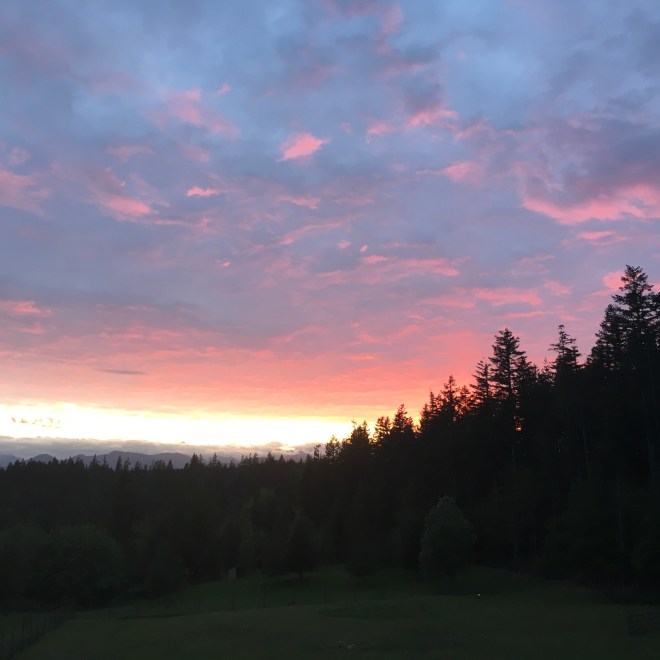
Sunset over the Olympic Mountains
“The changing light and seasons have their ways …”

Familiar Ways

I choose to walk the old familiar ways,
To wend ways where I’ve put my foot before,
To gaze anew on views seen other days,
Which, though familiar, never seem to bore.

The changing light and seasons have their ways
Of making old things new: The light-laced hoar,
The first-flush, green-glow, bursting-forth spring days,
The growing tinge of gold we can’t ignore.

Each day, my dear, I choose afresh our trail,
The one we blazed so many years ago,
Eschewing other routes that might avail,
And hewing to the well-worn way we know.
Forsaking novelty need be no jail
With your face bathed in sunset’s golden glow.


Poet John Ciardi relates this story about Robert Frost, who at a lecture was asked by  a woman in the audience: “Mr. Frost, surely when you write one of your beautiful poems, you are not thinking of technical tricks!”

Frost looked at the woman a while and replied, “I revel in them!”

Ciardi says Frost was like a horse trader who “would pick up an idea and whittle at it until he either wound up with a little whittled shape or a pile of shavings on the floor.”

I felt a little like a horse trader as I was writing this poem.  It started with a simple, little idea.  I can’t remember ever “whittling” more on a poem before.  At first, this one seemed like it just never wanted to happen. I just kept whittling and whittling until something very different began to emerge from where I started.

After what seemed like an eternity, I began to see the tricks of the trade — namely rhythm, diction, image and form — coming together to embody the simple little idea.

This one did not plop, fully formed, into my lap.  It was written, re-written, and re-written again.  I wrote in on my phone.  I copied it out by hand in a notebook.  I typed it in Microsoft Word on my laptop.  I read it aloud and even recorded a reading of it to hear how it sounded.

I found myself being keenly aware of assonance, alliteration and internal rhyme like never before.

I found myself unconsciously using the same sounds and rhymes over and over again as if I was consciously reinforcing the central idea.  Then, I found myself breaking the pattern with lavish, flamboyant word choices in the middle of the poem to demonstrate the message.

I found myself coming around to embracing a metaphor in the final part of the poem.  It was an idea that emerged only after the first part of the poem was written.

It may be a pile of shavings.  Or it might be a little whittled shape.

You can be the judge.