Hippie haiku

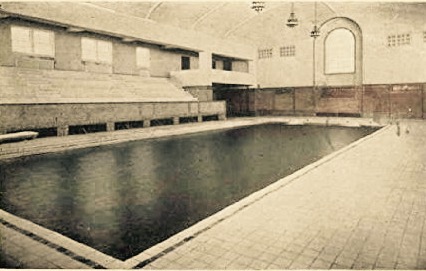
Vintage college swimming pool
“Liberate the pool!”
We presumed naked meant free.
We didn’t know jack.


Notes

The year: 1970.

Location:  A liberal arts college with a reputation for being a little “out there” situated in the upper Midwest.

A delegation of hometown friends make a long journey up to pay a fall break visit to a group of their high school friends who inexplicably all had happened to enroll in the same Liberal Arts College with a Reputation for Being a Little “Out There.”

It’s great to see old friends.  Partying ensues.  Someone (remembering with fondness the skinny-dipping escapades back home in the bucolic farm ponds and rock quarries of west central Missouri) suggests that a group be formed to go “liberate the pool” on campus.

It seemed like such a good idea at the time.

The word goes forth through the hallways of the dormitories of the liberal arts college with a reputation for being a little out there.

A party is formed, and the pool is “liberated.”

The campus police are called, and the liberators are duly cited for their violations of civility.

I’m not saying who was, and who wasn’t actually there.  Or who was a participant, and who was just an observer.  Perhaps, you were not available, but you would have gone had you been available.  Perhaps, you were horrified at the mere suggestion.  Memories get fuzzy when seen through the gauzy veil of so many years.

But, I’ll let the following people explain to their families and descendants just what role they actually played that evening in the notorious Macalester College Skinny-Dipping Affair of 1970:

  • David DuBois
  • John Swisher
  • Marty Swisher
  • Rob Greenslade
  • Robert Lee Van Arsdale
  • Ann Heinzler
  • Sheri Fritz
  • Paul Thompson
  • Alison Williams Coulson
  • George Cossette
  • Becky Roberts Kabella
  • Alan Ballew

John Marquand, I’m pretty sure you were not along on that trip.  But if you had been, I’m also pretty sure you would have been right there with the other liberators.  This is your chance to set the record  straight.


There is a balm in poetry

Gerard Manley Hopkins was a poetic champion
Gerard Manley Hopkins (1844-1889)

When I can’t take another newscast, another politician, another argument about Brexit, or another protest march, I’m so happy that we have poetry.

And when I seek solace in poetry, I’m so happy that poetry has Gerard Manley Hopkins.

He’s truly a treasure. Virtually unpublished during his own lifetime, he left behind a small but rich collection of stunning poems.

A complete original, he labored in obscurity, writing poetry in his spare time when not occupied with his vocation as a Roman Catholic priest.

He took his poetry — like his religion — seriously, developing his own philosophy of poetry.  And he innovated style and form, as well, creating his own form he called “sprung rhythm.”

Check out his poem, “Inversnaid.”  The poem is a description of a steam rushing down a hillside emptying into Loch Lomond in Scotland.

The description is wonderful, and well worth clicking away to read the whole poem.  But the last stanza is amazing. It’s four lines that form a prayer, seemingly beseeching God to preserve nature from the depredations of mankind:

What would the world be, once bereft
Of wet and of wildness? Let them be left
O let them be left, wildness and wet;
Long live the weeds and the wilderness yet.

When I read that out loud, I forget about what’s blaring on television, and I smile a little smile, and I find myself drawn back to the heart and center.  Actually drawn back to God.

That’s what John Ciardi must have meant when he said, “Enrich language, and you cannot fail to enrich our experience. Whenever we have let great language into our heads, we have been richer for it.”

Hometown haiku

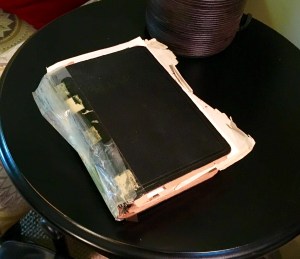
Mother's old Bible
Mother’s old Bible,
Worn out from years of long use.
Much like its owner.

Father’s Day Haiku

The calloused farmer with his son.
The calloused farmer
cradles his newly born son,
awkwardly tender.


Notes:

I’m descended on both sides from dirt farmers.  My father was a brilliant man, who didn’t have the opportunity to finish high school because he had to go to work to survive in the midst of the Great Depression.

I recall him telling stories of working for a dollar a day as a hired farm hand, performing such long-forgotten tasks as stripping bluegrass and threshing grain.

He had to lobby hard with his boss to get Saturday off to get married.  His new father-in-law served the wedding guests watermelon.  Mainly because he was a watermelon farmer and that was what he had on hand.

It was a brief honeymoon over in the nearest town, and then back to work on Monday.

My folks started having kids right away because if God blessed you with children, you were grateful.

This photo is my father with my oldest brother, John, back in May, 1934.

I’m re-blogging this one in honor of Father’s Day.

Father’s Day Haiku

Raymond Ball outstanding in his garden
How to explain Dad?
Outstanding in his field, he
lived a simple life.

Haiku for my father

Well over sixty, Dad built a barn by himself ...
Well over sixty,
Dad built a barn by himself.
Now it, too, molders.

Love Sonnet

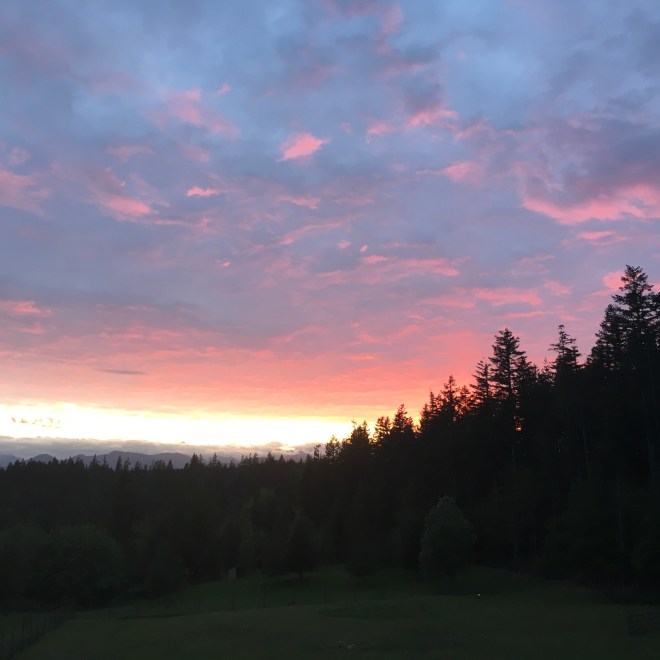
Sunset over the Olympic Mountains
“The changing light and seasons have their ways …”

Familiar Ways

I choose to walk the old familiar ways,
To wend ways where I’ve put my foot before,
To gaze anew on views seen other days,
Which, though familiar, never seem to bore.

The changing light and seasons have their ways
Of making old things new: The light-laced hoar,
The first-flush, green-glow, bursting-forth spring days,
The growing tinge of gold we can’t ignore.

Each day, my dear, I choose afresh our trail,
The one we blazed so many years ago,
Eschewing other routes that might avail,
And hewing to the well-worn way we know.
Forsaking novelty need be no jail
With your face bathed in sunset’s golden glow.


Poet John Ciardi relates this story about Robert Frost, who at a lecture was asked by  a woman in the audience: “Mr. Frost, surely when you write one of your beautiful poems, you are not thinking of technical tricks!”

Frost looked at the woman a while and replied, “I revel in them!”

Ciardi says Frost was like a horse trader who “would pick up an idea and whittle at it until he either wound up with a little whittled shape or a pile of shavings on the floor.”

I felt a little like a horse trader as I was writing this poem.  It started with a simple, little idea.  I can’t remember ever “whittling” more on a poem before.  At first, this one seemed like it just never wanted to happen. I just kept whittling and whittling until something very different began to emerge from where I started.

After what seemed like an eternity, I began to see the tricks of the trade — namely rhythm, diction, image and form — coming together to embody the simple little idea.

This one did not plop, fully formed, into my lap.  It was written, re-written, and re-written again.  I wrote in on my phone.  I copied it out by hand in a notebook.  I typed it in Microsoft Word on my laptop.  I read it aloud and even recorded a reading of it to hear how it sounded.

I found myself being keenly aware of assonance, alliteration and internal rhyme like never before.

I found myself unconsciously using the same sounds and rhymes over and over again as if I was consciously reinforcing the central idea.  Then, I found myself breaking the pattern with lavish, flamboyant word choices in the middle of the poem to demonstrate the message.

I found myself coming around to embracing a metaphor in the final part of the poem.  It was an idea that emerged only after the first part of the poem was written.

It may be a pile of shavings.  Or it might be a little whittled shape.

You can be the judge.


Haiku for Memorial Day

My great grandfather the Civil War veteran.
Yankee ancestor,
Had Reb been a better shot
I wouldn’t be here.


I’ll pull out an old poem in honor of my last direct ancestor to be wounded fighting to defend our freedom.

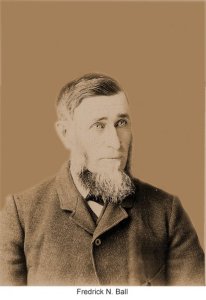
In my case, we must go back a bit.  All the way to the Civil War.  My great grandfather, Frederick N. Ball, was serving in General Sheridan’s Army in the campaign to take the Shenandoah Valley in Virginia.  When the Battle of Cedar Creek broke out, Sheridan was several miles away in Winchester.

As Sheridan was riding furiously back to rally his troops to victory, my ancestor was crawling back to safety after having been shot through the side early in the campaign.

The family story relates that he stuffed a rag in the hole in his side and made it to safety.

Thankfully, he survived.  Otherwise, this blog would be sadly empty today.

Poetry strikes a blow against tyranny

Boris Johnson, former mayor of London
Former Mayor of London, Boris Johnson, just won a poetry contest for the best dirty limerick making fun of the president of Turkey.

My favorite story of the week proves that poetry need not always be moping about over lost love, or waxing ecstatic about a new sweetheart.

Sometimes poetry can strike at the weak underbelly of tyrants, and expose them to well-deserved ridicule.  It’s a story that should warm the hearts of freedom-loving people everywhere.

A few weeks ago, the president of Turkey, Recep Tayyip Erdogan, blew a gasket over an offensive poem about him read on German TV by a German comedian.

Like tyrants everywhere, Erdogan just can’t take a joke.

He demanded Germany prosecute the comedian. As unbelievable as it sounds to us in America, where we enjoy the freedom of speech enshrined in the Bill of Rights, German Prime Minister Angel Merkel called for the German comedian to be charged under German law.

In response to the think-skinned Turkish dictator, and the weak-kneed German prime minister, the British publication, the Spectator, ran a poetry contest. The rules: basically, the best dirty limerick lampooning Erdogan wins.

There are a lot of political subtexts going on in this story, and you can read more about here.  In short, Turkey had once shown promise of evolving into a free, western-style democracy, but Erdogan has been amassing power, and is turning the country into an Islamist dictatorship, where blasphemers are punished, and objective journalists are jailed.

This is especially relevant as Turkey lobbies to join the European Union, while at the same time becoming more like a sharia-governed caliphate everyday.

The colorful and wild-haired Johnson, while retired as mayor, is currently leading the fight to get Britain out of the EU, and could run a strong campaign to be the next Prime Minister.  He reportedly dashed off his winning entry during and interview.  The poem got entered, and subsequently was named the winner.

For posterity, and the historical record, here is the text of Johnson’s prize-winning poem

There was a young fellow from Ankara
Who was a terrific wankerer
Till he sowed his wild oats
With the help of a goat
But he didn’t even stop to thankera.

Now, whatever you think about good taste, you’ve got to admit that’s one darn good dirty limerick.

Stephen Murray, the British writer and free-speech-advocate, who created the contest had this to say:

“I think it is a wonderful thing that a British political leader has shown that Britain will not bow before the putative Caliph in Ankara.  Erdogan may imprison his opponents in Ankara.  Chancellor Merkel may imprison Erdogan’s critics in Germany.  But in Britain we still live and breathe free.  We need no foreign potentate to tell us what we may think or say.  And we need no judge (especially no German judge) to instruct us over what we may find funny.”

Amen.  God save the Queen.  And don’t tread on me.


Hometown Haiku

The gravestone of Jim the Wonder Dog.

My town’s motto states:
“Smart dog, nice folks ….” Pretty sure
the dog, too, was nice.


The most famous resident of my hometown was a dog

When I moved to the central Missouri town of Marshall in the late 1950s, I was six years old.  My father had literally sold the farm and was setting out on a bold attempt to pursue the American dream by going into the farm implement business. After spending the first six years of my life on a farm in northwest part of the state, Marshall, with its 12,000-plus inhabitants, seemed like a big city to me, full of potential and possibilities. For the first time in my life I had a room of my own and indoor plumbing.

One of the first things I heard about my new hometown was that it was that it had been the home of Jim the Wonder Dog.  It had been just a little over 20 years since Jim’s death, and many of my new neighbors had seen Jim while he was alive.  Someone gave us a book about Jim, which I eagerly devoured.  We were told to be sure and visit Jim’s grave out at the end of Yerby Street at Ridge Park Cemetery.  He was the only animal buried in the human graveyard, we were told, and he deserved to be there more than a lot of the people, one added.  We visited Jim’s grave with my mother, who brought flowers, because that’s what you did when you visited cemeteries in those days.

Everyone we talked to accepted the story of Jim at face value.  To them, Jim had been a true walking miracle.  He was a dog who could understand human speech, and follow instructions to the letter.  But more than that, he knew things that humans could not possibly know.  He was not only highly intelligent.  Jim was also clairvoyant, we were told.  Jim could predict the future.  He could accurately predict the gender of babies before they were born and he knew who would win elections and sporting events.

To a six-year-old boy with an active imagination, this was a fascinating story.  But I grew up and forgot about Jim.  I went away to college, and started a career and a family, and got involved with my life.

Years later, I returned to Marshall, and I discovered that Jim was enjoying a revival of popularity.  The Viking Hotel (formerly the Ruff Hotel) just off the town square, where Jim and his owner had lived, had burned down.  A civic group had raised some money, and convinced the city fathers allow a memorial park to be created on the site.

Jim was becoming a full-fledged tourist attraction.

Then someone (bless their hearts!), persuaded the city to adopt a town motto.  It reads, and I kid you not: “Smart dog, nice folks ….”

I admire the humility and sense of humor that animated that motto.  It is in the same spirit that I wrote this little haiku.