We may have been poor
but we always had clean clothes.
Our mother made sure.
Notes:
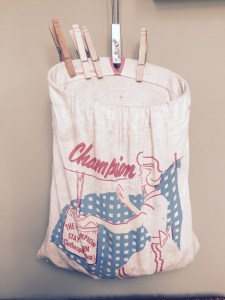
I hadn’t seen a clothes pin bag like this is decades. But, recently, in Sonoma of all places, in the laundry room of a little house my family had rented, I found this item from the past. It was identical to the one my mother used all through the 1960s.
It seemed to be just another part of the retro-nostalgia vibe of the décor. It took me back in time. Back to that little house on East Mitchell Street, where a Missouri farm family found their slice of the American Dream.
My mother used to wash our clothes in an electric wringer washing machine that was more wash tub than machine. I’m pretty sure my dad must have proudly ordered it back in the 1950s from the Montgomery Ward catalog to make life easier for his wife, our mother.
The modern feature was the wringer that squeezed the excess water out of the clothes to speed up the line drying.
I suppose it was a big step up from the washboard down by the stream, but it still required considerable manual labor.
One day, my mother absentmindedly fed some clothes through the wringer and got her left hand caught. I remember blood and crying and a bent wedding ring.
But, all in all, that was a minor event in the grand scheme of things. We knew more than one farmer who had lost a whole arm in a disagreement with a stubborn corn picker.
When it became apparent that the first location of the clothesline in the back yard was interfering with the natural layout of the whiffle ball diamond, my dad relocated the clothesline, even though uprooting and transplanting the poles amounted to considerable work.
Is it my imagination, but is there nothing like the smell of clothes dried on the line in the July Missouri sun? It’s a fragrance Proctor & Gamble can only wish they could duplicate.
Strategic brothers,
knew the key to a girl’s heart
involved a hot car.
Notes:
My father got in on the ground floor of the automobile revolution. He learned auto mechanics by hanging around the only garage in his small Missouri farm town. He cut his teeth fixing Ford Model Ts, and kept learning from there.
Although he spent years trying to make a living as a farmer, and then as a businessman, he ultimately returned to mechanic work. It was really his true calling.
He could fix things, and make them run. He didn’t buy new cars. He bought old cars in need of work and fixed them up.
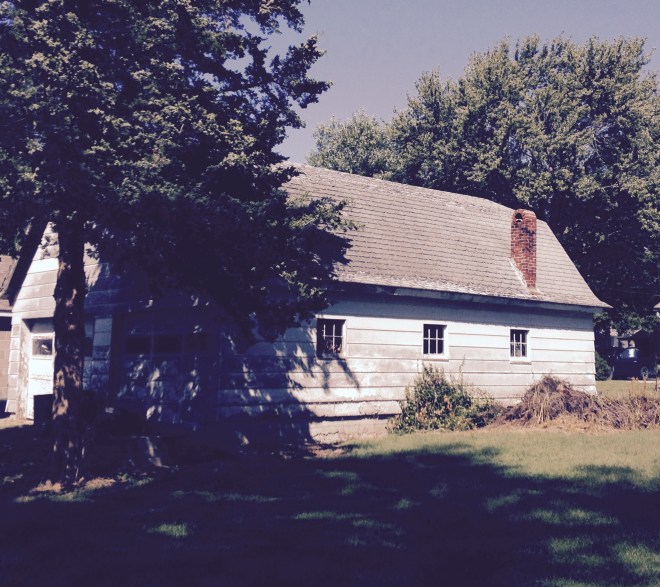
When it became clear to him that he was going to be a mechanic for the rest of his life he went out in his back yard, and proceeded to build himself a proper workspace. It looked just like a barn, because that is what he had built before during his days on the farm.
But he built it himself from scratch when he was well past 60 years old. Of course, he used reclaimed lumber scavenged from various tear-downs.
In his later years he ran a mechanic repair business out of his new garage. He was the only mechanic for miles around who would make house calls. The farmers all over Saline County knew that he could be depended on to fix their tractor, hay baler, or corn picker.
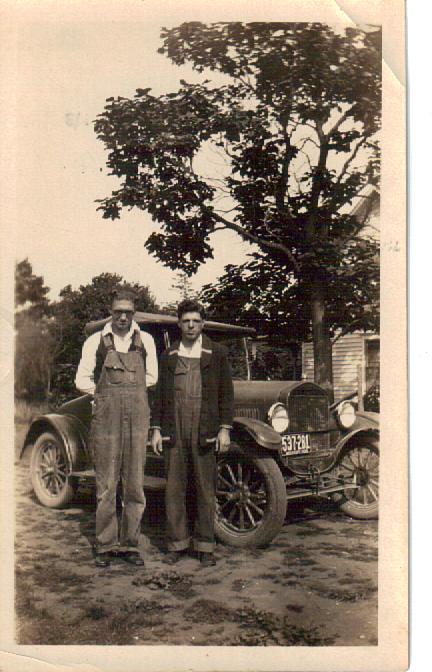
The photo at the top of this post shows my father, left, and his brother, Ralph, in front of one of the hot cars of the day.
The calloused farmer
cradles his newly born son,
awkwardly tender.
Notes:
I’m descended on both sides from dirt farmers. My father was a brilliant man, who didn’t have the opportunity to finish high school because he had to go to work to survive in the midst of the Great Depression.
I recall him telling stories of working for a dollar a day as a hired farm hand, performing such long-forgotten tasks as stripping bluegrass and threshing grain.
He had to lobby hard with his boss to get Saturday off to get married. His new father-in-law served the wedding guests watermelon. Mainly because he was a watermelon farmer and that was what he had on hand.
It was a brief honeymoon over in the nearest town, and then back to work on Monday.
My folks started having kids right away because if God blessed you with children, you were grateful.
This photo is my father with my oldest brother, John, back in May, 1934.
I’m re-blogging this one in honor of Father’s Day.
My town’s motto states:
“Smart dog, nice folks ….” Pretty sure
the dog, too, was nice.
The most famous resident of my hometown was a dog
When I moved to the central Missouri town of Marshall in the late 1950s, I was six years old. My father had literally sold the farm and was setting out on a bold attempt to pursue the American dream by going into the farm implement business. After spending the first six years of my life on a farm in northwest part of the state, Marshall, with its 12,000-plus inhabitants, seemed like a big city to me, full of potential and possibilities. For the first time in my life I had a room of my own and indoor plumbing.
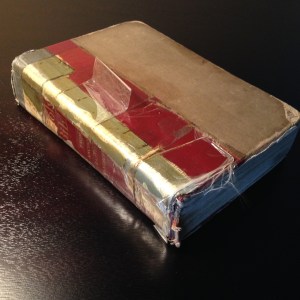
One of the first things I heard about my new hometown was that it was that it had been the home of Jim the Wonder Dog. It had been just a little over 20 years since Jim’s death, and many of my new neighbors had seen Jim while he was alive. Someone gave us a book about Jim, which I eagerly devoured. We were told to be sure and visit Jim’s grave out at the end of Yerby Street at Ridge Park Cemetery. He was the only animal buried in the human graveyard, we were told, and he deserved to be there more than a lot of the people, one added. We visited Jim’s grave with my mother, who brought flowers, because that’s what you did when you visited cemeteries in those days.
Everyone we talked to accepted the story of Jim at face value. To them, Jim had been a true walking miracle. He was a dog who could understand human speech, and follow instructions to the letter. But more than that, he knew things that humans could not possibly know. He was not only highly intelligent. Jim was also clairvoyant, we were told. Jim could predict the future. He could accurately predict the gender of babies before they were born and he knew who would win elections and sporting events.
To a six-year-old boy with an active imagination, this was a fascinating story. But I grew up and forgot about Jim. I went away to college, and started a career and a family, and got involved with my life.
Years later, I returned to Marshall, and I discovered that Jim was enjoying a revival of popularity. The Viking Hotel (formerly the Ruff Hotel) just off the town square, where Jim and his owner had lived, had burned down. A civic group had raised some money, and convinced the city fathers allow a memorial park to be created on the site.
Jim was becoming a full-fledged tourist attraction.
Then someone (bless their hearts!), persuaded the city to adopt a town motto. It reads, and I kid you not: “Smart dog, nice folks ….”
I admire the humility and sense of humor that animated that motto. It is in the same spirit that I wrote this little haiku.
Father, all I ask —
unbutton your coat, and warm
my toes on your skin.
This weary world is so cold,
and I am a trembling reed.
Notes on the form:
Tanka is a type of Japanese short poetry that some believe predates haiku. Rather than the three line 5/7/5 haiku for, tanka adds two more seven syllable lines to form a 5/7/5 7/7 pattern.
From what I can determine, the content tanka tends to be more personal than haiku. Some are even love notes passed between lovers. But many also express an appreciation of nature.
I chose the tanka form for this poem inspired by my own father, and written as a prayer.
Notes on the content: The example of a good father
I had the most excellent good fortune to have been blessed with a wonderful dad. Because of his example, I found it easy to comprehend the idea of God as a good and loving father.
One of my earliest memories goes back to a winter day when I must have been no more than 3 years old. Word came to our farmhouse on the party phone line that something strange had been found in a tree a couple of miles from our place.
We all bundled up and went to the scene. It seems that a large weather balloon had fallen back to earth and gotten snagged high up in the tree. It seemed to me that it took forever for the local high school-age farm lads to determine how best to climb the tree and free the object from its captor.
As the proceedings dragged on and on, I got colder and colder, and my feet were freezing. When I complained to my dad, he scooped me up, took off my socks and shoes, and stuck my tiny feet inside his coat and inside his shirt to warm them up.
A bit about my dad
He was a provider. He worked hard all his life to provide for his family the best way he knew how. In his youth during the Great Depression, working as a farmhand for a dollar a day (and glad to get it!) Then, after saving up, he bought his own 80 acre dirt farm, which he operated for many years.
I came along as a late child, as Mom and Dad were facing middle age. When I was young, he sold the farm, made the one big entrepreneurial move of his life, and bought a Ford Tractor dealership with a couple of partners. When that business ultimately failed, Dad kept one working, this time as a mechanic. Through hard times and disappointments, he just kept chopping wood, and doing the best he could.
He possessed a merry disposition, quick with a story or a quaint country expression. But he was capable of administering effective corporal punishment when required. His boys learned early on that he was not afraid to use his belt to emphasize a disciplinary point. I must say his spankings, while no fun, were short, undamaging, and few.
He was honest to a fault, even refusing to charge mark-ups on the parts he bought to use in repairing cars, trucks, and farm implements. Even though that was standard practice in auto and farm repair shops everywhere, it just didn’t seem right, he said, to take that money for nothing. It was known throughout the county that if Ray Ball couldn’t fix it, it couldn’t be fixed.
And in those rare cases when he could not get the tractor to run or the corn picker to pick, Dad wouldn’t charge the farmer anything at all.
An example as a husband
Dad was faithful to our mother throughout his life, and he clearly adored her. And when she declined in health past the point where he could care for her at home, he visited her in the nursing home every day, personally spoon feeding lunch to her.
Finally, Dad did his best to expose his four sons to faith and to the love of God as he had come to know it. He had seen his own father undergo a dramatic adult conversion, which resulted in a softening and sweetening in the disposition of my grandfather. This must have had an effect on my own father, because he was always a gentle and kind man.
Although my brothers and I all initially rejected the faith of our parents, at least some of us eventually came around. Dad passed away in 2000, but I would like to think that Dad would appreciate this little poem, if he were around to read it.





 Poetic Champions