Anniversary sonnet

Never a dull moment with you.

Familiar Ways

I choose to walk the old familiar ways,
To wend ways where I’ve put my foot before,
To gaze anew on views seen other days,
Which, though familiar, never seem to bore.

The changing light and seasons have their ways
Of making old things new: The light-laced hoar,
The first-flush, green-glow, bursting-forth spring days,
The growing tinge of gold we can’t ignore.

Each day, my dear, I choose afresh our trail,
The one we blazed so many years ago,
Eschewing other routes that might avail,
And hewing to the well-worn way we know.
Forsaking novelty need be no jail
With your face bathed in sunset’s golden glow.


NOTES:  Thirty-two years of marriage and never a dull moment.

Hometown haiku

Marshall, Missouri, 1968.
Courtesy of Susumu Wakana

Old streets remind me
I did not know compassion
when I walked them then.


NOTES: I have come into possession of a treasure trove of photos from the late 1960s taken by an old schoolmate, Susumu.  He was our Japanese foreign exchange student when I was a junior in high school in 1968 and 1969.

Across the years and across the internet, we reconnected and he sent me the photos he collected during his year in my hometown.

Susumu saw things through his camera lens that I had long forgotten.  These are shots I would never have thought to take.  Simple street scenes.  Iconic buildings long since torn down.  Teachers and friends long forgotten.

The gift of these photos is almost indescribable.  It is as though I am seeing my hometown again, for the first time.  I’m transported back nearly half a century to the place of my childhood, to the places where I lived my formative years.

No fancy Instagram filters are required.  These photos already have the faded Kodachrome quality you cannot fake.  They come with authentic poignancy.

These photos take me back to my youth.  And my heart is filled with questions.  What if?  If only?  Didn’t I realize?

Winter echo

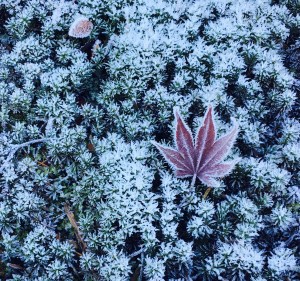
Hoarfrost

FROST IN MORNING

When the willow world is with hoarfrost hung,
And the white fog lifts leaving trees bright new,
The foliage flashes with a crystal clue
Of how the world looked when light first leaped young.

Before man’s weight and weakness had begun
To break the branch or bruise the sodden slough,
The garden grew unburdened, bathed in dew,
Grew like a canticle, perfectly sung.


NOTES: Many years ago and many miles away, I awoke one Minnesota winter morning to the most astounding display of hoarfrost I had ever seen.  The world was completely coated, clothed in white.

This was approximately 35  years ago.  Garrison Keillor was just getting traction with his Prairie Home Companion show.  He still had a day job on the local public radio station, and that morning, he celebrated the frosty morning by reading a poem.

I regret that I do not remember the name, or author of the poem he read that day.  Perhaps it could have been this poem, Hoarfrost and Fog, by Barton Sutter.  But I don’t think so.

It might have been his own work.  But his efforts inspired the modest 8 lines I’ve posted above.

This fall, I’ve been writing a lot about how the death of summer is a metaphor for the inevitable death we all as humans face.  This might be the single most-used image in all of literature.

Gerard Manley Hopkins wrote a marvelous poem along these lines, Spring and Fall.  It’s one of my most beloved poems of all time.

Hopkins also wrote a 2-part poem, The Leaden Echo and the Golden Echo, that gets at something even more.  The first part, The Leaden Echo, sets up the problem of the decline and decay of beauty.  It ends with despair.

But, in The Golden Echo, we come back to hope for redemption, for eternal life, and for the love of a Heavenly Father who restores.

“When the thing we forfeit is kept with fonder a care
Fonder a care kept than we could have kept it ….”

(For a real treat, listen to Richard Burton read this poem.  He reads poetry as it should be read, not with whiny, tinny detachment, but with passion.)

So, as I look at nature, there are signs of both despair and hope.   Leaden echoes and golden echoes alike.

When I see the world covered in frost, I think of a more perfect world.  A world like what may have been before sin and death entered into it.  Or the world that is to come.

Autumn haiku

Felled brances, fragrance of cedar
Autumn squall moves through
felling branches and needles.
Fragrance of cedar.


Cat haiku

Cat crouching in lush autumn grass
The grey cat crouches
in the lush October grass,
wary and alert.


Notes:

I’ve been a bit busy lately so this one is getting posted a few days after the photo was taken and the poem written.  But here in the Pacific Northwest, the grass stays green all winter, so that hasn’t changed much.  The grass is even greener now than in the peak of summer, when things often get a bit dry.

Funny thing, I can go for weeks without seeing a cat on my evening walks, but one day in October, it seemed like every cat in town was outside, either lurking in the foliage or dozing in the fast-departing patches of late afternoon sun.

They seemed to sense, like I, that the autumn rains would be coming soon.  We all were taking advantage of the last dry days of Indian Summer.


Halloween Haiku

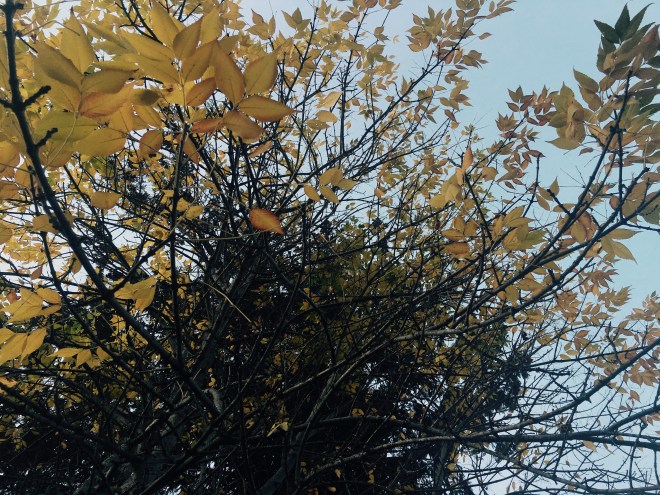
Ginkgo tree in autumn
The modest ginkgo
adorns herself in splendor
for All Hallows’ Eve.


Notes:

Growing up in Missouri, I don’t think I ever saw a ginkgo tree.  Now that I live in Washington state, I wouldn’t say they are common, but they pop up now and then.

Since I first noticed ginkgos, I thought they were exotic and different from other trees.  And, sure enough, the ginkgo biloba is the only living species of its biological family.  All the other ginkgo species are long extinct.

It’s also known as the maidenhair tree.  I’m not sure why, but it is a lovely tree with light green leaves in the summer.  It doesn’t really call attention to itself until the fall, when it turns a vivid gold.

They must be one of the toughest trees to kill.  Six ginkgo trees between 1 and 2 kilometers of the Hiroshima atomic bomb blast of 1945 are recorded to have survived.  While they were charred, they were soon growing and healthy.

Autumn haiku

Autumn sunset over the Olympic Mountains

The fragrance of leaves.
The chill that comes with evening.
Old wounds ache again.

Autumn haiku

Autumn leaves

I’ve never been one,
For wallowing in the past,
But, the falling leaves …

Autumn poem

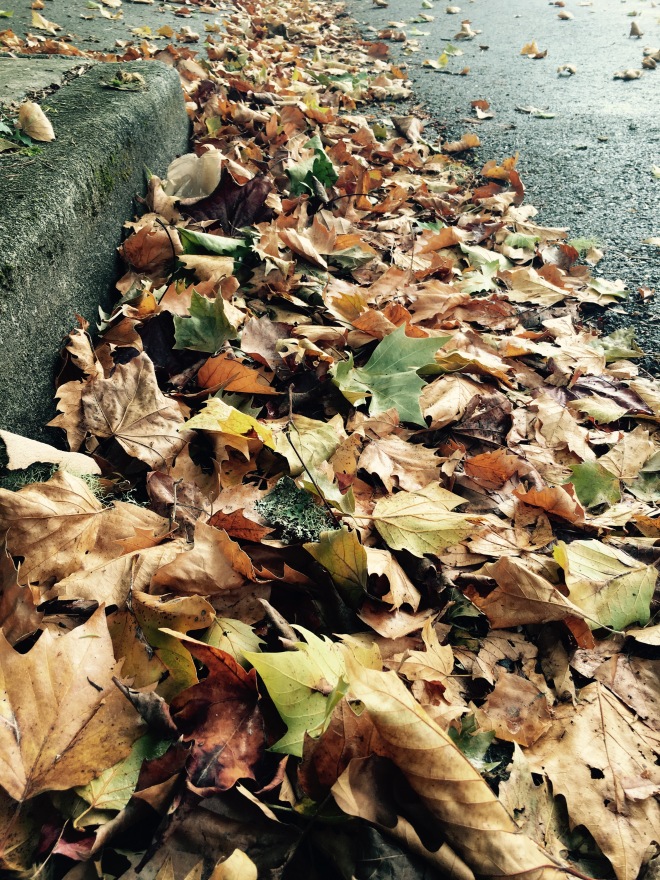
Autumn leaves in the gutter
Autumn Song

Afternoon in late September
Shows us signs we both can follow,
Shadows where there were no shadows
Days before, encroach on meadows,
Turning brittle brown and yellow.
Six o’clock’s a dying ember
Causing grown men to remember
Another fall’s disturbing echo.

When, unnoticed, fell the first leaves,
Yellow elm leave tired of sunshine?
Who suspected seeing such ease
When the first chill stunned the green vine?
Is embarrassment the reason
Sumac’s crimson hides its poison?
When was foliage last so supine?

Rainy night in mid-October
Brings the icy confirmation —
Twigs encased in shiny coffins
Clenched in cold that never softens.
Even daylight’s ministration
Alters no repose so sober
As the sleep of mid-October,
Sleep of spreading desolation.


Notes:  Written years ago and far away, when I lived in a much different climate.  My Puget Sound friends and neighbors might find it hard to relate to an autumn that leaves twigs encased in icy coffins, but my friends back in Minnesota understand all to well.

I recall one Halloween when my son and I set out at dusk to trick or treat in Minneapolis.  We made our way about two blocks as it began to snow hard, then harder.  We almost didn’t make it back home as we trudged through calf-deep drifts.

Autumn has its beauty.  “Every leaf is a flower,” is a beautiful sentiment.

Bit the fall is also one of God’s great metaphors.  And that makes it poignant, even as it is achingly beautiful.