Memento Mori Free Verse

Sappington Cemetery

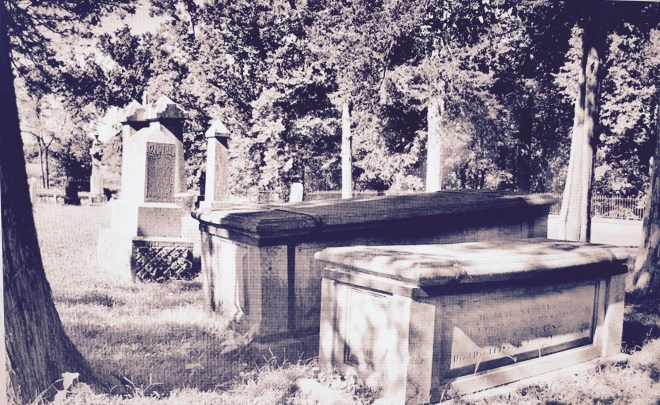
Old Cemetery

That day we ditched our duties at the music contest,
And drove to the old cemetery out by Arrow Rock,
The one with the mossy tombs above the ground,
Like down in New Orleans.
And it was even better because it was like we were playing hooky,
Only there were no classes,
Just that we’d volunteered to welcome the kids from other schools,
And help them find their rooms.
It was expected that we’d show up and do our civic duty,
But we figured they’d never notice we were missing.
We heard the call of other tunes,
And we had other demands that day to serve.
It was coming down one of those warm spring rains,
The air and everything was wet and willing,
It was the middle of the day but no one would be driving by,
And, even if they had, the old Ford’s windows were so fogged up
That no one could ever see what was going on inside.
In school, we’d learned how the doctor buried there
In the grandest tomb of all had made his fortune and his fame
selling quinine to cure malaria,
Made it possible for pioneers to settle in the boggy bottomlands,
And for America to finish where the French had failed
at digging the Panama Canal,
Opening up a passage that had never before been penetrated.
(In another class, we’d hear it wouldn’t be the last time
We would have to bail out the hapless Frenchmen.)
And though the aging tombs beckoned us to come and learn,
And contemplate the weakness of our flesh,
We’d have to take our teachers’ word for it.
That day we never got out of the car …
++++++it was raining so hard …
And we had other geography to explore,
And history of our own to write.


Notes:  Growing up in my Missouri hometown, I heard stories like this actually happened. This one may or may not be partly true.  Names have been redacted to protect the guilty.

The medieval Christian tradition had an ascetic practice called memento mori, meaning, “Remember that you will die.” The monk might keep some object, such as a skull, to remind him that life is transient, and that death is inevitable. The idea was to focus the soul on things that really mattered.

I’m not sure, but some of the poems I write might serve as my own personal memento mori.

Vanishing Act

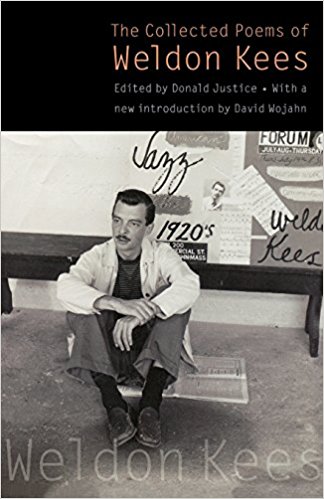
Unjustly overlooked poet Weldon Kees

Made another discovery recently, this one thanks to my old friend and schoolmate, the photographer and artist (and poet) John Marquand.

John turned me on to his favorite poet, Weldon Kees, an important, but overlooked poet from the last century. Kees really hasn’t gotten the attention his fans think he deserves, possibly because his output was small.

He was a modern day Renaissance Man, who in addition to writing poetry, was a novelist, short story writer, painter, literary critic, jazz pianist, and filmmaker.

Kees’ career was cut short when he disappeared in 1955 at age 41, a presumed suicide. His car was found near the approach to the Golden Gate Bridge, but his body was never found.

Kees captured the despair of modern urban life in the 20th Century, and expressed in fresh ways.

Perhaps the best examples of this is his series of four “Robinson” poems about an outwardly successful, but inwardly despairing modern man.

One of these is perhaps his mostly widely known poem, “Aspects of Robinson.” This essay by one of Kees’ champions, the poet Dana Gioia, gives a far better explanation of the poem than I ever could write.

If you’re interested in this sort of thing, it’s worth your time to read the whole essay, but I’ll include a tidbit:

“This poem demonstrates how Kees transformed the alienation and vacuity of contemporary life into lyric poetry. It does not offer readers comfort or escape. Kees did not transcend the problems of his century with a religious or a political faith. He did not elude the vulgarization of public culture by stealing away into an aesthetic realm. What he offered was uncompromising honesty, the transforming shock of recognition.” — Dana Gioia

It would very well be that the Kees’ uncompromising honesty combined with his inability to find redemption amidst a fallen culture finally led to his demise.

Some have speculated that Kees’ anti-hero, Robinson, was named after E.A. Robinson, the earlier American poet, who enjoyed a bit of a revival after Simon and Garfunkle adapted one of his poems into a famous song in the 1960s — “Richard Cory.”

There are certainly similarities between Kees’ Robinson, and Robinson’s Richard Corey.  But Kees’ Robinson is much more of a world-weary man of the mid-century.  Robinson’s Cory was a member of the sated upper class at the turn of the century.

More intriguing is the theory that Kees’ Robinson is really an aspect of the poet himself.


Inspirational Doggerel

False Hawaii missile attack alert

A wise man once opined
That nothing so focuses the mind
Quite as much as knowing
That you’ll be hanged in the morning.

And while that may be true,
That knowledge is not really new.
Another wise man said
Soon or late we all wind up dead.


NOTES:  I can’t imagine what it must have been like in Hawaii Saturday when the alert of an incoming ballistic missile was issued by mistake.  Hopefully, all of the sober reflection that occurred during those tense minutes will bear some positive fruit.


Full Moon Haiku

The Super Moon of 2017

Autumn’s last full moon
illuminates my night walk.
No fear of stumbling.


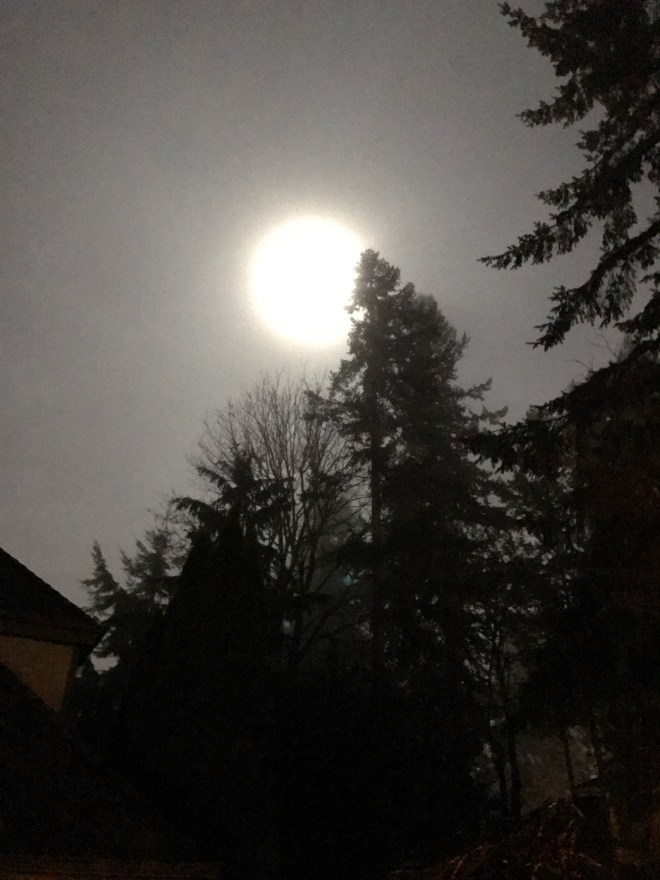
Notes:  The only supermoon of 2017 just happened Sunday night.  We had a bit of fog that — instead of obscuring the light of the moon — only amplified it.  It was so bright you could detect some colors.

Autumn Sonnet

Autumn scene

FALLING LEAVES LIKE LOVERS

The leaves, the leaves are gone except the oak,
Which cling to trees and rattle needlessly.
The others flame and fall for all to see.
They streak and sizzle, leaving only smoke.
But oak leaves hang as by some unseen yoke,
All browned and curled awaiting sympathy,
Or sap to course and lend vitality —
The leaves cannot perceive the sorry joke.
For spring will end the lie and they will drop,
To drift and rot and turn in time to dust.
As sure as buds will burst to make a crop
Of new, the old will flutter down — they must.
The falling leaves like lovers never stop.
It’s hardly gentle, but ’tis just, ’tis just.


NOTES: It was a mild and beautiful and extended autumn here in the Pacific Northwest, but the rains and winds have returned, knocking most of the remaining leaves off the trees over the Thanksgiving weekend.

Oak trees are not as plentiful here as they are back in the Midwest, where this poem was written some 35 years ago. But if there is an oak around, you can bet it will be hanging onto its leaves long after all the other trees have shed theirs.

Philosophy and Poetry

The poet in a philosophical mood

A Short Philosophical Love Note

Of what does missing consist?
(But first, know this, you are missed.)
It could be the lack of tender attack –
You see, I’ve missed getting kissed.

It might be like a disease
That only your treatment can ease.
The symptoms persist and although I resist
I wind up down on my knees.

It’s metaphysical tricks –
That’s strange, I know, but it sticks –
What else could explain the internal pain
When my heart my law contradicts.

It could be all in the mind,
If mental’s the way we’re designed.
But wishing you were does not make you here –
That’s truth of a different kind.

Who plumbs the depths of the soul?
And who knows the depth of the hole
Gouged when a lover heads for safe cover,
Exacting outrageous toll?


NOTES: When I headed off to college, my long-suffering father advised me to study “something practical.”  He suspected that I was likely to squander my opportunity at getting the education he never had the chance to acquire.

It might have been my hair, which had not been cut since the end of football season.  It might have been his knowledge that I was not the type of kid who listened to his elders.

So, of course, I went straight ahead and majored in philosophy with a minor in Greek and Latin.

And, also of course, the universe proved my father right.  Upon graduation I entered the job market and landed a coveted job as fry cook at a pancake house.

It was the only job I could get.

I had gravitated towards philosophy because I wanted to find answers to the big questions of life. I wanted to find Truth, Beauty and Love, and thought that philosophy was the route.

I didn’t find the answers I sought in philosophy. Instead, I grew weary of hairsplitting arguments and arcane debates about the meaning of language.

By my senior year, I was tired of the whole enterprise.

But I did find truth in a most unsuspected place. Not in the heavy and thick books of philosophical and impenetrable prose.  But in a dusty old Bible, the same Bible my father had been pointing me towards all my life.

Ironically, not only was my father right about studying something practical, he turned out to be right about where to find truth as well.

But off at college, I experienced my own personal John Newton/Saul of Tarsus moment.

Like the notorious English slave trader, I realized I had been blind about my own wretchedness.

Like the self-righteous Pharisee, I was knocked to the ground and scales fell from my eyes.

Like both of them, I was touched by grace and set on a new path with a completely fresh start.

After searching for truth in the ancient writings of Socrates and Plato, and seeking power in the seductive teachings of the East, I discovered that the truth I sought had been under my nose all the time.

But now that I had found truth, I still had to figure out what to do with my life. I was a decent short order cook, but I was pretty sure it wasn’t my calling.

I finally hit on the idea that I needed to do something that involved writing. And in those days in the afterglow of Watergate, this meant journalism.  So I went back to school to take just enough classes to land a newspaper job.

We all wanted to be the next Woodward and Bernstein.

I was delighted when I landed my first freelance stringer assignment. I drove to City Hall, spent 3 hours at a city council meeting, drove back home and then spent another 4 or 5 hours writing up as many stories as I could. The next morning, I drove the finished copy to the office.

I was delighted that for this they’d pay me a whole 15 bucks! And if one of the stories was decent, I might get a treasured byline.

What I didn’t realize was that the newspaper business had already started its long, slow decline. By the early 1980s, afternoon dailies were already going out of business all across the U.S.

Newsrooms were shrinking and it was tough to get on with a major metropolitan paper. And this was all before the internet cut the legs out from under newspapers’ business model.

Impatient with the career prospects at the big papers, I took a job as the editor of a financial newsletter.

(Had I been a better investigative journalist, I would have discovered that this publication had nothing to do with reporting objective truth. Instead, it was the front-end lead generator for a rare coin and precious metals dealer. It was really a direct marketing enterprise.)

But things worked out, and that first direct marketing job eventually led me to doing fundraising for good causes, which has been my career for the past quarter century.

But for several years — before I found the love of my life and the mother of my children — my love life followed the same tragic-comic early trajectory as my circuitous career path.

Full of false starts and spectacular missteps.

After one of these disasters, many years ago, I wrote the poem posted today.

It’s about the only thing I have to show today for my philosophy major.
Poem Against Alzheimer’s

My mom as a young mother

Ice Age

Dear gentle woman grown so early old,
You’ve all but left us on our lonesome own.
Now after many years to spirit sown,
A creeping glacier scrapes your memory cold.

You, greener days ago, recited verse,
And planted hardy seeds of simple song
That rooted deep, perennial and strong,
To flourish in the shadow of the hearse.

Today your weathered hands no longer know
The jonquil from the mum, nor how to weed.
Today you prattle on without the seed
Of sense, that for so long you toiled to grow.

So now for you I pick this small bouquet
Out of the garden patch you used to tend,
Now choked with worldly weeds from end to end,
In need of hands to cultivate its clay.


NOTES:  This month, my mother would have been 106 years old.  She died nearly 30 years ago, but she began to leave us several years before that as she fell under the spell of some type of dementia.

She was my first poetic champion, instilling a love for poetry from an early age.  This poem was written back when she was still alive, but unable to communicate with us.

So, let me say that I hate Alzheimer’s and all its ilk.

I recently paid the fee and spit in a test tube to have my DNA read by the smart folks at 23andme.  I learned that I do not have the classic Alzheimer’s gene, so there is some good news there.

But I am well aware that no man knows his time and we’re all going to die of something.

I had a brother who joked he wanted to die at age 100 being shot by a jealous husband.  He didn’t quite make it, though through no lack of effort on his part.

I can think of a lot of better ways to go than wasting away for years after having lost your mind.

Mother was forced to drop out of grade school when her mother died in a flu epidemic.  She was needed at home to care for her younger brothers and sister.

Her tastes were simple and traditional, with a leaning towards folksy American poets, like James Whitcomb Riley and St. Joseph’s own Eugene Field.  But she also like Robert Frost and Wordsworth.

We really only had one book of poetry in the house, a leather-bound volume entitled One Hundred and One Famous Poems, published in 1929. It contained remarkably robust collection of poems, and she read them aloud to me often.

There were selections from Shakespeare, Emerson, Poe, Kipling, Byron, Keats, and even Whitman.  In the back of the book were some bonus classics of English prose including the Gettysburg Address, the Magna Charta, the Ten Commandments, and the Declaration of Independence.

I daresay, I got a better education from that one book than I received in four years attending a semi-prestigious liberal arts college during the self-absorbed 1970s.

Eclipse Haiku

Day of the total eclipse

Fog, please go away.
(At least we won’t be tempted
to burn out our eyes.)


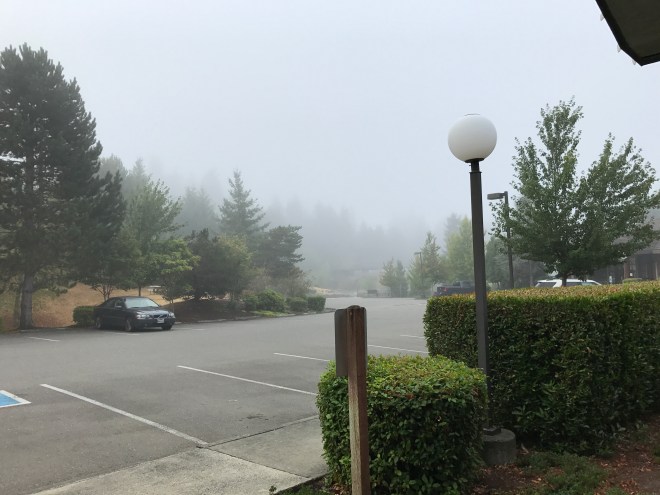
NOTES: It’ll be a close call whether or not we’ll be able to see the eclipse today on the Kitsap Peninsula.  The fog is expected to burn off and be gone just before — or after — the sun goes dark.


Grandfather Free Verse

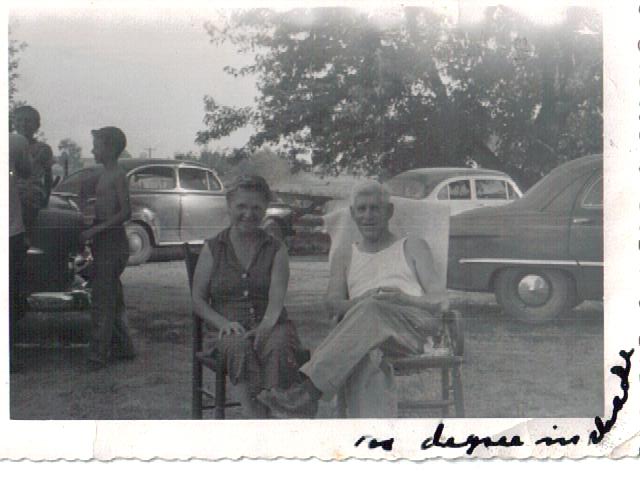
My paternal grandparents trying to stay cool during a brutal Missouri summer.
My paternal grandparents trying to stay cool during a brutal Missouri summer. The handwritten note says, “100 degrees in shade..”

The Day the Call Came

The day the call came
We had just dished up the ice cream.
A special treat for a Friday farm dinner,
(Not to be confused with supper.)
Mother had made it early that morning in ice cube trays.
“Freezer ice cream,” she called it,
Vanilla, made with Junket tablets to keep it creamy,
Even as it froze.
Not as good as the real, homemade ice cream cranked by hand,
But a whole lot easier.
And America was just starting its long affair with convenience.

The call came over the telephone
Mounted on the farmhouse wall.
With two bells for eyes,
You spoke into its honking, beaklike nose.
The earpiece cradled appropriately
Where the right ear should be,
While a hand crank made a poor excuse
For a drooping left ear.
It was a party line,
So the snoopy widow woman down the road
Knew as soon as we did.

The call came, and the man on the phone
Said Grandpa had just keeled over dead
At the auction over in Poosey.

So, we all got up—Mom, Dad, Big Brother and me,
And climbed into the ’50 Ford sedan
Dad was so proud to own.
The first car he’d ever bought brand new.

By the time we got to the auction –
It was a farm sale, really —
Where the worldly possessions of one farm family
Were being sold off.
One at a time.
By the hypnotically fast-talking auctioneer.
Not as depressing as the foreclosure sales
That were all too common
Just a few years before in the Depression.
This was a voluntary sale,
But a little sad nonetheless.

Some farmer was getting too old to run the place,
And didn’t have kids—or leastwise kids who wanted to farm.
A lot of boys joined the service in those days,
Or headed to Kansas City to find work, and a little excitement,
Rather than stay and try to coax a living
Out of that hilly, rocky dirt.

The man at the auction told us
Grandpa had been standing there in the sun with everybody else.
They were just about to start the bidding on the John Deere hay rake
When he grabbed his chest and fell right over.

Years later, they told me when he was a grown man
Grandpa had gone down to the river,
And been baptized, and filled with the Holy Ghost,
With the evidence of no longer speaking in profane tongues.
For, it was well known Grandpa had been gifted
In the art of colorful language.
“He used to could cuss by note,” was how Mother put it.
But after the washing with water and the Word,
Grandpa was never heard to swear again.
I only knew him as a white-haired old man
With a merry smile, and infinite patience
With Grandma, who required it.

And that was it, really.
Nothing more to say,
Except for the understated condolences
Of the country folk.
Nothing more to do,
Except for my father,
Now lately promoted to the role of the family elder,
Who assumed the duties and made the necessary arrangements.
Although I didn’t know quite what had happened,
I felt a lurch … as something shifted beneath me …
And I was yanked one more notch forward.

By the time we got back to the house,
The ice cream had long since melted
And now was returning back to solid state,
As it curdled in the September heat.


NOTES:  I got the news this week that a friend’s grandfather had passed away. This death was expected, and from all reports, merciful in coming. But there is still grieving to be done and respects to be paid. You can be happy your loved one is no longer suffering, but terribly sad that they’re gone.

This all got me thinking about my own grandfather, and day close to 60 years ago, and a bit of a poem I wrote about that day as best as I could recall it. It seemed fitting to haul this out of the vault, dust it off and publish it again.

Back in the 1950s on the farm, we didn’t have air conditioning. Shoot, we had just gotten electricity a few years before.

So when the long Missouri summers dragged on and the humidity rose, folks headed outdoors to keep cool. When the nights were really hot, we’d sleep outdoors.

The poem is about a day pretty much like the one documented in this photo. In fact, the events took place not too many days after this photo was shot.

A Delightful Discovery

Just yesterday, I published my little sonnet, “Late Summer Sun” in this blog.  This morning as I was reading the wonderful book, “The Wild Braid,” by Stanley Kunitz.

When I came to his poem “Touch Me,” I had to pause.  This poem seemed to be hitting some of same notes.  Much deeper, but with little glimpses of the same melody.

The two poems are very different on the surface — mine is a sonnet, his is free verse.  He makes different observations about nature.

But the season is the same — late summer.  And there is something similar in the underlying emotion. Here’s his poem:

Touch Me
–Stanley Kunitz

Summer is late, my heart.
Words plucked out of the air
some forty years ago
when I was wild with love
and torn almost in two
scatter like leaves this night
of whistling wind and rain.
It is my heart that’s late,
it is my song that’s flown.
Outdoors all afternoon
under a gunmetal sky
staking my garden down,
I kneeled to the crickets trilling
underfoot as if about
to burst from their crusty shells;
and like a child again
marveled to hear so clear
and brave a music pour
from such a small machine.
What makes the engine go?
Desire, desire, desire.
The longing for the dance
stirs in the buried life.
One season only,
++++++++++++++ and it’s done.
So let the battered old willow
thrash against the windowpanes
and the house timbers creak.
Darling, do you remember
the man you married? Touch me,
remind me who I am.