Honeymoon sonnet

Honeymoon epiphany

Epiphanies

We come now to the winter of our years
(Where did the autumn with its pleasures go?)
Our roof will all too soon be cloaked with snow,
So, come, let’s stoke our fire against the fears.

It seems another life ago, my dear,
That full of grace you pilgrim sat aglow
Enkindled so this prodigal would know
That grace was free and grace was very near.

Midsummer’s eve brought more epiphanies
Of spotless bride adorned, redeemed, in white,
Too ill for customary liberties,
So wan, yet still for these sore eyes a sight.
Then! Over Lake Champlain the full moon sees
A railway sleeper car rock through the night.


(2013)

Notes:

When love is good and it lasts, it can be tempting to idealize its beginnings.

But, the very first time I saw my wife, she was glowing. I kid you not. Sitting in the second row of a darkened auditorium listening to the Chaplain of the U.S. Senate, there she was — surrounded by a golden aura.

At the time, I was a reporter for a small suburban weekly paper, and was there on assignment. I had a camera, but was so befuddled I failed to get the shot. (Of the Glowing Girl, that is.) You might argue I was imagining things, but I don’t think so. I’m not given to visions nor hallucinations. I’ve never witnessed anything like it before or since.

I kept my eye on her while I got my story. But at the end of the program, she went right up to the speaker. I figured she must be with the group of important people who had accompanied him from Washington, D.C.

So, I put The Glowing Girl out of mind and tried to forget about her.

Fortunately for me, she turned up again a couple of weeks later at church. It turns out she was a friend of a friend, who introduced us and immediately left us alone. I didn’t let her get away a second time.

I think the whole experience was a special gift for a fellow a bit slow on the uptake, who needed a sign to notice a good thing right under my nose.

That’s my story and I’m sticking to it.

We were married three years later at Midsummer. She was sick and only made it through the festivities with the help of cold medicine. The next morning we flew out of town to New York, and the very next night, took an overnight train to Montreal.

I’ve been a fan of railway travel ever since.

Paradise Sonnet

Our paradise is something less instead

Our Paradise

Wafting comes the mower’s comforting hum,
Assuring all is just as it should be.
Our gates and fences all are rightly plumb,
We celebrate our capability.

New curbs and gutters sluice away wild rain,
Alarms and locks protect our doors from breach,
Our lives arranged to minimize our pain,
Designed to keep us safely out of reach.

But wreaking roots upheave the sidewalk path,
And worms devour our precious woolen thread,
The black and red mold creep into our bath,
Insomnia disturbs our peace in bed.
Despite our engineering and our math,
Our paradise is something less instead.

(2016)


Notes:   Summer-ish weather has come to the Pacific Northwest.  It seems fitting to haul out this old sonnet.

Don’t get me wrong.  I appreciate material comforts and modern conveniences.  Probably even more than most of my friends and colleagues.

I was born in the middle of the last century, and started out life on a farm that was primitive, even for that time.

How primitive?  Well, we milked our own cow, raised our own chickens for eggs, butchered our own hogs, and raised our own vegetables in the garden.

For special occasions and Sunday dinners, Mother would grab one of the slower chickens, chop off its head, and fry it up.

When we sold our farm to the Amish, they took one look at the house, and commenced on an immediate upgrading and remodeling project.

As for me, I was delighted in my new home in a Missouri farm town of 12 thousand souls.  For the first time in my life I had my own room, central heat, and indoor plumbing.

I could finally take a bath in something that wasn’t a galvanized wash tub in the middle of the kitchen floor.  In freshly drawn water that hadn’t been previously used by other members of the family.

I thought I’d died and gone to heaven.  I didn’t even notice that we didn’t have air conditioning, even when the Missouri summer visited its oppressive humidity and triple-digit heat upon us.

So, I am thankful for many things.  I am certainly grateful for indoor plumbing and running water. I am so  thankful I can enjoy sardines from Norway and wine from France.

I am grateful for antibiotics, and the miracles of modern medicine.  I missed the polio epidemic, but just barely.  Had I been just a couple of years older, I could have suffered withered limbs or worse, like the older brothers and sisters of some of my friends who were not so fortunate.

All of my ancestors as far back as I can research were dirt farmers.  I am grateful for a professional job in a meaningful enterprise.  (Inside work.  No heavy lifting.)

Many years ago, when I moved out to Seattle, we settled in the suburbs because — even then — the city was too expensive.  We made a serendipitous choice, because our little suburb has become a highly desirable place for Microsoft employees coming here to live from all over the world.

Heck, in one of those specious magazine “Top 15” lists, our little suburb was once ranked the “Most Friendly Town in America.”

Crime is low.  Violent crime is virtually non-existent.  The weather is temperate.  People take care of their property.  Unemployment is not really an issue. People of seemingly every tribe and tongue live side-by-side here in peace.  You can walk or jog without fear.

Pinch me because sometimes I start to fool myself into thinking we live in paradise.

Yet, it is good to remember that even heaven on earth is not really heaven.

Just a Little Lumberjack Love Poem

Don't shield your limbs below nor lips above

LUMBERJACK LOVE

Though I am not a bearded man nor burly,
I love you with a lumberjack-type love.
The only axe I take in hand securely,
This meager pen across the page I shove.

Please treat me not so fickle nor so surly,
Don’t shield your limbs below nor lips above.
I aim to fell you skillfully and purely;
Each word’s to chip the bark around your love.


(1982)

NOTES: Van Morrison said, “I got hit by a bow and arrow, got me down to the very marrow.” John Lee Hooker said, “Baby please don’t go.”  The Bee Gees, said, “It’s only words, and words are all I have to take your heart away.”

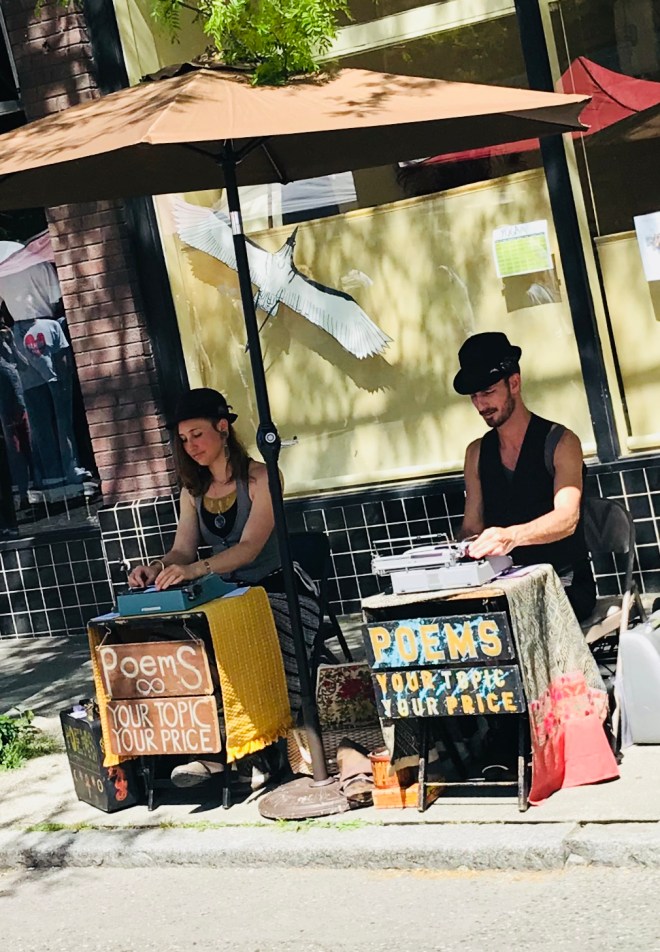
POEMS — Your Topic. Your Price.

Street scene at the Ballad Market

This whimsical scene at Seattle’s Ballard Market the other day made me smile. This pair of poetical hustlers are bittersweet reminders of the plight of poets everywhere.

They brought to mind the funny (but not-too-funny) little poem by Hayden Carruth, written when he was studying and writing about the Japanese haiku master, Basho, who lived and wrote in the late 1600s.

Basho, you made
a living writing haiku?
Wow! Way to go, man.

This pair at the market did not appear to be doing much business, but they were earnest and eager, and I wish them the best.

Poem for Flower Time

I kissed you first in tulip time

Flower Time

I saw you first in jonquil time,
When you were bathed in grace.
You sat aglow with fire sublime,
And golden shone your face.

I loved you first in lilac time.
A bloom I plucked for you.
I wrote you verse with song and rhyme.
I hoped you loved me too.

I kissed you first in tulip time,
It must have been a sign.
The buds and we were in our prime
When your two lips met mine.

I married you in daisy time
On summer’s longest day.
We traded rings and heard bells chime.
We pledged always to stay.

Too soon we’ve come to aster time.
The days are shorter now.
Would stealing some be such a crime?
We’ll make it right somehow.

Should we endure ’til wintertime,
The time when flowers sleep,
Dreams we’ll share of a gentler clime
Where we no more shall weep.


Notes:  A bit of controversy arose when I last posted this poem.  The object of this verse pointed out to me that tulip time generally comes before lilac time, and thus the poem was out of chronological order.

My appeal to poetic license did not, I feel, fully satisfy her.  But I have resisted the pressure to revise the poem to make it more consistent to botanical facts.  That’s because my recollection of the events of so many years ago was that I was completely and hopelessly in love before the first kiss.

Sometimes we should not allow the facts to get in the way of a good story.

And I did stop by the roadside and pick some lilacs for our first date.

(2016)

Madeleine L’Engle, also a Poet

Madeleine L'Engle and

With the release of the new move, “A Wrinkle in Time,” writer Madeleine L’Engle has come back into the cultural consciousness. Her Newbery award-winning book was first published when I was at an impressionable age, and helped fuel both my imagination and love of reading.

I haven’t seen the movie, but I understand that despite a strong cast headed by Oprah Winfrey, it is not doing particularly well at the box office. As I write this it has a long way to go to earn back the more than $100 million it took to produce.

L’Engle’s book was criticized for its liberal treatment of religious themes back in the 1960s. Ironically, this year’s movie has been criticized for not sticking closely enough to the book and watering it down its Christian references even further.

But I digress.

Today, in one of my used bookstore haunts, I was intrigued to discover a slender book of verse by L’Engle, entitled “The Weather of the Heart.” I hadn’t realized she also had written poetry.

And what a discovery! Chock full of verse about wonder and love and death and faith.

But the one that really jumped out at me was all too human, and startling in its honesty. Written to her husband while they were apart, it recounted an affair averted. It’s hard to say just how close she came, but because the poem is so honest, it results in a reaffirmation and celebration of fidelity.

It helps to understand the poem to know that L’Engle’s husband, Hugh Franklin, was a stage and television actor.

L’Engle’s poem doesn’t seem to be published on the internet, so I will set it down for you here. It is inspiring on many levels.

Lovers Apart

In what, love, does fidelity consist?
I will be true to you of course.
My body’s needs I can resist,
Come back to you without remorse.

And you, behind the footlight’s lure,
Kissing an actress on the stage,
Will leave her presence there, I’m sure,
As I my people on the page.

And yet–I love you, darling, yet
I sat with someone at a table
And gloried in our minds that met
As sometimes stranger’ minds are able

To leap the bounds of times and spaces
And find, in sharing wine and bread
And light in one another’s faces
And in the words that each has said

An intercourse so intimate
It shook me deeply, to the core,
I said good-night, for it was late,
We parted at my hotel door

And I went in, turned down the bed
And took my bath and thought of you
Leaving the theatre with light tread
And going off, as you should do,

To rest, relax, and eat and talk–
And I lie there and wonder who
Will wander with you as you walk
and what you both will say and do …

We may not love in emptiness,
We married in a peopled place;
The vows we made enrich and bless
The smile on every stranger’s face.

And all the years that we have spent
Give the joy that makes me able
To love and laugh with sacrament
Across a strange and distant table.

No matter where I am, you are,
We two are one and bread is broken
And laughter shared both near and far
Deepens the promises once spoken

And strengthens our fidelity
Although I cannot tell you how,
But I rejoice in mystery
And rest upon our marriage vow.

Poetry Month, Continued …

Oyster.shell

As the Oyster Forms the Pearl

As the oyster forms the pearl,
So the poet pens the verse
As balm for the current ache
Born out of the ancient curse.

As the oyster feels compelled
To shellac the sandy grain,
So the poet feels the urge
To transmogrify the pain.

So the pearl grows rich and round
As its luster covers the sand.
So the verse unseen takes form
In its way, designed unplanned.

Sad the pearl that lies unseen
In the depths of the murky sea.
Sad the verse that dies unheard
In the heart clandestinely.

So the diver frees the pearl,
Breaks the stony shell apart.
So the poet frees the verse
Ripped out of his broken heart.


NOTES:  Apparently there is some skepticism about my assertion that April is Poetry Month.

Let this settle the matter once and for all.

Let’s call this one an extended metaphor.

Something We Can All Relate To

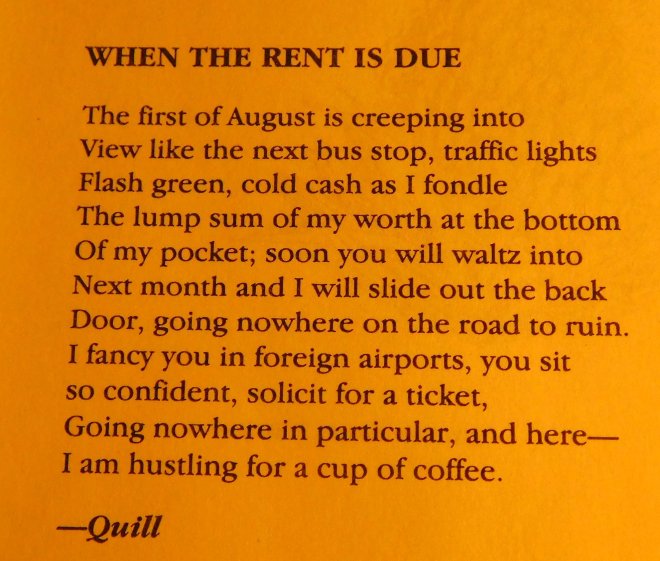
When the Rent is Due by John Marquand

My friend and schoolmate, John Marquand, was writing poems before I knew what to do with a pencil. While I was playing football, Johnny was putting his heart on paper and getting published.

Our senior high English teacher saw his potential and submitted some of John’s poems to a magazine that published the best of Missouri high school poetry.  He got three poems accepted, including one on the cover.

He went off to the University of Missouri, where he took some writing classes, and met some real, live poets.  He was influenced by Weldon Kees, an undervalued and underappreciated poet from the 20th Century.

I got to read a few of his poems when we were back in school together.  They inspired me even then.

While John is now concentrating on nature photography, he is still a poet at heart.

His pen name is Quill.  He’s got a bit of Weldon Kees in him.  But he is his own poet.

Poem in protest of spring

Late snowfall

COME GENTLE SNOW

Come gentle snow and cloak the ground,
Shroud budding branches all around,
Let not one scent of spring be found,
Make flowers wait.

Come frost and freeze the throbbing juice,
Break March’s short and shaky truce,
No sprout nor songbird yet aloose,
Let spring be late.

Come wind and make the oak leaves hiss,
When they descend no one will miss
Their brittle shade — no artifice
Can bring them back.

Come night and steal the season’s gain;
The verdure will begin to wane
Despite the wealth of easy rain
If it stays black.

Come sleep and shield me from the past,
Help me forget her I loved last,
Wrap safely me in sanctums vast,
Away from pain.


NOTES: We haven’t had that wonderful March snowstorm here in Western Washington yet this year.  So I’ll have to settle for a photo from last year.

We had some snow in late February, but I’m still pulling for a blizzard in March.

You see, I’m allergic to March here — the alder and cedar pollen are not kind to me.

Nearly 40 years ago when I wrote this poem protesting spring, I was an unrequited, tragic romantic. O woe was me!  I thought I’d never be happy again.  Of course, I was wrong.

If I can just make it through March to April, I should be fine.