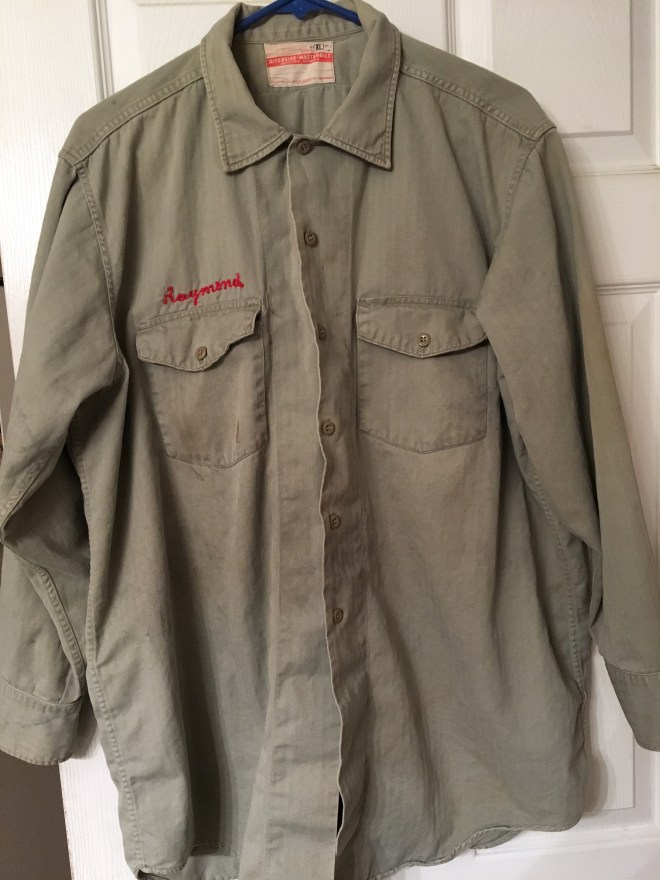
Greased-stained forever,
Dad’s shirt bore proof of hard work,
and so did his hands.
NOTES: Dad was a son of the Great Depression, accustomed to hard work. He didn’t have the chance to finish high school due to the need to find work to contribute to the family. The work available was farm hand labor at a dollar a day. Hoeing beans, putting up hay, stripping blue grass. Good money if you could get it.
Too young for World War I, he got a pass for World War II because by that time he was the only adult male on his own farm. The idea was to keep all the farms operating to provide for the war effort. So while all 4 of his brothers-in-law went off to fight, Dad stayed home growing corn and soybeans and producing eggs and milk.
In the post-war prosperity, Dad prospered and saved his money. Finally, in the late 1950s, he made the one big entrepreneurial move of his life, sold the farm, and went into the farm implement business.
We moved from the farm to the farm town of Marshall, got a house with indoor plumbing and central heat.
Things went fine for a few years, but then something happened. I was young and didn’t get the full story. But either through some poor marketing decisions, or through some financial shenanigans by a partner, the business went into debt and had to be sold.
It was a defeat for Dad, but he didn’t let it defeat him. He landed a job in the shop at Reeder Auto Parts. It had to be tough going from the boss to being an employee again, but Dad never complained.
He just showed up everyday and kept chopping wood to do what it took to pay the mortgage and keep hamburger on the table. I recall a time when I was whining about needing a few dollars to buy some knickknack or the other.
My older brother Larry took me aside and gave me the older brother admonishment. “Shut up and quit bothering Dad,” he said. “Don’t you realize we could lose the house?”
I had no idea.
But, Dad kept working away. Mom got a job baking pies at the MFA Grocery Story and we didn’t lose the house.
Let it be said that Dad was a master mechanic. He made things work. He also was perpetually marinated in grease and gasoline.
He would clean his hands with Goop grease cutter and then wash his hands with Lava soap. But they never really got truly clean.
When I hung out with him I usually got the job of cleaning parts in gasoline. I grew to hate the smell, and my mechanical ability has suffered accordingly.
He eventually went on to establish a freelance mechanic business. He primarily served the farmers around Marshall, making house calls to repair balky tractors, combines, corn pickers, and hay balers right where they died out in the fields.
His services were in demand, and he had all the work he wanted. Sometime the farmers would pay him in produce. Like the old German farmer Ludwig who sent Dad home with a quart jar of canned horseradish.
As the family story went, brother Larry returned home late one night scrounging around in the refrigerator for something to eat. Seeing a jar of something that looked like gravy, he unscrewed the lid and took a big snort.
Farmer Ludwig’s horseradish nearly blew the top of his head off.
The haiku master
explicated his own work.
So I could do worse.
NOTES: You could get the idea in sophisticated poetry circles, that it’s low-rent to indulge in writing poetry about yourself or discussing your own work.
You can almost hear a schoolmarmish voice laying out the ground rules.
“Best to write about concept and ideas, and always with an ironic detachment lest you should be accused of wallowing in sentimentality.
“Do not indulge in personal poetry. And, whatever you do, be sure to let the poem speak for itself. Don’t commit the sin of talking about your work or trying to explain what it means. The work is what it is, and it means what it means to the reader.”
Well, I say hogwash to all that.
And my first expert witness is none other than Matsuo Basho, the 17th century haiku master.
Like every fan of haiku, I had read Basho’s poems, but I couldn’t say that I had really gotten to know Basho until I stumbled across his travel diaries.
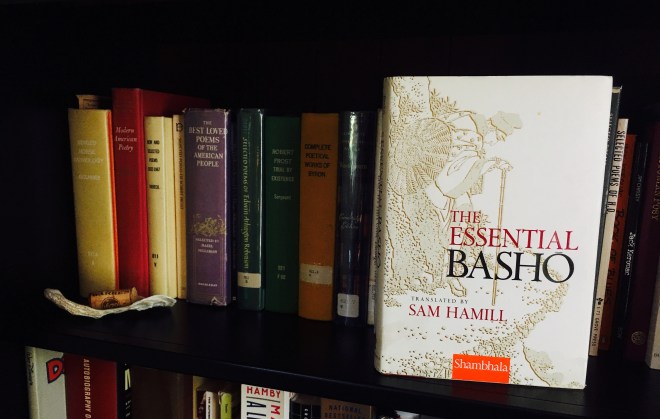
If I have some free time on a weekend, one of my favorite pastimes is to duck into our local used bookstore to see what new poetry books have trickled in. A couple of weeks ago, I spotted “The Essential Basho” translated by Sam Hamill.
After thumbing through a few pages, I knew I had to have it.
What I learned was that Basho made several walking journeys around Japan in the 1600s. Often accompanied by a student, he walked from town to town seeking out shrines and temples, natural landmarks, and other artistic souls along the way.
And as he went he not only wrote haiku, but he kept a journal. He would explain where he was and what he was seeing as he wrote his poetry.
Sometimes he would quote an ancient poem written about the same view he was seeing. Sometimes he would write his own poem. But sometimes he would humbly decline to add anymore.
Basho hired a boat at a town called Yoshizaki so he could sail out to see the famous pine trees at Shiogoshi. He was well aware of the poem written some 500 years before by Saigyo.
All the long night
salt-winds drive
storm-tossed waves
and moonlight drips
through Shiogoshi pines.
Basho declined to write a poem of his own.
“This one poem says enough,” Basho wrote. “To add another would be like adding a sixth finger to a hand.”
But, when he does write his own poems, Basho often provides the setting to give the reader enough context to better understand the meaning.
For example, when he writes this haiku, it is possible to get a feel for what is going on from just the text itself:
If’ I’d walked Walking-
stick Pass, I’d not have fallen
from my horse.
But it means much more when you read Basho’s explanation.
“They say the ancient poet Sogi nearly starved to death in the high village of Hinaga,” Basho wrote. “I hired a horse to help me over Walking-stick Pass. Unfamiliar with horses and tack, both saddle and rider took a tumble.”
In other cases, without the poet’s explanation, you won’t really understand the poem at all.
On the second day,
I’ll rise early to welcome
the oncoming spring.
On the surface, this seems like a sentimental, but shallow little seasonal poem. But when you read Basho’s context, it becomes a much more interesting and humorous glimpse into his soul.
“Reluctant to see the year-end,” Basho wrote, “I drank until well past midnight on New Year’s Eve, only to sleep through the morning on New Year’s Day.”
It turns out Basho missed the first morning of the new year because he was hung-over.
If he had been alive today, I’m pretty sure Basho would have been a blogger. I’m happy he left behind his journals to help us understand his work.
With such an illustrious example as his, I resolve to be less sheepish about providing commentary on my own poetry.
Just miles south of town
missiles waited in silos,
hell in a cornfield.
NOTES: In the early 1960s, we began hearing talk of the government planning to put missiles in underground silos in our part of the country. Sure enough, Minuteman sites began to appear in fields across west-central Missouri.
The silos weren’t advertised, but they were not hidden either. There was one clearly visible from the main highway south of town. Many others were scattered about the surrounding countryside, both in our Saline County and in neighboring counties.
The Minutemen were intercontinental ballistic missiles with nuclear warheads. They burned solid fuel, which allowed for much faster launches than the older, liquid-fuel missiles.
The idea was deterrence. Our missiles were able to target Soviet cities, which would discourage them from initiating an attack on the United States. They had missiles pointing at us. We hoped nobody blinked.
It was vaguely unsettling to know that we had nuclear missiles located so close. But, I was just a grade school kid, and didn’t think too much about such things.
A few years later, when I was in high school, talk started about upping the ante and locating anti-ballistic missiles (ABMs) nearby. These were defensive weapons, designed to shoot down incoming ICBMs from the other side.
I read a couple of articles, believed myself to be an expert, and declared my opposition to the ABMs. If I remember correctly, the nationwide high school debate topic was about the ABM issue.
I really didn’t know what I was talking about. My big argument was that having ABMs located close to our homes would make us a primary target. I remember having no real answer when a classmate’s big brother, who attended the Naval Academy, pointed out that we were already targets because of the Minuteman missile installations. Having ABMs nearby, he said, would at least give us a chance to shoot down the Russian missiles headed for us.
The Minuteman missiles stood on guard until 1991, when then President George H.W. Bush ordered them off alert status. Under the terms of the START I treaty, the missiles were removed and the silos destroyed a few years later.
In hindsight, the Minutemen seemed to have done their job. The Russians never attacked. The inherent weakness of the Soviet Communist system gradually became more and more evident as their economy crumbled.
In 1989, Mr. Gorbachev did indeed “tear down this wall,” as Ronald Reagan demanded. Or at least the Soviet leader allowed East Germans to tear down the Berlin Wall themselves. And then we saw the Soviet empire collapse.
China essentially gave up on Communism around the same time, when its leaders realized that if they wanted to make money, they had to harness the power of markets.
Today we see Venezuela teetering on chaos as its experiment with socialism goes up in smoke. Cuba still soldiers on under the heel of the second-string Castro, yearning for the day when real freedom returns.
Of course North Korea continues to keeps the flame alive for all those who dream of establishing a world-wide Worker’s Paradise. It’s our best example of what happens when Communism reaches full flower.
It seems fitting on May Day to pause and think on these things.
Dear upperclassmen,
we idolized you so much,
you were like heroes.
Then, that class trip fiasco,
And class trips were abolished.
NOTES: The class ahead of us in high school was impressive. It included some very smart and talented people who challenged and inspired us underclassmen.
Counted among its members were some of the best athletes, actors, debaters, musicians and scholars ever to come out of our little Missouri town of Marshall. When they went away to college in the fall of 1969, they returned on their breaks with fascinating stories of life at their campuses.
I paid close attention to their testimonials, and followed a couple of them when it came time to make my own college choice.
The class of 1969 certainly went out with a bang. Our high school had long had a tradition of the senior class trip, which involved a long trek to some exotic destination far enough away to make getting there grueling and sleep-deprived.
That year the seniors made the long bus ride to Six Flags Over Texas. But during the course of that journey, something happened.
The stories we heard were somewhat hushed and confusing, but whatever happened was so serious that school officials cancelled senior trips forevermore.
The next year, there was not even a discussion about our own class taking a senior trip. Not. A. Chance.
The Class of ’69 was already notable in that it had voted to abolish the venerable tradition of selecting the most popular and respected girl to preside over Achievement Night as Miss Fair Marshall.
Now, our heroes had managed to put the kibosh on another tradition. In a way it enhanced the reputation of the Class of ’69 even further. In addition to all their other superlatives, they had also become the Biggest Screw-Ups.
I’m hoping some of my old schoolmates from the Class of ’69 might finally come forward with the true story of what transpired on that notorious trip. Why don’t you just come clean? Confession is good for the soul and the statute of limitations on your crimes certainly has expired.
Some members of my own class are still a bit aggrieved that we didn’t get to have our senior trip because of you.
It would be good to be able to put the scurrilous rumors to rest, and to finally forgive and forget.
STYLE NOTE: Like haiku, the tanka is a traditional Japanese short poem form with a prescribed number of syllables. The pattern is 5-7-5-7-7.
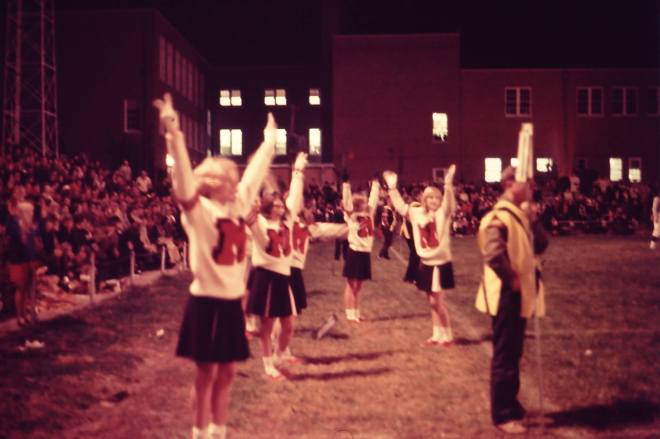
Unattainable,
cheerleaders stirred crowds and our
imaginations
NOTES: Here’s another invaluable photograph from my friend, Susumu. This must have been taken in the fall of 1968, amidst an exciting small town high school football season.
It most certainly was an away game. The home games of the Marshall High School Owls were played at Missouri Valley College’s Gregg-Mitchell Field, and this setting does not look familiar. I’m guessing it might have been the away game that year at the home field of our most hated rival, the Excelsior Springs Tigers.
Marshall had been playing second fiddle to the Tigers for several years, just unable to put together enough power to overcome dislodge them from the top of the Missouri River Valley Conference.
The year before, we had endured a humiliating defeat as the Tigers came into our stadium and beat us on a frigid night in Marshall. Those old aluminum benches had never felt so cold.
This year turned out much better. Coach Cecil Naylor had us worked into such a frenzy that we could have taken on a band of Viking berserkers. We travelled into the Tigers’ home turf, took care of business, and vanquished them 20 to 0.
But I digress.
The topic is cheerleaders. What is with their mystique? And why couldn’t they get a date with their own classmates?
I could be misremembering, but it seemed that very few cheerleaders ever dated guys in their own class. Older guys might work up the confidence to “date down” with a cheerleader from lower grade. But mating between cheerleaders and a classmate was scare and rare.
One of life’s great mysteries. The Cheerleader Paradox.
Mysterious even when you factor in the fact that in our little town, many of us had attended school together since first grade, and the rest of us had been together in the same building since 7th grade.
The long history and close familiarity meant that most of your classmates were like family. That contributed to sense that the cute girl in chemistry class seemed more like your sister or your cousin than girlfriend material.
I mean, you’d grown up together! You’d seen each other on good days and bad days. Good hair days and bad. You’d fought on the playground in grade school, and competed for teachers’ attention. Not much mystery left.
But even that doesn’t explain the Cheerleader Paradox.
Dr. Freud, call your office. I’m open to hypotheses.
The old hometown is aging, as am I,
The once wide streets grow narrow with the years,
As night descends, you all but hear a sigh,
For what once was has gone, and twilight nears.
Now friends and kinsmen number fewer, too,
And memories fade like the painted sign
Proclaiming that the city “Welcomes You!”
Strange how one’s soul and place so intertwine.
Life used to bustle round our stately square
‘Til commerce shifted to the edge of town.
The grand facades are now much worse for wear,
Some landmarks have been torn completely down.
The business of my life took me elsewhere,
Cracks grew in walkways of both man and town.
NOTES: I must ask forgiveness for reposting this poem so soon. But one of the photos sent to me from my old friend and schoolmate has made it necessary to repeat myself.
Quick explanation: During my junior year of high school, our school hosted a foreign exchange student from Japan. Susumu jumped into the life of a Missouri farm town with both feet. Among other activities, he participated in music competitions and he landed a role in our semi-annual school musical. Ironically, that year we were producing “South Pacific,” which took place against the backdrop of the U.S. war against Japan.
Susumu was a real sport, even when his role as Lieutenant Cable involved him talking about “Japs.”
Susumu took some photos during his year in my hometown, and he shared them with me recently. The photographs are full of beauty and nostalgia for me.
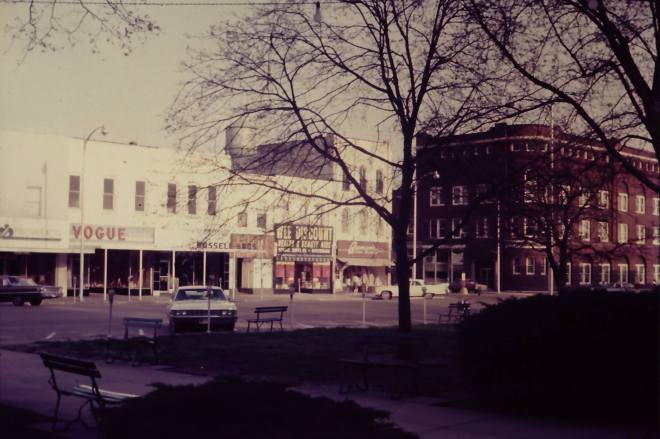
The shot above is an image I’ve been seeking for a long time.
I actually had something quite like it in mind when I wrote this poem.
The shot is of the southeast corner of our town square. The large, 4-story brick building that dominates the scene is the original Farmers Savings Bank.
The east side of our square was clearly the “serious” side of the square. If you could just see a bit more to the left in the photo, you would see the other bank in town, Wood & Huston, which anchored the northeast corner of the square.
The Farmers Savings Bank was a landmark. I still remember walking in there for the first time in the mid-60s with my dad to open my first savings account. I had landed a job detasseling corn with DeKalb, and needed to sock my money away in a safe place.
My memory of the bank was dark wood, glass and really fancy tile or stone floors. I could be completely wrong. But that is the impression the place left on me.
It definitely gave me the experience that banks at one time strived for: Substantial, important, unshakeable, solid, eternal.
I also have another memory of that building. I’m not sure if this is a real memory or if I imagined it. The memory goes like this: I’m with a couple of my buddies, and somehow we gain access to the hallways of the offices that occupy the stories above the bank.
We explore and when we get to the top floor, we open a door and, behold — inside is a Masonic Temple, with its colorful and elaborate falderal. A exotic stage set for a play with curtains and colorful, elaborate props. A sense of mystery and danger.
We don’t stay long.
Sadly, sometime after I departed my hometown for college, the bank was torn down to make way for a more modern, low-slung and efficient building. I’m sure that was the fashionable thing for banks to do in that era.
I always hated what that demolition did to the look of the square. The old bank building had been a solid landmark one could count on. Solid. Now it was gone.
Most bank buildings I walk into these days (and only when I must), seem more like low-rent office buildings. Nothing impressive or awe-inspiring about them. Designed with the corporate stock price firmly in mind. Designed to encourage you to skip coming inside and avail yourself of the ATM outside instead.
Old streets remind me
I did not know compassion
when I walked them then.
NOTES: I have come into possession of a treasure trove of photos from the late 1960s taken by an old schoolmate, Susumu. He was our Japanese foreign exchange student when I was a junior in high school in 1968 and 1969.
Across the years and across the internet, we reconnected and he sent me the photos he collected during his year in my hometown.
Susumu saw things through his camera lens that I had long forgotten. These are shots I would never have thought to take. Simple street scenes. Iconic buildings long since torn down. Teachers and friends long forgotten.
The gift of these photos is almost indescribable. It is as though I am seeing my hometown again, for the first time. I’m transported back nearly half a century to the place of my childhood, to the places where I lived my formative years.
No fancy Instagram filters are required. These photos already have the faded Kodachrome quality you cannot fake. They come with authentic poignancy.
These photos take me back to my youth. And my heart is filled with questions. What if? If only? Didn’t I realize?
There once was a time
when blossoms and I were both
fresh and unabashed.
NOTES: When I was a junior, my high school hosted a foreign exchange student from Japan. Susumu stayed with the DuBois family, who lived a few blocks away.
A couple of years ago, through the miracle of Facebook, I reconnected with Susumu. When I discovered he had taken several photos of his days in my hometown, I was excited. He very kindly shared them with me, and I have been lovingly looking through them and rekindling old memories.
Those photos include precious images of teachers long since gone. Of friends and classmates not seen for decades. And simple scenes of my hometown, a town that has changed so much since I walked its streets.
One of the photos was of me. I don’t remember it being taken. All evidence points to it being the spring of 1969. I am outfitted in what passed for a tennis uniform in those days. I must have just finished practicing with Susumu’s host brother, Dave DuBois. We were teammates on the Marshall High School tennis team, and we practiced out on the new hard surface courts at Missouri Valley College.
From the foliage, it was early spring. The tulip tree was in full bloom, but the other trees had not leafed out. I wore a leather bracelet on my right wrist, which was the cool, hippie thing to do.
My hair was growing out and would need to be cut before football practice started in August. (Coach Cecil Naylor really didn’t like long hair!)
Marshall High School Honor Stations 1969. (Photo courtesy of Susumu Wakana)
So blithely we scrapped
our outmoded traditions.
But what did we know?
NOTES: My high school had long observed a set of traditions at graduation time. While probably only a few decades old, to us callow kids, those customs may just as well have been prehistoric.
For as long as we could remember, our school had marked the end of the school year with a Baccalaureate service, a Commencement ceremony, and Honor’s Night. The first was inspirational, and still carried a whiff of religion. Commencement was more perfunctory, and mainly served to get your tassel turned and your diploma into your eager, waiting hands.
But the real ceremony happened at Honor’s Night. That was where academic achievement and athletic prowess were feted. Scholarships were announced. Awards and certificates of all types were handed out. But while the awards were many, there was still a good measure of exclusivity. Not everyone got a trophy. It was the merit system on steroids.
The pinnacle of Honor’s Night was–as it had always been–the presentation of the Honor Stations. Four couples from the senior class had been selected, each meant to represent one of the four cardinal virtues of our school. They were to be arrayed on the stage of the auditorium beneath solemnly lit candelabras dressed in formal gowns and white dinner jackets. They personified:
Most Industrious
Best Sport
Most Courteous
Best Citizen
(Historical note by way of full disclosure: My brother Larry had been named Most Courteous in 1960, coasting to the honor on his winning smile and prodigious gift of gab.)
At the center of the stage sat Miss Fair Marshall, complete with a tiara. We were not sure, but we suspected she represented all the good and pure and gracious qualities of Missouri womanhood.
I forget exactly how the Honor Stations were nominated and selected, but I seem to remember some sort of balloting by the student body.
THE DEMISE OF MISS FAIR MARSHALL
Miss Fair Marshall had a male escort, but he was merely unelected arm-candy. The star of the evening and the center of attention was the fair maiden.
I should add one more fact, especially for those too young to remember. The late 1960s were a time of upheaval and ferment. Across the country, kids were growing their hair, listening to loud music and protesting the Vietnam War.
The times were a’changing, and although change might have come more slowly to our Missouri farm town than other places, we were not immune.
When I was a junior, the senior class of 1969 did a bold and daring thing. (Many of my classmates and I admired our elders in the class of ’69. We saw them as smart and sophisticated and worldly.)
The dramatic move they made was to vote to eliminate Miss Fair Marshall. It was a shocking move.
I’m not sure if there was ever a cogent explanation made why this was a good idea. I suspect it had something to do with an unconscious awareness that having a “princess” without an equivalent prince was somehow unfair or sexist. Or perhaps it was a rejection of the whole patriarchal-vestal-virgin vibe given off by the institution
I dunno. But the hippies and the intellectual artsy kids rejoiced that year over the demise of Miss Fair Marshall. And, I suspect that many would-be beauty queens wept.
THE NEXT YEAR, OUR CLASS HAD ITS TURN
I recall sitting the next year in our snoozy all-senior-class meeting called for the sole purpose of deciding whether we would bestow a clock or a plaque as our senior gift to the school.
At some point in the proceedings, I turned to my friend Clyde Smith and joked, “Wouldn’t if be funny if we abolished Honor Stations?”
He replied that that was a great idea, and that I should propose it. I told him to do it. He looked directly at me and said, “No, it’d be better if you did it.”
Thinking back, I do recall that there had been some earlier joking about how ridiculous the Honor Stations had become. The year before, the position of male Most Industrious had been filled by our older friend John Swisher. Now John was one of the smartest, funniest and cleverest guys you’d ever want to meet. But he was the first to admit that he was nowhere close to being the most industrious member of his class.
John had even made many a hilarious joke about his lackluster work ethic and the irony of him being named Most Industrious.
So, I had already concluded that the Honor Stations were hypocritical. And, with no more forethought than that, I popped out of my seat, walked to the front and made a motion to abolish Honor Stations.
I think I heard what you might call an audible silence.
I’m not sure exactly what happened next. I thought I detected murmuring from the gaggle of popular girls. Probably looking forward to wearing formal dresses up on the stage, I thought.
There may have been a person or two who spoke in opposition. But I distinctly remember the debate ending after Tom Nicholas stood up. Tom was the most rock ‘n’ roll member of our senior class. He had long hair before anyone else. He played guitar in a real band, and he exuded rebel cool.
Tom strode forward, leaned into the microphone, and pronounced with authority, “We have a word for this. It’s called ‘ego-trip.'”
That pretty much sealed the deal. Honor Stations were ego trips. The question was called, and the motion overwhelmingly carried.
The Class of 1970 had finished the work of our predecessors. We had killed off the Honor Stations and drained the pomp from “Pomp and Circumstance.”
I was exhilarated and pretty darn proud of myself–for a short time.
A UNEXPECTED LESSON
Later that day, I was pulled aside by Mrs. Van Meter for a brief, one-way conversation. Dorothy Van Meter taught English, and was pretty much universally regarded as one of the “cool teachers.” She conducted discussion nights at her apartment for students and former students. These were heady salons where heady subjects like philosophy, truth and beauty were seriously discussed.
Mrs. Van Meter had hung a small peace symbol over the door to her classroom, and on the day of the Vietnam War Moratorium, she came to school dressed in black. So, she had credibility with the free-thinking, progressive students. She was actually the last teacher I suspected would hector me for my blow against hidebound tradition.
She was also known to take an interest in the character formation of her students. She was known to prescribe books or disciplines she thought would round out a particular student’s soul. I was a muscle-bound jock and she told me to pick up a book on yoga. And when I was flirting with the moral perils of agnosticism she gave me her copy of Screwtape Lettersby C.S. Lewis. She even recommended weight-lifting for one of my classmates who was musical and brilliant, but soft and plump.
Her word to me on this day was matter of fact and brief.
“You know,” said Mrs. Van Meter, “some ideals are worth preserving whether they are fully lived out or not.”
That was it, and she wheeled around and left.
Her words took a while to sink in. But that simple truth just might have been the most important thing I learned in high school.
Mrs. Dorothy Van Meter (Photo courtesy of Susumu Wakana)




 Poetic Champions