Love Poem for Independence Day

July 4th fireworks in Minneapolis, Minnesota

INDEPENDENCE DAY

The wind and you played in my hair,
++++You lambent in the moon,
The night arranged as by design,
++++Mysteriously boon.

Afresh the breeze and warm our hands,
++++So lately introduced,
Traced so gently new found lands,
++++From tyranny aloosed.

While all around with fire and bang
++++Our freedom was proclaimed,
A nation’s liberty was meant,
++++To us, two hearts unchained.


(1982)

NOTES: I didn’t want the July 4th weekend to pass by without reposting this modest little poem from the past. It’s become a bit of a personal holiday tradition.

You see, I celebrate the Fourth of July as a double holiday. I’m proud and happy to honor our nation for its exceptional on-going story. What a remarkable experiment in human freedom and self government!

Each year I also pause to remember that night many years ago when I discovered my role in an on-going love story.

My personal affection for July Fourth goes back to 1982, when a young couple snuck to the roof of the Calhoun Beach Club in Minneapolis to watch the fireworks. This perch, high above Lake Calhoun, offered a 360 degree view of the entire Twin Cities area. You could see several fireworks displays from there, both near and far away.

Not gonna lie … best fireworks ever.

From the poet to his love playing hard to get

Don't shield your limbs below nor lips above

LUMBERJACK LOVE

Though I am not a bearded man nor burly,
I love you with a lumberjack-type love.
The only axe I take in hand securely,
This meager pen across the page I shove.

Please treat me not so fickle nor so surly,
Don’t shield your limbs below nor lips above.
I aim to fell you skillfully and purely;
Each word’s to chip the bark around your love.


(1982)

NOTES: Seems like everyone’s felt like this at one point or another.

Van Morrison said, “I got hit by a bow and arrow, got me down to the very marrow.” John Lee Hooker said, “Baby please don’t go.”  The Bee Gees, said, “It’s only words, and words are all I have to take your heart away.”

Who says poetry doesn’t pay?

THE PASSIONATE WRITER TO HIS LOVE

Come live with me and be my love,
Assured before you voice your fears
That we will meld as hand to glove
With tender wearing through the years.

How could I love another more,
Or ever you abandon me?
So come, our prospects let’s explore
Assay our hopes in honesty.

I’ll write old-fashioned poems for you,
The kind that sing with foot and rhyme,
To soothe your ear and gently woo
Your cautious heart in its due time.

We’ll stay abed when springtime rains,
And care not if it’s ever done;
We’ll pedal wooded country lanes,
And bask beneath a merry sun.

In lilac-time I’ll break for you
The heart-shaped leaf and purple bloom
That flourished when our love was new,
And filled the night with strong perfume.

Like hardy husbandmen of old,
Who ploughed and tilled the fertile soil,
We’ll give ourselves to labors bold,
And harvest children for our toil.

And when the winter of our years
Bespecks our thinning hair with snow,
We’ll stoke our fire against the fear,
Companions though the chill winds blow.

Relentless time moves on apace,
Time leaves its vanquished under stone.
But we can win at time’s own race
By choosing not to run alone.

Defying reason, let’s unite
To form a sturdy three-fold cord,
A braid miraculously tight,
Of bridegroom, bride and gentle Lord.

If my proposal your love stirs,
If this be your desire for life,
If to my faith your heart avers,
Come live with me and be my wife.


(1985)

Notes: In what has become a somewhat of a tradition, I share my proposal poem to Jan on the occasion of our anniversary.

I sprung it on her 34 years ago. Thankfully, she didn’t think it was too goofy, but she didn’t give me an official response on the spot. She made me sweat until the next day. We went out to brunch at a now-defunct Minneapolis restaurant staffed by hippies who hadn’t gotten the memo that the ’70s were over.

When I dug into my scrambled eggs, I noticed a folded piece of paper. It was grease-soaked and writing from the other side was showing through. I thought one of the yogi-fry cooks had lost his Sanskrit prayer in my breakfast. I was about to send it back when Jan urged me to unfold the note and read it.

It was her response. She had slipped her note to the waitress and had her hide it under the eggs. Jan had taken the last verse of the poem and turned each line around into an affirmative response.

Somehow we managed to misplace that grease-laden scrap of paper. Pity, it would have been a treasured keepsake. But I’m pretty sure her response went like this:

Yes, your proposal my love stirs,
Yes, this be my desire for life,
Yes, to your faith my heart avers,
I’ll live with you and be your wife.


I was delighted and didn’t mind a bit that she adapted my poem for her answer.

How could I mind? I had shamelessly ripped off the first line myself from Christopher Marlowe’s poem “The Passionate Shepherd to his Love.”

My proposal may not have been wholly original poetry, but it did the trick. She said “yes.”

The funny thing is … soon after that I wound up practicing direct marketing copywriting as my day job.

After my experience with this poem, I should have known I was destined for direct marketing. The poem was my very first direct marketing letter.

I got a 100% response rate. Retention has been solid, and long-term value excellent.

Thank you, Christopher Marlowe.

Sonnet for May

And balmy blossoms like a banquet spread

When May Bursts Forth

When May bursts forth all moisture and mirth,
And birds bestir while you are still abed,
With everything bent on fostering birth,
And balmy blossoms like a banquet spread
Call to the wanderer weary and wan,
“Close your eyes and breathe and remember nights
When you lay upon the redolent lawn,
And took your bashful taste of love’s delights.”
For though that time is but a glimmer now,
And keenness of the night is now subdued,
A fragrant echo still awakes somehow,
And stirs again a near forgotten mood.
One kiss with wonder could the world endow.
In one embrace you found all you pursued.


(2017)

NOTES: I couldn’t let the month slip away without posting this May-inspired poem.

Love when you are young and young love at any age share a common quality.  My favorite month of May reminds me of that.

When I was very young and in love for the first time, I ran across a short little Robert Browning poem called Summum Bonum, which spoke to me quite vividly at the time.  Many years  and many miles later, I discovered — thankfully — that you did not have to be young to fall in love again.

There just may be a whisper of an echo from that poem in here.

Poem for Poetry Month

Bobby Ball 1972

I Sing Not for Glory

I sing not for glory nor for bread,
Nor for the praise of the credentialed clique.
But for hire more valuable instead,
To touch the honest kindred heart I seek.

I sing for lovers when love is green,
When time stops for a solitary kiss.
When light shines anew as with new eyes seen,
I celebrate your fey and fragile bliss.

I sing for the lonely, lovelorn heart,
When light grows cold and aching will not cease,
When your enchanted world falls all apart,
I offer modest salve to give you peace.

I sing for the pilgrim searching soul
Pursuing the heart’s true cause and treasure.
May Heaven’s Hound, you hasten to your goal,
And propel you to your proper pleasure.

I sing for the wise who see their end,
And, too, for those who have not yet awoke.
For to a common home we all descend,
With common dirt for all our common cloak.

I sing not for money nor for art,
Nor to amuse curators of our trade.
The simple wages of the simple heart
Will satisfy when my accounts are weighed.


NOTES: I couldn’t allow Poetry Month to slip away without posting this manifesto for those who write for love.

The photo is from long ago and far away, before I had much to write about. But that would change in time.


Maui Revisited Haiku

Jan in Maui

Give Maui credit
As for my wife, I must say,
She looks younger here


(2015)

Back to Maui after four years and the place still works its magic.

Poem for anyone sick of winter (or who has ever lost a love)

Grey weeds withered beside a roadside ditch

That Bleak Season

That bleak season the cold creek ceased to run,
Grey weeds withered beside the roadside ditch,
Flat leaden clouds obscured a sullen sun,
Winds lashed ice-lacquered leaves without a twitch.

Field stalks bowed down to winter’s weary weight,
The world conspired to pile pang upon pang,
Even the crusted snow cried, “Much too late!”
Caged by a skeleton hedge, no bird sang.

That bleak season love went the way of leaves,
Good green seeming, but poised to take the fall,
First frost stunned then assailed by windy thieves,
Some futile few sought stubborn to forestall
The impending end ’til a fell gust cleaves
Asunder with only a scrawny squall.


(2017)

Notes: This endless winter has reminded me of the poem above, written not too long ago, but inspired by events in another time, in another life.

Robert Frost once said:

Ah, when to the heart of man
++Was it ever less than a treason
To go with the drift of things,
++To yield with a grace to reason,
And bow and accept the end
++Of a love or a season?

The comfort I can offer is only this: Love, like spring will surely bloom again.

Poem for Autumn

October's blaze adorns the lawn

Autumn Lament

September’s sun has come and gone
++++And now the fall is here.
October’s blaze adorns the lawn,
++++The swan song of the year.

The bonfires of my autumns past
++++Burn cool as I recall
The hayride loves that failed to last
++++Beyond the end of fall.

Out on the gridiron battlefield,
++++Where so much toil was paid,
Where cheers and chants once loudly pealed,
++++Now flags and glory fade.

Our friends and kinsmen now are few.
++++Our lovers are all gone.
All those we thought would see us through
++++Cannot be counted on.

When we were young we loved the fall.
++++We loved the leaves aglow.
Knew always we’d have one more fall.
++++Those days, what did we know?


(2018)

NOTES: Something about autumn makes me want to return to the poems of British poet A.E. Housman.

Housman once said in a lecture that the special function of poetry was “to transfuse emotion–not to transmit thought but to set up in the reader’s sense a vibration corresponding to what was felt by the writer.”

There is something in so many of his poems that vibrates on the same wavelength with the sense of loss I feel when fall arrives. So when the nights began to cool and the leaves began to turn, I picked up my old copy of A Shropshire Lad and relished Housman’s lean, direct, and delicious verse once again.

One of the forms he used was a type of ballad that alternates lines of 8 syllables with lines of 6 syllables.  It’s the form Housman used in one of my favorites, Number XXXVI in Shropshire, a poem that opens:

White in the moon the long road lies,
The moon stands blank above;
White in the moon the long road lies,
That leads me from my love.

It’s a seemingly simple form, but ideal for conveying emotion in a concise, concentrated way. It’s tricky because the lines are so short. There is no room for filler or fluff. I had tried my hand at it before, but neglected it recently.

So, with my emotion fortified by Housman’s verse, and my memory refreshed regarding a potent poetic form, I sat down this week to try my hand at “transfusing emotion.”

Let me know if you picked up the vibration.

Sonnet for Love in Late Summer

Wine barrel signed by Orson Welles

“We’ll Sell No Wine…”

“We’ll sell no wine before its time,” we’re told.
The fat and famous spokesman made it clear,
Each vintage has its period of gold.
(You must assess the pressing and the year.)

So, likewise, for each vintage comes a time
The point past which there’s no return at all.
Decay and oxidation work their crime,
And turn your sweetest nectar into gall.

So come, my dear, what are we waiting for?
Our cellar holds a few more bottles still.
Pick one and brush away the dust before
Time turns its contents back to must — time will.
Cast off our caution and our clothes and pour,
And drink with joy until we’ve had our fill.


(2016)

Photo courtesy of TripAdvisor

NOTES: The shorter days and fainter light of September are stirring all sorts of poignant feelings. Something about this time of year makes me want to haul this old poem out of the cellar one more time.

I’m old enough to remember when Orson Welles employed his considerable talent to pitch some middle-of-the-road wine back in the late 1970s. He had been a celebrated actor, who had co-written, directed, and starred in Citizen Kane, what many still consider the best film ever made.

But he was difficult to work with, and had trouble raising money for his projects.  So he turned to advertising to pay the bills. His Paul Masson spots where he declared, “We will sell no wine before its time,” are classic examples of great advertising.

Paul Masson sales reportedly rose by 33% while that campaign ran.

Sonnet for Late Summer

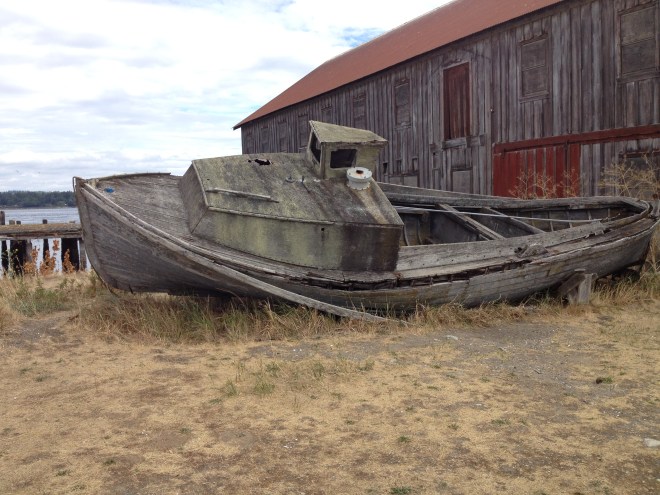
Dry grass, abandoned boat, and old shed

Late Summer’s Sun

Late summer’s sun has baked the grass to brown.
The days grow shorter with each passing day,
Soon, autumn’s chill will make the leaves fall down.
All of this aching beauty will decay.

And yet I love the shadows’ slanting trace,
The once green grain gone golden in its rows,
And how I love the lines etched in your face.
It’s funny, as love ripens how it grows.

The number of our days we do not know.
No sleeper knows if he will ever wake.
So come, let’s join above, between, below.
My dear, let’s cause our fragile clay to quake.
Let us make love as if it’s our last go.
Let us embrace like dawn will never break.


(2015)

Notes:  It’s not really late summer, but it just feels like it. The ground is parched, the foliage is showing its mortality, and I’m ready for some rain. Normally I would wait until September to haul out this sonnet, but this year it feels later than it is.

Extra credit to any poetry geek who can spot the homage to John Donne in this poem.