
My dad always had
just the right tool for the job.
I’m just making do.
Tag: hometown
Hometown Haiku

My town’s motto states:
“Smart dog, nice folks ….” Pretty sure
the dog, too, was nice.
The most famous resident of my hometown was a dog
When I moved to the central Missouri town of Marshall in the late 1950s, I was six years old. My father had literally sold the farm and was setting out on a bold attempt to pursue the American dream by going into the farm implement business. After spending the first six years of my life on a farm in northwest part of the state, Marshall, with its 12,000-plus inhabitants, seemed like a big city to me, full of potential and possibilities. For the first time in my life I had a room of my own and indoor plumbing.
One of the first things I heard about my new hometown was that it was that it had been the home of Jim the Wonder Dog. It had been just a little over 20 years since Jim’s death, and many of my new neighbors had seen Jim while he was alive. Someone gave us a book about Jim, which I eagerly devoured. We were told to be sure and visit Jim’s grave out at the end of Yerby Street at Ridge Park Cemetery. He was the only animal buried in the human graveyard, we were told, and he deserved to be there more than a lot of the people, one added. We visited Jim’s grave with my mother, who brought flowers, because that’s what you did when you visited cemeteries in those days.
Everyone we talked to accepted the story of Jim at face value. To them, Jim had been a true walking miracle. He was a dog who could understand human speech, and follow instructions to the letter. But more than that, he knew things that humans could not possibly know. He was not only highly intelligent. Jim was also clairvoyant, we were told. Jim could predict the future. He could accurately predict the gender of babies before they were born and he knew who would win elections and sporting events.
To a six-year-old boy with an active imagination, this was a fascinating story. But I grew up and forgot about Jim. I went away to college, and started a career and a family, and got involved with my life.
Years later, I returned to Marshall, and I discovered that Jim was enjoying a revival of popularity. The Viking Hotel (formerly the Ruff Hotel) just off the town square, where Jim and his owner had lived, had burned down. A civic group had raised some money, and convinced the city fathers allow a memorial park to be created on the site.
Jim was becoming a full-fledged tourist attraction.
Then someone (bless their hearts!), persuaded the city to adopt a town motto. It reads, and I kid you not: “Smart dog, nice folks ….”
I admire the humility and sense of humor that animated that motto. It is in the same spirit that I wrote this little haiku.
Hometown haiku

The calloused farmer
cradles his newly born son,
awkwardly tender.
Hometown haiku
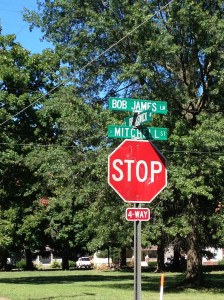
Who would have thought it —
my old neighbor does so well
they rename the street?
Love haiku

Before I met you
I thought I was so darned cool.
Clueless, more like it.
Hometown Haiku

My dear old classmates,
so very innocent, and,
so very human.
Farm Life Free Verse
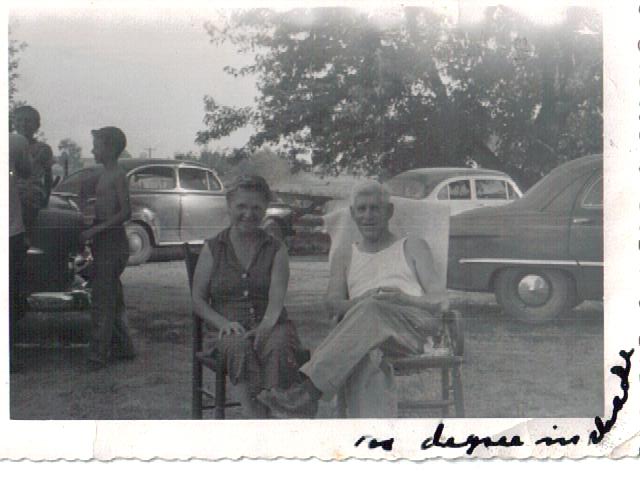
Back in the 1950s on the farm, we didn’t have air conditioning. Shoot, we had just gotten electricity a few years before.
So when the long Missouri summers dragged on and the humidity rose, folks headed outdoors to keep cool. When the nights were really hot, we’d sleep outdoors.
The following poem is about a day pretty much like the one documented in this photo. In fact, the events took place not too many days after this photo was shot.
The Day the Call Came
The day the call came
We had just dished up the ice cream.
A special treat for a Friday farm dinner,
(Not to be confused with supper.)
Mother had made it early that morning in ice cube trays.
“Freezer ice cream,” she called it,
Vanilla, made with Junket tablets to keep it creamy,
Even as it froze.
Not as good as the real, homemade ice cream cranked by hand,
But a whole lot easier.
And America was just starting its long affair with convenience.
The call came over the telephone
Mounted on the farmhouse wall.
With two bells for eyes,
You spoke into its honking, beaklike nose.
The earpiece cradled appropriately
Where the right ear should be,
While a hand crank made a poor excuse
For a drooping left ear.
It was a party line,
So the snoopy widow woman down the road
Knew as soon as we did.
The call came, and the man on the phone
Said Grandpa had just keeled over dead
At the auction over in Poosey.
So, we all got up—Mom, Dad, Big Brother and me,
And climbed into the ’50 Ford sedan
Dad was so proud to own.
The first car he’d ever bought brand new.
By the time we got to the auction –
It was a farm sale, really —
Where the worldly possessions of one farm family
Were being sold off.
One at a time.
By the hypnotically fast-talking auctioneer.
Not as depressing as the foreclosure sales
That were all too common
Just a few years before in the Depression.
This was a voluntary sale,
But a little sad nonetheless.
Some farmer was getting too old to run the place,
And didn’t have kids—or leastwise kids who wanted to farm.
A lot of boys joined the service in those days,
Or headed to Kansas City to find work, and a little excitement,
Rather than stay and try to coax a living
Out of that hilly, rocky dirt.
The man at the auction told us
Grandpa had been standing there in the sun with everybody else.
They were just about to start the bidding on the John Deere hay rake
When he grabbed his chest and fell right over.
Years later, they told me when he was a grown man
Grandpa had gone down to the river,
And been baptized, and filled with the Holy Ghost,
With the evidence of no longer speaking in profane tongues.
For, it was well known Grandpa had been gifted
In the art of colorful language.
“He used to could cuss by note,” was how Mother put it.
But after the washing with water and the Word,
Grandpa was never heard to swear again.
I only knew him as a white-haired old man
With a merry smile, and infinite patience
With Grandma, who required it.
And that was it, really.
Nothing more to say,
Except for the understated condolences
Of the country folk.
Nothing more to do,
Except for my father,
Now lately promoted to the role of the family’s eldest male,
Who assumed the duties and made the necessary arrangements.
Although I didn’t know quite what had happened,
I felt a lurch … as something shifted beneath me …
And I was yanked one more notch forward.
By the time we got back to the house,
The ice cream had long since melted
And now was returning back to solid state,
As it curdled in the September heat.
Football and Love Haiku

If not for football
Or the women I have loved
I’d hardly know pain.
Hometown Haiku

Pop fixed everything.
Pity that talent wasn’t
hereditary.
Faith haiku
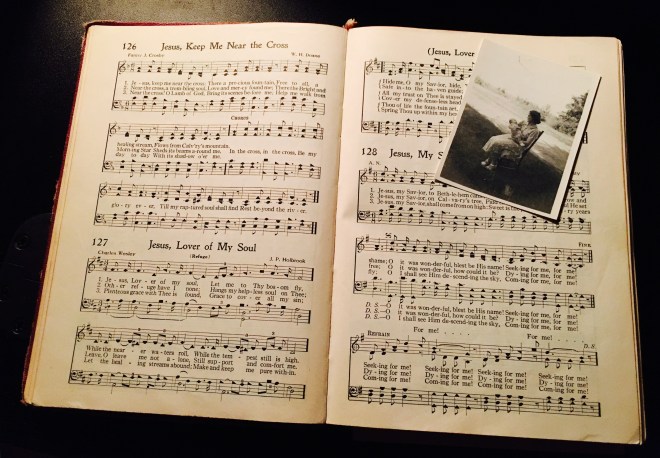
Faith of our forebears.
No organ. No liturgy.
Just Jesus. That’s all.
 Poetic Champions