Late Summer Sonnet

Late summer's sun has baked the grass to brown

Late Summer’s Sun

Late summer’s sun has baked the grass to brown.
The days grow shorter with each passing day,
Soon, autumn’s chill will make the leaves fall down.
All of this aching beauty will decay.

And yet I love the shadows’ slanting trace,
The once green grain gone golden in its rows,
And how I love the lines etched in your face.
It’s funny, as love ripens how it grows.

The number of our days we do not know.
No sleeper knows if he will ever wake.
So come, let’s join above, between, below.
My dear, let’s cause our fragile clay to quake.
Let us make love as if it’s our last go.
Let us embrace like dawn will never break.


NOTES:  It’s not really late summer yet, but it feels like it.  It has been hot and dry, giving us the sense of late August when July hasn’t even ended.

The seasons seen to come and go more quickly of late.  Perhaps I’m paying closer attention. Perhaps I realize more summers now lie behind me than still ahead.

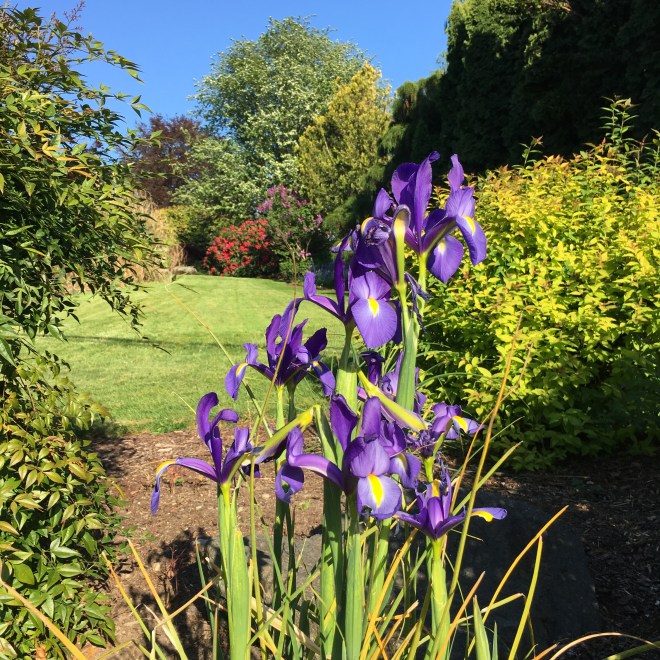
Something in the air caused me to pull this sonnet out of the vault today.  I snapped the photo on my late afternoon walk.


Love Poem

Evergreen tree

LUMBERJACK LOVE

Though I am not a bearded man nor burly,
I love you with a lumberjack-type love.
The only axe I take in hand securely,
This meager pen across the page I shove.

Please treat me not so fickle nor so surly,
Don’t shield your limbs below nor lips above.
I aim to fell you skillfully and purely;
Each word’s to chip the bark around your love.


Notes:  This one was written 35 years ago, almost to the day.

July 3 Love Poem

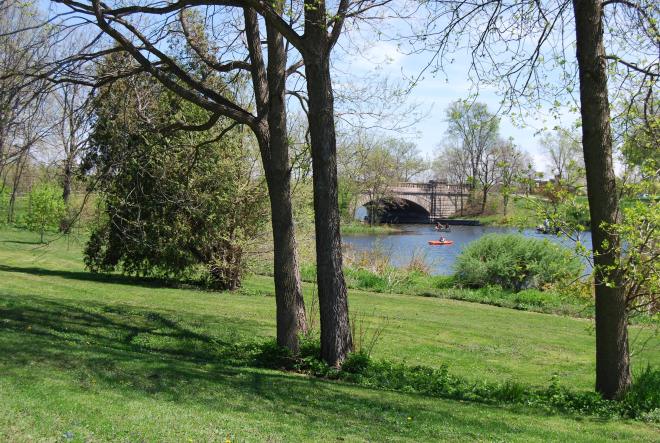
Lake of the Isles, Minneapolis
Lake of the Isles, Minneapolis … long ago

That Day We Lay Upon the Grass

That day we lay upon the grass,
A luminescent green.
The sparks that arced from arm to arm
Across the space between.

Our bodies quickened by the sun,
The willow leaves aflush,
The sunlight sparkling on the lake,
Our blood bestirred to rush.

Up and down the parkway, flowers
Enticing with their blooms,
Our loveless winter ended there,
Emerging from our tombs.

For we had slept as sleepers sleep,
Unmindful of the world,
Astonishingly we awoke,
Much like a rose unfurled.


Notes:  I have a theory that memorializing milestones in a relationship will fortify it to help it withstand the inevitable stresses and storms of life.  Remembering and celebrating events in the early, first phase of a love story are especially powerful.

On July 3, 1982 I took a walk with a beautiful woman around that most beautiful of the Minneapolis lakes, Lake of the Isles.  We had known each other less than two months. We sat down in the grass by the lagoon.  And then this happened.

July 3 has been my own personal holiday ever since.

Suburban Summer Sonnet

Suburban summer

Our Paradise

Wafting comes the mower’s comforting hum,
Assuring all is just as it should be.
Our gates and fences all are rightly plumb,
We celebrate our capability.

New curbs and gutters sluice away wild rain,
Alarms and locks protect our doors from breach,
Our lives arranged to minimize our pain,
Designed to keep us safely out of reach.

But wreaking roots upheave the sidewalk path,
And worms devour our precious woolen thread,
The black and red mold creep into our bath,
Insomnia disturbs our peace in bed.
Despite our engineering and our math,
Our paradise is something less instead.


NOTES:  Summertime has finally come to the Pacific Northwest.  It seems fitting to haul out this sonnet from last year.

Don’t get me wrong.  I appreciate material comforts and modern conveniences.  Probably even more than most of my friends and colleagues.

I was born in the middle of the last century, and started out life on a farm that was primitive, even for that time.

How primitive?  Well, we milked our own cow, raised our own chickens for eggs, butchered our own hogs, and raised our own vegetables in the garden.

For special occasions and Sunday dinners, Mother would grab one of the slower chickens, chop off her head, and fry her up.

When we sold our farm to the Amish, they took one look at the house, and commenced on an immediate upgrading and remodeling project.

As for me, I was delighted in my new home in a Missouri farm town of 12 thousand souls.  For the first time in my life I had my own room, central heat, and indoor plumbing.

I could take a bath in something that wasn’t a galvanized wash tub in the middle of the kitchen floor.  In freshly drawn water that hadn’t been previously used by other members of the family.

I thought I’d died and gone to heaven.  I didn’t even notice that we didn’t have air conditioning, even when the Missouri summer visited its triple digit heat and humidity  upon us.

So, I am thankful for many things.  I am so  thankful I can enjoy sardines from Norway and wine from France.

I am grateful for antibiotics, and the miracles of modern medicine.  I missed the polio epidemic, but just barely.  Had I been just a couple of years older, I could have suffered withered limbs or worse, like the older brothers and sisters of some of my friends who were not so fortunate.

All of my ancestors as far back as I can research were dirt farmers.  I am grateful for a professional job in a meaningful enterprise.  (Inside work.  No heavy lifting.)

Many years ago, when I moved out to Seattle, we settled in the suburbs because — even then — the city was too expensive.  We made a serendipitous choice, because our little suburb has become a highly desirable place for Microsoft employees coming here to live from all over the world.

Heck, in one of those specious magazine “Top 15” lists, our little suburb was once ranked the “Most Friendly Town in America.”

Crime is low.  Violent crime is virtually non-existent.  The weather is temperate.  People take care of their property.  Unemployment is not really an issue.  You can walk or jog without fear.

Yet, sometimes it is good to remember that even heaven on earth is not really heaven.

Anniversary sonnet

Never a dull moment with you.

Familiar Ways

I choose to walk the old familiar ways,
To wend ways where I’ve put my foot before,
To gaze anew on views seen other days,
Which, though familiar, never seem to bore.

The changing light and seasons have their ways
Of making old things new: The light-laced hoar,
The first-flush, green-glow, bursting-forth spring days,
The growing tinge of gold we can’t ignore.

Each day, my dear, I choose afresh our trail,
The one we blazed so many years ago,
Eschewing other routes that might avail,
And hewing to the well-worn way we know.
Forsaking novelty need be no jail
With your face bathed in sunset’s golden glow.


NOTES:  Thirty-two years of marriage and never a dull moment.

May sonnet

IMG_2271

When May Bursts Forth

When May bursts forth all moisture and mirth,
And birds bestir while you are still abed,
With everything bent on fostering birth,
And balmy blossoms like a banquet spread
Call to the wanderer weary and wan,
“Close your eyes and breathe and remember nights
When you lay upon the redolent lawn,
And took your bashful taste of love’s delights.”
For though that time is but a glimmer now,
And keenness of the night is now subdued,
A fragrant echo still awakes somehow,
And stirs again a near forgotten mood.
One kiss with wonder could the world endow.
In one embrace you found all you pursued.


NOTES:  Love when you are young and young love at any age share a common quality.  My favorite month of May reminds me of that.

When I was very young and in love for the first time, I ran across a short little Robert Browning poem called Summum Bonum, which spoke to me quite vividly.  Many years  and many miles later, I discovered — thankfully — that you did not have to be young to fall in love again.

There just may be a whisper of an echo from that poem in here.

Spring haiku

Sparrow in the woods
Photo courtesy of John Marquand

When the sparrow sings
deep in the woods all alone,
is it still lovely?


NOTES:  My old friend and schoolmate, John Marquand is a bird whisperer.  He rises early in his Colorado home and gets out when the light is good to stalk and take amazing photos of birds.

John shoots other beautiful photos as well, but he’s got a thing for birds.  They seem to pose for him.  He shares a lot of his photos on his Facebook page.  If he ever puts out a nature calendar, I’d buy one.

Mother’s Day Poem

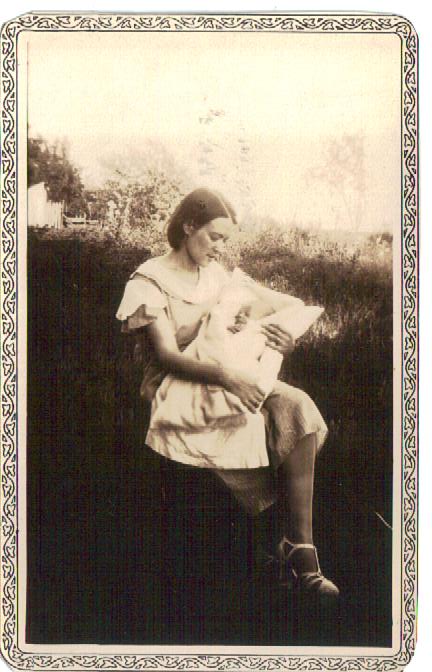
My first poetic champion

ICE AGE

Dear gentle woman grown so early old,
You’ve all but left us on our lonesome own.
Now after many years to spirit sown,
A creeping glacier scrapes your memory cold.

You, greener days ago, recited verse,
And planted hardy seeds of simple song
That rooted deep, perennial and strong,
To flourish in the shadow of the hearse.

Today your weathered hands no longer know
The jonquil from the mum, nor how to weed.
Today you prattle on without the seed
Of sense, that for so long you toiled to grow.

So now for you I pick this small bouquet,
Out of the garden patch you used to tend,
Now choked with worldly weeds from end to end,
In need of hands to cultivate its clay.


NOTES:

My mother loved poetry.  Her own mother died when she was just a girl, so she dropped out of school to help raise her younger siblings.  She never got to go to high school, but she loved the music of English words artfully strung together.

She read the American classics of the time: Wordsworth, Emerson, Eugene Field, and even that new fellow, Frost.  Some of my earliest memories are of her reading to me from “The Duel” (aka “The Gingham Dog and the Calico Cat,”) “Lil’ Boy Blue,” and “Hiawatha.”

She filled a buffet drawer scraps of paper bearing homespun verse she had copied by hand, or clipped from the pages of Capper’s Weekly.  After her death, I found her Bible.  It was worn out and held together at the spine with pieces of packing tape.  Tucked amongst the hand-scrawled Bible verses and sermon notes was a tiny piece of paper where she had written this fragment from John Greenleaf Whittier:

Of all sad words of tongue or pen
The saddest of these, it might have been

In her 70s, Mother began a long, slow journey with Alzheimer’s.  At first we thought she was just getting forgetful, but, in time, we realized she was losing her faculties.  She forgot names and nouns.

Early on, she devised clever strategies to trick us into helping her fill in the missing blanks.  “I’m going to the, um, you know,” she would offer, hoping one of us would bail her out by supplying “the A&P,” or the name of some other destination that had eluded her.

But, in time, she lost the ability to play Guess the Word with anyone.  She slipped away from us and never came back, even though she lived for years neither speaking nor, as far as we could tell, understanding anything spoken to her.  She lived so long probably due to some diligent care at the county nursing home in our small Missouri town, and to the fact my father visited her every day and spoon fed her lunch.

I wrote her a poem, which I read at her funeral.

Hometown haiku


Minuteman missile silo, Saline County, Missouri
Photo courtesy of Susumu Wakana

Just miles south of town
missiles waited in silos,
hell in a cornfield.


NOTES:  In the early 1960s, we began hearing talk of the government planning to put missiles in underground silos in our part of the country.  Sure enough, Minuteman sites began to appear in fields across west-central Missouri.

The silos weren’t advertised, but they were not hidden either.  There was one clearly visible from the main highway south of town.  Many others were scattered about the surrounding countryside, both in our Saline County and in neighboring counties.

The Minutemen were intercontinental ballistic missiles with nuclear warheads.  They burned solid fuel, which allowed for much faster launches than the older, liquid-fuel missiles.

The idea was deterrence.  Our missiles were able to target Soviet cities, which would discourage them from initiating an attack on the United States. They had missiles pointing at us.  We hoped nobody blinked.

It was vaguely unsettling to know that we had nuclear missiles located so close.  But, I was just a grade school kid, and didn’t think too much about such things.

A few years later, when I was in high school, talk started about upping the ante and locating anti-ballistic missiles (ABMs) nearby.  These were defensive weapons, designed to shoot down incoming ICBMs from the other side.

I read a couple of articles, believed myself to be an expert, and declared my opposition to the ABMs.  If I remember correctly, the nationwide high school debate topic was about the ABM issue.

I really didn’t know what I was talking about.  My big argument was that having ABMs located close to our homes would make us a primary target.  I remember having no real answer when a classmate’s big brother, who attended the Naval Academy, pointed out that we were already targets because of the Minuteman missile installations. Having ABMs nearby, he said, would at least give us a chance to shoot down the Russian missiles headed for us.

The Minuteman missiles stood on guard until 1991, when then President George H.W. Bush ordered them off alert status.  Under the terms of the START I treaty, the missiles were removed and the silos destroyed a few years later.

In hindsight, the Minutemen seemed to have done their job.  The Russians never attacked.   The inherent weakness of the Soviet Communist system gradually became more and more evident as their economy crumbled.

In 1989, Mr. Gorbachev did indeed “tear down this wall,” as Ronald Reagan demanded.  Or at least the Soviet leader allowed East Germans to tear down the Berlin Wall themselves.  And then we saw the Soviet empire collapse.

China essentially gave up on Communism around the same time, when its leaders realized that if  they wanted to make money, they had to harness the power of markets.

Today we see Venezuela teetering on chaos as its experiment with socialism goes up in smoke.  Cuba still soldiers on under the heel of the second-string Castro, yearning for the day when real freedom returns.

Of course North Korea continues to keeps the flame alive for all those who dream of establishing a world-wide Worker’s Paradise. It’s our best example of what happens when Communism reaches full flower.

It seems fitting on May Day to pause and think on these things.

Motorcycle Maintenance haiku

Zen and the Art of Motorcycle Maintenance

There once was a time
motorcycle maintenance
meant something to me


NOTES:  Got the news today that Robert Pirsig has died.  When his book “Zen and the Art of Motorcycle Maintenance” was published in 1974, it became an unlikely best seller, and an iconic work as the counterculture was fading away.

Like many a child of the 1960s, I read the book, and pondered its ponderous philosophy of “Quality.”  As the son of a mechanic, I resonated with his idea the “classical” personality, who pays close attention to his machine and makes sure it runs at peak efficiency.  I wanted to be like that.

But I realized I fell more into the category Pirsig calls the “romantic personality,” that was more focused on living in the moment at the expense of rational analysis.

To this day I’m not sure if “Motorcycle Maintenance” is a great work on the level of Plato, or a pop phenomenon.  But I sure thought a lot about it.

The primary reason I perked up my ears when I heard the news today is more poetic than philosophical.

You see, the very first date I went on with my wife was at the Blue Heron Café in Minneapolis, a hippy-dippy veggie establishment that was operated by Pirsig’s ex-wife, Nancy James.

Who needs online dating services?!  The first time I saw my future wife, she was glowing.  Honest to Pete.  She was bathed in a golden aura, sitting a darkened auditorium, listening to the chaplain of the U.S. Senate speak about living “the deeper life.”  We were both independently reading St. Augustine’s Confessions.  (Is that weird or what?)  We were both footloose and fancy free and unencumbered by any other relationships.

After I finally screwed up the courage to ask her out, among other things, we discovered that we had the same favorite restaurant in common — the aforementioned Blue Heron.

So, of course, we had to go there for dinner there on our first date.  Which we did.  I do not remember the main course, but I do remember drinking a bottomless glass of herbal iced tea.

Then on to the second part of the date, the initial screening of the German World War II movie, Das Boot.

In case you don’t remember this classic, starring Juergen Prochnow, 90% of it took place on a German submarine.  Close quarters, high tension, and lots of dripping water.  Lots of water.

I was quite sure that it being a sophisticated foreign film, there would be an intermission when I could go to the restroom and relieve myself of all the iced herbal tea.

Wrong.

No intermission.

When the movie was finally over, and the final sub was sunk, we both sprinted for the bathrooms.

Quite the romantic first date.

Somehow we survived this inauspicious beginning, and 35 years later are still together.

So, tonight, I raise a glass of herbal tea to you, Robert Pirsig.  Godspeed.