As spring comes into its full, glorious own here in the Pacific Northwest, I discovered a wonderful spring poem I had never read before.
Mary Karr posted a short poem by Philip Larkin last week on her Facebook page. In one of those interesting coincidences, I had just been encouraged to look into Larkin by my literary friend and colleague, Mark Neigh.
(You know how you discover a new word one day, and then you see it and hear it all around you the next? It was sort of like I was surrounded by Larkin all of a sudden.)
I already had Larkin’s “Collected Poems” on my bookshelf, but hadn’t read much in it. I’d never been much impressed by what little I had read of Larkin, but his spring poem really hit home. I must never have given him a proper chance. Or the timing wasn’t right.
Here it is, just 12 short, beautiful lines:
The Trees
by Philip Larkin
The trees are coming into leaf
Like something almost being said;
The recent buds relax and spread,
Their greenness is a kind of grief.
Is it that they are born again
And we grow old? No, they die too.
Their yearly trick of looking new
Is written down in rings of grain.
Yet still the unresting castles thresh
In fullgrown thickness every May.
Last year is dead, they seem to say,
Begin afresh, afresh, afresh.
You can listen to Larkin read this poem here. (It just sounds better when he reads it.) This small gem gives me hope that I’ll find other poems that speak to me in Larkin’s work.
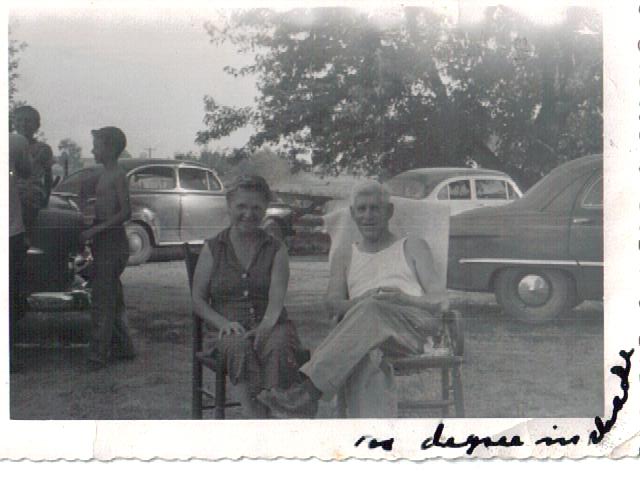
My paternal grandparents trying to stay cool during a brutal Missouri summer. The handwritten note says, “100 degrees in shade..”
Back in the 1950s on the farm, we didn’t have air conditioning. Shoot, we had just gotten electricity a few years before.
So when the long Missouri summers dragged on and the humidity rose, folks headed outdoors to keep cool. When the nights were really hot, we’d sleep outdoors.
The following poem is about a day pretty much like the one documented in this photo. In fact, the events took place not too many days after this photo was shot.
The Day the Call Came
The day the call came
We had just dished up the ice cream.
A special treat for a Friday farm dinner,
(Not to be confused with supper.)
Mother had made it early that morning in ice cube trays.
“Freezer ice cream,” she called it,
Vanilla, made with Junket tablets to keep it creamy,
Even as it froze.
Not as good as the real, homemade ice cream cranked by hand,
But a whole lot easier.
And America was just starting its long affair with convenience.
The call came over the telephone
Mounted on the farmhouse wall.
With two bells for eyes,
You spoke into its honking, beaklike nose.
The earpiece cradled appropriately
Where the right ear should be,
While a hand crank made a poor excuse
For a drooping left ear.
It was a party line,
So the snoopy widow woman down the road
Knew as soon as we did.
The call came, and the man on the phone
Said Grandpa had just keeled over dead
At the auction over in Poosey.
So, we all got up—Mom, Dad, Big Brother and me,
And climbed into the ’50 Ford sedan
Dad was so proud to own.
The first car he’d ever bought brand new.
By the time we got to the auction –
It was a farm sale, really —
Where the worldly possessions of one farm family
Were being sold off.
One at a time.
By the hypnotically fast-talking auctioneer.
Not as depressing as the foreclosure sales
That were all too common
Just a few years before in the Depression.
This was a voluntary sale,
But a little sad nonetheless.
Some farmer was getting too old to run the place,
And didn’t have kids—or leastwise kids who wanted to farm.
A lot of boys joined the service in those days,
Or headed to Kansas City to find work, and a little excitement,
Rather than stay and try to coax a living
Out of that hilly, rocky dirt.
The man at the auction told us
Grandpa had been standing there in the sun with everybody else.
They were just about to start the bidding on the John Deere hay rake
When he grabbed his chest and fell right over.
Years later, they told me when he was a grown man
Grandpa had gone down to the river,
And been baptized, and filled with the Holy Ghost,
With the evidence of no longer speaking in profane tongues.
For, it was well known Grandpa had been gifted
In the art of colorful language.
“He used to could cuss by note,” was how Mother put it.
But after the washing with water and the Word,
Grandpa was never heard to swear again.
I only knew him as a white-haired old man
With a merry smile, and infinite patience
With Grandma, who required it.
And that was it, really.
Nothing more to say,
Except for the understated condolences
Of the country folk.
Nothing more to do,
Except for my father,
Now lately promoted to the role of the family’s eldest male,
Who assumed the duties and made the necessary arrangements.
Although I didn’t know quite what had happened,
I felt a lurch … as something shifted beneath me …
And I was yanked one more notch forward.
By the time we got back to the house,
The ice cream had long since melted
And now was returning back to solid state,
As it curdled in the September heat.
Time was, the sun stood high and corn grew green,
The juice of youth coursed through our throbbing veins.
Love easy and free as the night was keen.
The grass our bed, our bath the gentle rains.
We took up books of verse and lingered long,
Imagined we were wise as those in odes,
Took guidance from the lyrics of a song,
Cast off the quaint restraint of outworn codes.
All along, ignoring every sign:
The chill that comes and strikes the landscape dead,
The smut that spoils the corn and rots the vine,
The vulture drifting gravely overhead,
And, one subtle clue even less benign,
That not one selfless thought entered our head.




 Poetic Champions