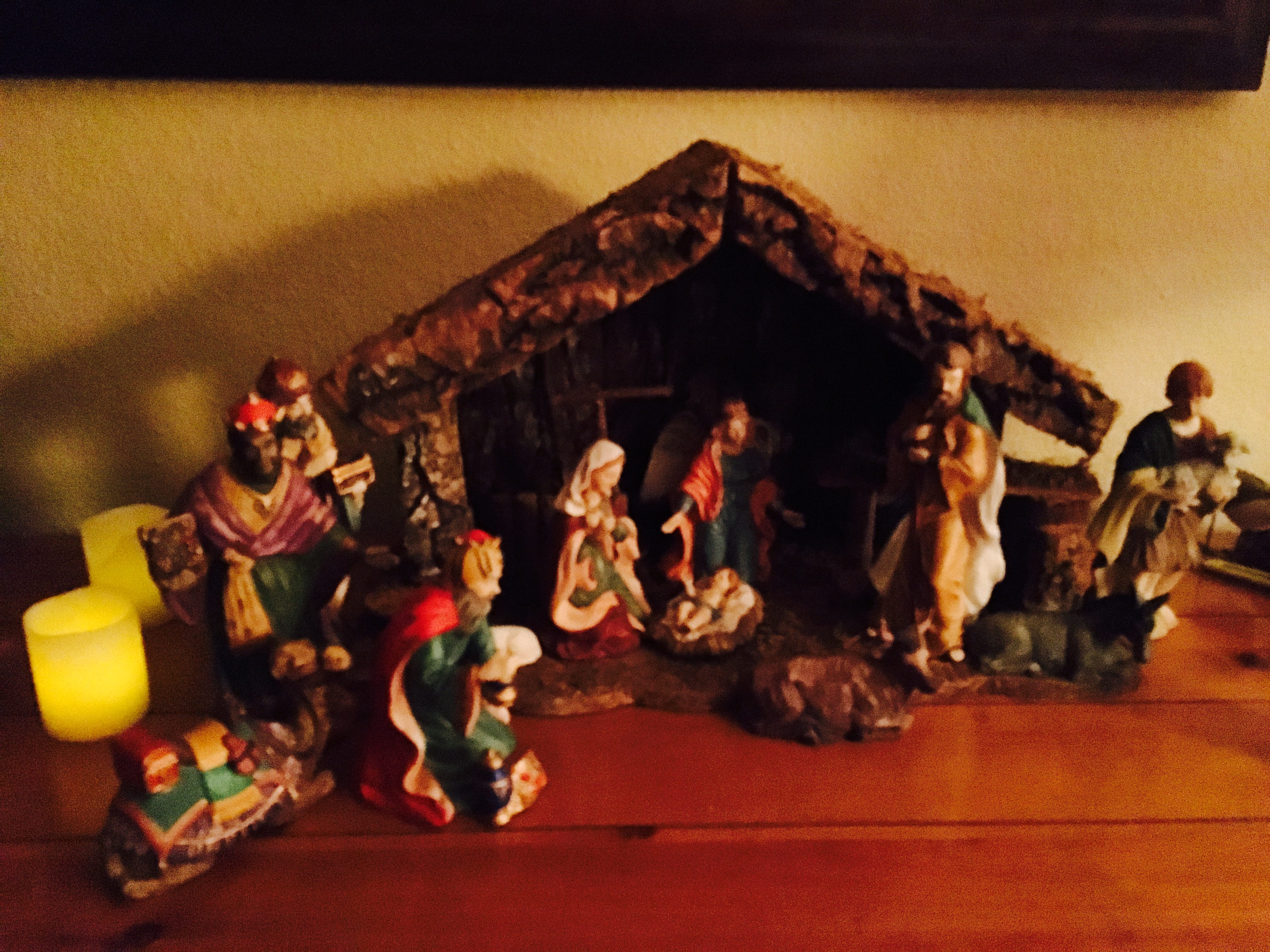
Inconceivable
that the author would cast himself
in such a small role
Inconceivable
that the author would cast himself
in such a small role
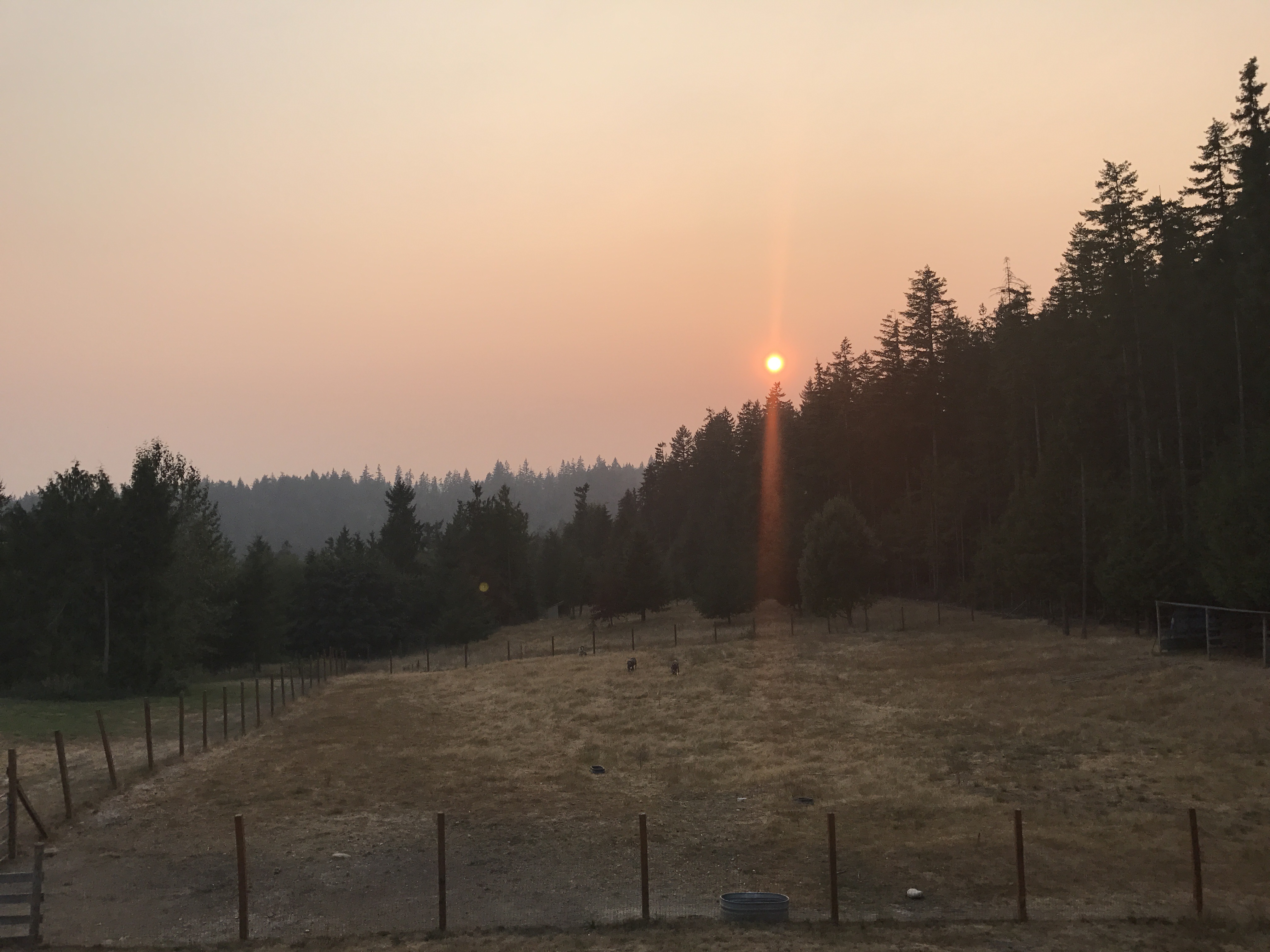
Late Summer's Sun

Late summer's sun has baked the grass to brown.
The days grow shorter with each passing day,
Soon, autumn's chill will make the leaves fall down.
All of this aching beauty will decay.

And yet I love the shadow's slanting trace.
The once green grain gone golden in its rows.
And how I love the lines etched in your face.
It's funny, as love ripens how it grows.

The number of our days we do not know.
No sleeper knows if he will ever wake.
So come, let's join above, between, below.
My dear, let's cause our fragile clay to quake.
Let us make love as if it's our last go.
Let us embrace like dawn will never break.
Living in Florida has discombobulated my internal calendar. With none of the old familiar clues, autumn snuck up on me this year. I’ve resorted to flipping through old photos to get a sense of what fall feels like. Here’s a little sonnet from 2015 written when I was spending a lot of time away from home for work, and obviously missing my wife.
P.S.: Psychology Today says that our master circadian clock — the one that keeps track of the seasons is called the Suprachiasmatic Nucleus, which contains about 20,000 nerve cells and is located in the hypothalamus. Gonna have to take their word for it.

I thought this place could
help iron out my verses.
False advertising.
A few years ago, while visiting Maui, I made a special drive to check out this village with an irresistible name. That’s two hours of my life I’ll never get back.
INDEPENDENCE DAY

The wind and you played in my hair,
    You lambent in the moon.
The night arranged as by design,
    Mysteriously boon.

Afresh the breeze and warm our hands,
    So lately introduced,
Traced so gently new found lands,
    From tyranny aloosed.

While all around with fire and bang
    Our freedom was proclaimed.
A nation's liberty was meant,
    To us, two hearts unchained.
(1982) To continue the story from yesterday, some 24 hours after that first kiss, my new love and I made a plan to watch the Fourth of July fireworks.
It was really more her plan than mine. My default tendency is to be a rule-follower. Hers is to make everything an adventure, get the best seat possible, and just go for it. If she had a motto, it could well have been, “All things are permitted unless expressly forbidden.”
She lived across the street from Minneapolis’s Calhoun Beach Club, which in those days before high-rise condos sprung up, had a 360-degree view of the city. She had already explored the building and discovered how to get on the roof. (I mean, no one had told her she couldn’t!)
You walk through the lobby, take the elevator as far as it would go, locate the door to the stairway, and then ascend the final story by way of a metal ladder.
I was skeptical about getting away with it. But from the beginning, she had a way of drawing me outside of my comfort zone. (Maybe that’s what love is all about. Opening yourself up to possibilities of connection, hoping against hope you’ll be met with openness, despite the danger of having your heart broken.)
At any rate, love can make you do crazy things, so we set out, hauling a big pack with our picnic provisions, and two lawn chairs.
Fortunately, those were earlier, more trusting times. No guard in the lobby, no code needed for the elevator, and no lock on the door to the roof. The hardest part was climbing the ladder with all our stuff.
But when we walked out onto the roof in the slanting light of late afternoon, the view was marvelous — lakes and trees and parkways arrayed out below us. In the distance we had an unobstructed view of the tall buildings of downtown.
But the real show began when it got dark and the fireworks started. We could see fireworks in every direction. Some near, and some more distant. It seemed every municipality in the Twin Cities was putting on a show. We surely had the best seats in town.
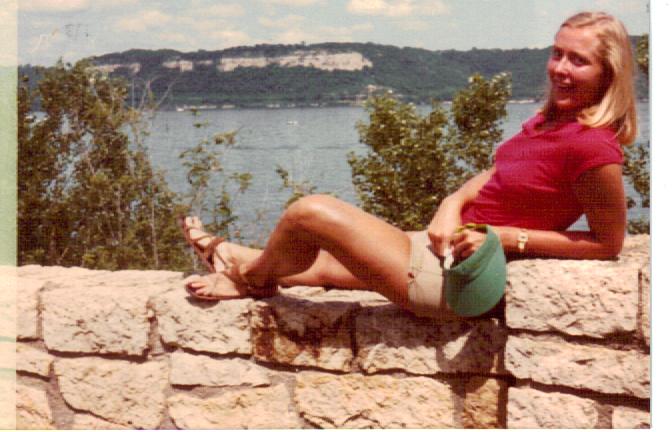
There are no photos from that night. This was before we all had cell phones and we tended to experience things firsthand, rather than through the lens of a camera. So it’s for the best. The one photo I have from that month is attached to this post. You can see why I was smitten.
Forty-two years later with that woman, and there’s never been a dull moment.
Note for poetry nerds: For years I’ve been a little troubled by departing from the rhyme pattern in the last verse. But I’ve resolved that it’s better to use exactly the right word rather than rigidly follow the rules and use almost the right word.

The Calhoun Beach Club in later times.
THAT DAY WE LAY UPON THE GRASS

That day we lay upon the grass,
    A luminescent green.
The sparks that arced from arm to arm
    Across the space between.

Our bodies quickened by the sun,
    The willow leaves aflush.
The sunlight sparkling on the lake,
    Our blood bestirred to rush.

Up and down the parkway, flowers
    Enticing with their blooms.
Our loveless winter ended there,
    Emerging from our tombs.

For we had slept as sleepers slept,
    Unmindful of the world.
Astonishingly we awoke,
    Much like a rose unfurled.
(2015)
Some 42 years ago I worked as a journalist for a community newspaper in the suburbs of Minneapolis. I still have my pocket appointment calendar from that time. Along with recording the times and dates of city council meetings, photo ops, and interviews, it documents the progress of an uncanny romance.
We were two weary pilgrims, up to that point unlucky at love, but brought together by providence.
The calendar entry for Saturday, July 3, 1982: “Bike ride, sunning.” And then, emphatically, “1ST KISS.”
I’m a big fan of July 4th, but July 3rd is my own personal holiday.

He Knew the Worth of Tools
He was a man who knew the worth of tools.
How having just the right one for the job
Was worth a lot, but clearly not as much
As knowing what to do with ones you had,
And what to do with tools he surely knew.
When just a boy on a Missouri farm,
He started hanging round the blacksmith shop
Whenever he could catch a ride to town.
Old Henry Ford’s new-fangled auto car
Had sparked a need for handy fix-it men.
He joined the revolution, then and there,
Brought by the horseless carriage on the land,
And learned mechanics on a Model T.
He mastered use of wrenches and of pliers,
Learned lessons he would use for decades hence.
To make it through the Great Depression’s dearth
He took whatever labor he could find.
He hoed bean rows and stripped bluegrass by hand,
With just the simplest tools to do the job.
His daily wage back then was just a buck,
But any honest work beat none at all.
To earn his daily bread he tilled the soil
Just like his male ancestors all before.
But he saw tools of farming changing too,
With tractors putting horses out of work.
He gambled on a combine harvester
That reaped and threshed and winnowed all at once.
Then hiring out his cutting-edge machine,
He saved enough to buy his own small farm,
And one by one he added to his tools.
In time he sold the farm and moved to town
To try his hand in the commercial world.
Still very much a Ford man in his heart,
He bought a dealership of farm machines—
The boldest speculation of his life.
But business wasn’t really his strong suit,
And when it failed, he carried on with tools.
He built a practice fixing implements —
Hay balers, corn pickers, tractors — all repaired
Right where they’d broken down out in the field.
And farmers round about began to say,
“If Ray can’t make’er run she can’t be fixed.”
When he was well past sixty years of age
He got a crazy notion in his head—
He’d always dreamed of having his own shop—
So he measured out the plan in the back yard.
And there he built the thing all by himself
With salvaged lumber gotten almost free.
Of course, it looked just like a barn.
Because, well, that’s only thing that he’d built before.
But he knew well enough the tools required.
Beneath his hammer, nails sunk into boards
With just two strokes, or maybe three.
His singing handsaw made the sawdust fly.
His level, plane and plumb line kept all true.
Out of a worthless demolition pile
He fashioned form where there was none before.
His barn still stands though many years have passed.
With paint and care could stand for many more.
It needs someone with tools to care again.
And when his wife of more than fifty years
Grew absent minded and began to fail,
He looked in vain for tools to fix her with.
Installed a cook-stove, gas-line, shut-off valve
When she began to start forgetting things,
Like if she’d turned the burners on or off.
Nowhere on all his cluttered workshop shelves
Was there a tool to fix her slipping mind.
The final years he’d visit every day
Ensuring that she ate her rest home meal.
The only tool of any use a spoon.
In time, the spoon was of no use as well.
My work today requires different tools.
I toil in neither soil nor wood nor stone.
Instead of grease my hands are stained with ink.
I polish common syllables to rhyme.
I calibrate my words to find a song,
Fine tuning—like a carburetor—lines,
To make them run not either rich nor lean,
To purr and roar without the gassy fumes,
Obscuring sense and choking with the smoke.
My father’s tools lie idle on the bench.
The workman will not use them anymore.
With all the craftsmanship I can bestow,
I carry on instead with tools I know.
(2019)
I’m living proof that mechanical aptitude is not necessarily hereditary. You can’t say my Dad didn’t try to teach me automobile repair and maintenance. For years after I had moved out on my own, I dutifully changed my own oil and even greased the suspension as needed.
But my heart never was really in it. As soon as I learned I could pay someone to do that job for me and I could afford it, I gladly hung up my oil filter wrench and drain pan.
If he were still alive, I imagine my Dad would be quietly shaking his head at his spendthrift son paying good money for something I should be doing myself.
Dad didn’t really succeed in turning me into a shade tree mechanic, but he taught me something much more valuable. Lessons about loyalty, service, and love.
When my Mother began her slow descent into dementia, he took care of her at home until his own doctor told him it was killing him and ordered him to have her moved to a nursing home.
Thereafter, every day he was physically able until she died, Dad went to the nursing home to feed his wife her lunch. He did that year after year, long after she could no longer communicate or even recognize him.
These days, when I get a little frazzled taking care of my own wheelchair-bound wife, I remember how my Dad navigated his much, much more daunting challenge.
THE BACKSTORY
If you look up the term “blue collar” in an illustrated dictionary, you might find a picture of my father. Coming of age during the Great Depression, he never finished high school. He had to find a job and bring in some sort of income, pitifully small as it was.
He was raised on a farm, so after he married my Mother, they set out to be dirt farmers like their ancestors before them. It was a tough go, but he kept his family fed and managed to acquire 80 acres of so-so farmland in north Missouri. Along the way, he learned quite a bit about how to keep his farm machines running and in good repair.
After a quarter century of farming, he decided there had to be a better way to earn a living, and he tried to make a go as a partner in a farm implement dealership. But, as the narrative goes in the poem, That didn’t work out.
So he went fell back on his mechanic skills and earned a living keeping machines operating.
His hands were stained with grease and crankcase oil. And neither the Goop grease cutter, nor the green, grainy, Lava soap he used every day got them completely clean.
That’s about as blue collar as you can get.
But he also had a sharp and curious mind. He subscribed to magazines like Popular Science and Popular Mechanics because he wanted to know how things worked. He once told me that he had been pretty good at math in school. He said he wished sometimes that he had been able to continue his studies. He figured he could have been a pretty good engineer.
I knew he thought I was in danger of wasting my college scholarship by majoring in philosophy.
“Be sure to take something practical,” was his main advice to me as I left for school.
Perhaps he indulged my intellectual pursuits because he had a curious hobby for a dirt-farmer-mechanic. He was a student of the Bible and Biblical history. He ordered books by mail and built up a decent library of ancient historians, commentaries, apocryphal literature, alternate translations of scripture.
I still have the bible that he read every day. Fittingly, it is literally held together with duct tape.
By the time he was 80 he had lived to see his two oldest sons die in fluke accidents, and he had been forced to place my mother in a nursing home. He would soon go in for a multiple heart-bypass surgery himself.
I believe that as he increasingly saw the end of his life approaching, he focused more and more on things that really matter. I could do worse.
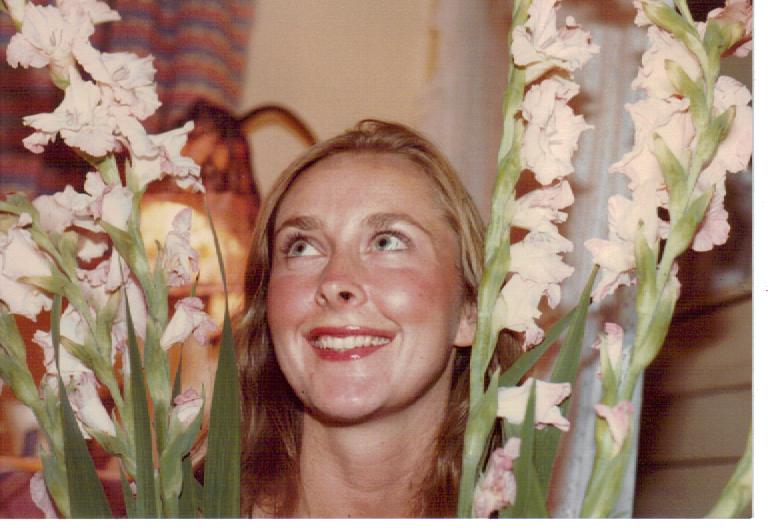
FLOWER TIME

I saw you first in jonquil time,
When you were bathed in grace.
You sat aglow with fire sublime,
And golden shone your face.

I loved you first in lilac time.
A bloom I plucked for you.
I wrote you verse with song and rhyme.
I hoped you loved me too.

I kissed you first in tulip time,
It must have been a sign.
The buds and we were in our prime
When your two lips met mine.

I married you in daisy time
One summer's longest day.
We traded rings and heard bells chime,
We pledged always to stay.

Too soon we've come to aster time.
The days are shorter now.
Would stealing some be such a crime?
We'll make it right somehow.

Should we endure 'til wintertime,
The time when flowers sleep,
Dreams we'll share of a gentler clime
Where we no more shall weep.
(2016)
Notes: My love was born on D-Day, and I don’t think I’ve ever failed to remember her birthday. It’s an appropriate date because she conquered me from the beginning. I didn’t stand a chance.
Flowers did play a significant role in our courtship. I really did pull over and pick some roadside lilacs before our first date. (And she really was glowing the very first time I saw her. A story for another time.)

In Florida

In Florida the flowers grow
Between the houses, row on row,
   While in the trees crows remonstrate
   As if to warn, "The time is late!"
And vex the tranquil scene below.

We are the Old. Short days ago
We sold and bought, we mastered fate,
    Or so we thought, and now we wait
        In Florida.

Next-comers all, be sure you know
The doleful message of the crow.
    Be not deceived, there's no debate,
    Man does not know his hour nor date.
And so we wait, though flowers grow,
         In Florida.
(2024)
The other day, while pondering my complicated feelings about my new home state, I found myself muttering a scrap of what I thought was spontaneous verse: “In Florida the flowers grow, between the houses, row on row.”
Pleased with the sound of this line, I thought, “Hey, I might really have the start of something good here!” But soon I realized it was too good to be true. This snippet sounded much too familiar to be original.
It was, of course, a blatant rip-off of the well known World War I poem, “In Flanders Field,” written by John McCrae, a Canadian soldier who would later die in that conflict. That poem was included in my mother’s precious 1929 edition of “One Hundred and One Famous Poems,” so I must have heard it read aloud many times in my youth. Its words had been buried in my subconscious for decades only to emerge just last week.
Well, darn.
I was hoping that perhaps the muse had returned. I had been in an extended period of writer’s block since moving from Washington State three years ago. In addition to the aggravation of selling a house, packing up, moving across the country, and settling into a new home, I had become the sole caregiver for my wife. A bicycle crash and subsequent spine operation had landed her in a wheelchair. With all that going on I scarcely thought of writing.
But lately, the old itch flared up and I began to sense the need to start putting words on paper again. However, when I realized I was just copying somebody else’s poem, my first inclination was to shelve it and forget it.
Then the thought occurred: Why not take this on as an exercise? I’d rewrite “In Flanders Field” as a way to work through my feelings about our new home. A little poetry therapy, perhaps. And then, maybe, just maybe, other more original ideas would come.
Something about the tone of that poached first line captured the mood … the feelings I was experiencing about this place.
I couldn’t let it go.
Robert Frost once said that writing a poem is having an argument with yourself. I was certainly conflicted about leaving the beautiful Pacific Northwest. But I also love a lot about Florida. You don’t need to bundle up with layers of fleece and rain gear. You never have to scrape ice off your car or shovel the precipitation. The culture still has a decent natural immunity against communist insanity, possibly due to the influx of Cuban refugees who fled when Castro took over in 1959.
That’s all positive. But I still dearly miss our Seattle friends and neighbors, and walks through the changing seasons and cedar-scented hills.
And, once we moved here I began to understand why my wise, late father-in-law, described Florida as “God’s Waiting Room.”
There are sure a lot of old people here! The the most common topics of conversation at social events revolve around health, ailments, and operations. It seemed like we’d just barely settled in and we were already going to funerals of new friends and neighbors.
The whole place is sort of life-sized memento mori.
With all these ambivalent feelings swirling about, I sat down to see what I could lift from McCrae’s poem for my purposes. Somewhere in the process I justified my thievery by likening it to modern recording artists who sample an earlier song and combine it with original material to create something new. Hey, if Snoop Dogg and Beyonce can do it, why can’t I?
But first I had a lot to learn about the poem I was about to rework. I discovered that McCrae wrote it after presiding over the funeral of a fallen friend on May 3, 1915. Legend has it that he was so dissatisfied with his verse that he threw it away only to have it retrieved by his fellow soldiers.
(In a weird bit of synchronicity, I’m pretty sure it was May 3 of this year when I first got the idea for my version. And I, too, initially decided to scrap the idea.)
“In Flanders Field” is a 15-line rondeau with a precise rhyme scheme. This form was popular in medieval and Renaissance French poetry, and later adopted by English poets. I’d never tried to write anything like this before, and took it as a challenge.
I believe my attempt was faithful to the structure of the original, except for the addition of internal rhymes in the last two verses. (A little twist just for fun.)
Time will tell if this warm-up exercise will lead to more inspiration.

A girl on a bike
passes through the streetlamp’s glow
and then she is gone
(2021)
This one is from three years ago, but somehow I never got around to posting it. I did not realize what I would miss about leaving Washington state three years ago. But on one of my last walks in the late winter evening damp I felt the impending loss of many things. I knew we would be moving soon.
My wife was learning to navigate life in a wheelchair after a fluke bike crash and subsequent spine surgery. We had lived for nearly 28 years in our two-story home, and now that she could no longer get up the stairs she resorted to sleeping in the dining room and showering at church.
On this evening, with her safely ensconced in bed, I got out for a bit of exercise. And I became keenly aware of loss. Our old life had already undergone drastic change and more big changes were coming soon.
The walks together through the changing seasons, up and down the hills and winding paths. The first spring crocus blossoms. The fragrance of cedar and plum blossoms. The chorus of song birds that woke us up on bright May mornings. The surprising glimpses of distant snow-capped peaks when the clouds parted. The long, perfect sunny, summer days. The brilliant leaves in autumn. The fog and mist and even the ubiquitous rain.
We would be leaving behind our dear neighbors and friendships forged over nearly three decades. Our familiar haunts, the used bookstore where I could always find an interesting old book of poetry. Not least, our home where we had raised our children, hosted countless dinners, laughed and conversed into the night, and where, without realizing it, we had grown old together.
It sunk in: I would miss it all.

She Knew the Names of Things
She knew the names of things, knew them by heart.
Not just the farmwife flowers of the yard,
But the wild ones in the hidden woods.
And in the woods, she knew the names of trees.
She knew quaint sayings about country ways.
“That’s no sign of a duck’s nest,” she would say,
Defying explanation even then.
She knew the names of birds, common and rare:
The Red Wing, Meadow Lark and Mourning Dove,
Brown Thrush and Gold Finch and sad Whippoorwill.
She knew them by their call as well as sight.
She knew the names of lonely widowed aunts,
And she knew dates and anniversaries,
And surely, she recalled that doleful day
When the son who called her “Mother” was fished
By divers out of San Diego Bay.
For grief, she never spoke of it again.
And though she’d barely gone to school, she
Had sense enough to hang a dishrag up,
She knew her Whitman and her Bible well.
And when the door-yard Lilacs bloomed she paused
Amidst the sweet perfume, breathed, and recalled
The poem and soft fragrance that she loved,
Sweet messenger of spring—but not too sweet,
Not like the syrupy Petunias
That she also loved, but differently.
She always favored the modest flowers
That had a tinge of tragedy and loss
Like Lilacs and Lilies of the Valley,
Named for the suffering Savior of mankind.
She knew the things she loved, and she could name them.
But winter of the mind came drifting in
And names of things were slowly covered up,
As when the snow erases hue and shape
And leaves the garden white, formless and blank.
The soaring Hollyhocks were overcome,
Begonias, Honeysuckle, Marigolds,
The Morning Glories high atop the gate
Were covered, as was Aunt Minerva, too,
(Whom she loved like the mother she had lost),
And cousin Gene undone at Normandy,
And buried there amidst a cross-white field.
Peonies bowed their heavy heads beneath
The heavy snow and disappeared away.
So too, the old folks’ graves that she adorned
With their bouquets each Decoration Day.
Wild Lady Slipper too did not escape,
Entombed beneath its own soft shroud of white
With Buttercup, Catalpa, Trumpet Vine,
With Thistle, Jimsonweed and Columbine.
And covered too were Maples, Elms and Oaks,
The Willow tree we started from a branch,
The stately Cottonwood that soared above
The old farm woods, completely covered up.
And covered too were barefoot childhood days
On Clear Creek growing up carefree, before
Her still-young mother died of Spanish Flu,
And left five other kids for her to raise.
Those days she loved them, and she knew their names:
Hayward, Walden (though others called him Joe)
Jesse, Vivian, and the youngest Bill.
All these names buried and forgotten now.
Gone was her motto written out longhand
Held by a magnet to the old icebox
With wise and frugal counsel: “Use it up
Wear it out. Make it do, or do without.”
Old photographs stuck in a musty book
Assembled even as the blizzard blew,
A vain attempt to thwart the mounting snow,
The names obliterated anyway
By endless pitiless nameless white.
I walk now through the fiery leaves of fall
And ponder piles of faded photographs,
Repeating names I learned so long ago,
Recalling things and places I have loved
In hopes this recitation will forestall
My own impending blanketing of snow.
Perhaps my winter will be mild—or not.
Perhaps I will become snowbound as well.
But I shall say the names of things ’til then
And recall her who taught them first to me.
Remembering, turn my face to winter’s blast,
Defying it to dare to land a blow.
For I shall sing the names of things until
I lie here frozen stiff beneath the snow.
(2019)
NOTES: I thought I hated Alzheimer’s Disease before when it robbed us of Mother far too soon. But just a few years ago it also took my dear friend and schoolmate, Clyde Smith. It’s a horrible, cruel disease. Cruel to the victim and cruel to the loved ones.
The poems I learned at my mother’s knee employed meter and rhyme. So it’s only natural that I’m most comfortable with forms like ballads and sonnets. They speak my heart language. I’ve long agreed with Robert Frost that writing in free verse is like playing tennis with the net down. It may do wonders for the self esteem, but it’s hardly sporting.
A few years ago, I had the itch to write something longer than a sonnet, or something more ambitious than eight lines of rhyming couplets. In hindsight, I believe that I needed to wrestle with the grief of losing two people so close to me to such a dreadful disease. It was going to be a protracted struggle, and a mere sonnet just couldn’t do.
I settled on blank verse, which sticks with meter, but dispenses with the need for rhyme. Sort of like playing tennis with the net lowered a couple of feet. I suppose if it was good enough for Marlowe and Shakespeare, it should be good enough for me.
 Poetic Champions