Midsummer Anniversary Poem

Here comes midsummer's milestone of our love
Here Comes Midsummer’s Milestone

Here comes midsummer’s milestone of our love,
Years since our selfish selves we pledged to yield,
So we’re as broken-in now as the glove,
I wore so long ago while in the field.

Fresh from the store unworn straight to my room,
Rubbed in the oil and every crease explored,
All through the night I savored the perfume,
The musky linseed leather I adored.

Come sober daylight with our job to do,
All awkward stiff not giving either way,
How many sweaty strivings’ deja vu
It took before we as one flesh could play.

Some ragged days I’d spit and pound the palm,
Or hurl the thing against the dugout wall,
But all the while a magic mute and calm
Mutated hand to glove with every ball.

The softening was gradual but sure.
Soon nerves and muscles seemed just like they spanned
From fingertips to join the glove secure,
As if I had been born with one webbed hand.

We’ve come now to the eve of middle age,
Well worn but with a lot of sport to go.
We must each for the other one assuage
Those stinging blows life certainly will throw.

We’ve held through wins and losses and through rain,
That etched new cracks not there at all before.
But loves like this were made to take the strain,
Just like that piece of cowhide that I wore.


Notes:

Not long ago, I asked my wife if she had a favorite poem.  Her blink reaction was, “the one about the baseball glove.”

So, that is what she gets on the eve of  our 31st anniversary.  A re-run.

It was written sometime in the early 1990s.  We were young and just starting a family.  I had a job I absolutely hated.  I would take long lunch breaks and write poems parked by the side of Lake of the Isles in Minneapolis.

Long before I discovered girls, back in Marshall, MO, my first love was baseball.

I cannot begin to total up the hours spent playing baseball, watching baseball, collecting baseball cards, sorting baseball cards, reading about baseball, and dreaming about playing in the World Series.

I knew the starting line-ups of both the St. Louis Cardinals and the Kansas City A’s by heart.

When I played one-man whiffle ball against my friend Royce, we would pick a team and go through the line up as each individual player. If the guy batted right, we batted right. If he batted left, we batted left.

(We drew the line at pitching left-handed, because neither of us was truly ambidextrous.)

Our spare time was spent searching for discarded pop bottles which we could turn into the neighborhood grocery store for two cents apiece. Every 5 bottles meant we could buy two more packs of baseball cards.

Somewhere between the ages of 12 and 13, we moved on to other interests. A long and winding path led me to the love of my life.

We were married 31 years ago today.

The inspirations for this poem are multiple. Several years ago, it was coming on to midsummer and my wedding anniversary.

I was feeling that sense of my youth slipping away. But, despite the oppressive job I was enduring, I was confident that good things still lay ahead.

I was also listening to a lot of Van Morrison. His song “Madame George” was stuck in my head. (Quite possible the most poignant song ever written.)

In particular, I was hearing the line where Van does his improvisational thing where he repeats the words “love” and “glove” over and over in an almost hypnotic chant.

My story is about a very different glove, and a very different love. But that merging of the two words was lodged in my mind.

The result of all of this ferment was this poem.

The only time I’ve ever read it in public, I was told it was “an audacious metaphor.”

I’ll take that.

Today, upon the occasion of my 31th wedding anniversary, I submit this little poem. It’s as true today as when I wrote it years ago
Love Sonnet

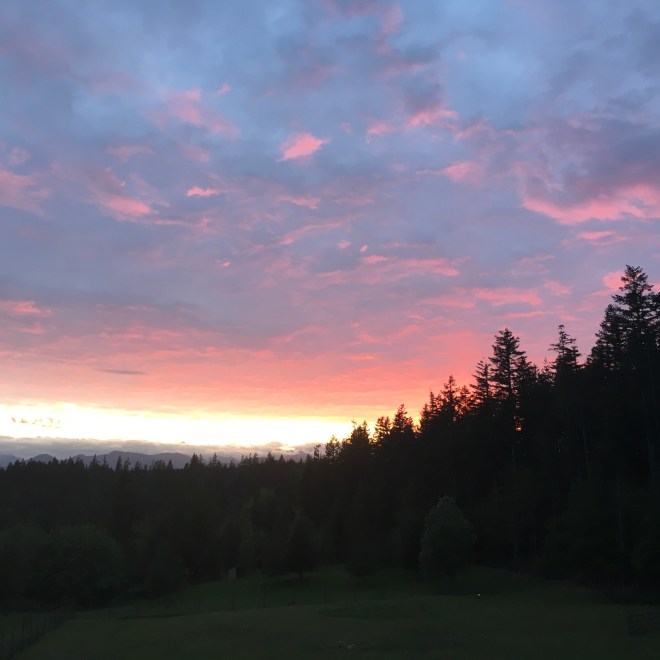
Sunset over the Olympic Mountains
“The changing light and seasons have their ways …”

Familiar Ways

I choose to walk the old familiar ways,
To wend ways where I’ve put my foot before,
To gaze anew on views seen other days,
Which, though familiar, never seem to bore.

The changing light and seasons have their ways
Of making old things new: The light-laced hoar,
The first-flush, green-glow, bursting-forth spring days,
The growing tinge of gold we can’t ignore.

Each day, my dear, I choose afresh our trail,
The one we blazed so many years ago,
Eschewing other routes that might avail,
And hewing to the well-worn way we know.
Forsaking novelty need be no jail
With your face bathed in sunset’s golden glow.


Poet John Ciardi relates this story about Robert Frost, who at a lecture was asked by  a woman in the audience: “Mr. Frost, surely when you write one of your beautiful poems, you are not thinking of technical tricks!”

Frost looked at the woman a while and replied, “I revel in them!”

Ciardi says Frost was like a horse trader who “would pick up an idea and whittle at it until he either wound up with a little whittled shape or a pile of shavings on the floor.”

I felt a little like a horse trader as I was writing this poem.  It started with a simple, little idea.  I can’t remember ever “whittling” more on a poem before.  At first, this one seemed like it just never wanted to happen. I just kept whittling and whittling until something very different began to emerge from where I started.

After what seemed like an eternity, I began to see the tricks of the trade — namely rhythm, diction, image and form — coming together to embody the simple little idea.

This one did not plop, fully formed, into my lap.  It was written, re-written, and re-written again.  I wrote in on my phone.  I copied it out by hand in a notebook.  I typed it in Microsoft Word on my laptop.  I read it aloud and even recorded a reading of it to hear how it sounded.

I found myself being keenly aware of assonance, alliteration and internal rhyme like never before.

I found myself unconsciously using the same sounds and rhymes over and over again as if I was consciously reinforcing the central idea.  Then, I found myself breaking the pattern with lavish, flamboyant word choices in the middle of the poem to demonstrate the message.

I found myself coming around to embracing a metaphor in the final part of the poem.  It was an idea that emerged only after the first part of the poem was written.

It may be a pile of shavings.  Or it might be a little whittled shape.

You can be the judge.


Love Haiku

My love before she met me.

Before you met me
you seemed so cool and carefree …
and a bit badass.

Early Spring Haiku

I loved you first in lilac time

Before I met you
I’d never stolen lilacs
for anyone else.

Love Haiku

Waking at midnight

Waking at midnight …
tender words and embraces …
drifting off assured.

A birthday poem for my wife

Never a dull moment with you

Today is my wife’s birthday, so I’m giving her a little poem.

What I miss most …

What I miss most when I’m away
Are the small shared jokes, the spoken and unspoken
Tokens of affection, the markers of our common history.

Like whenever you can’t find some misplaced thing
And I say, “It must be with your credit card,”
Which you lose like clockwork once a week
And then miraculously find again after a couple of days.

Or when all I have to do is ask, “You awake?”
To get a chuckle from you remembering
That old joke about Swedish foreplay,
Which leads to the joke about Scottish foreplay
And one of us saying, in a really bad accent,
“Brace yourself, Lassie!”

And then there’s that good old standby, “Want a backrub?”
That holds the promise of so much more.

Then there’s the way you have of so badly mangling
Ordinary, everyday sayings so as to make them
Almost unrecognizable, yet which make sense
In some altogether new, mysterious way.

How can I be jealous when you see some actor on TV,
And offer your careful, studied opinion,
“I wouldn’t kick HIM out of bed with a ten-foot pole.”
Or even though you may be mad at me
How can I do anything but laugh
When you stand there hands on hips and scold,
“You don’t listen to me two hoots!”

And I had no idea what you were talking about
When you said, “It was spreading like hotcakes!”
But I knew, whatever it was, it was going to be a big deal.
And of course, I had to just stop and marvel
When you described some half-baked effort of mine as
“Just a dent in the iceberg,”
And I didn’t even care that I knew I had a lot more work to do.

And it’s funny how our daughter seems to have inherited
Your gift of mixing words to make brand new verbal gems,
Or, as she so aptly put it just the other day,
“The spawn doesn’t fall too far from the tree.”

And there’s the way we can order dinner for each other
And just about always pick the right thing … because we just know.

Or the sound as you talk on the phone to some girlfriend
And I don’t even care what is being said on the other end
As long as I can eavesdrop on the music of your voice.
Or the way you propose some outrageous adventure
And then shortly thereafter change your mind,
Just to, I can only suppose, keep me on my toes.

“Never a dull moment,” is how I describe my life with you,
And, really, can there be a better endorsement?

Digging Issa, haiku master

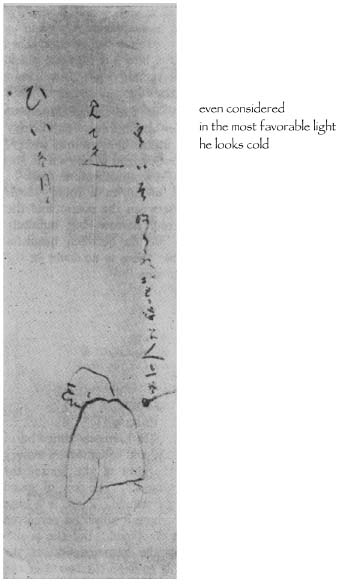
Haiku master Issa self portrait
Issa self portrait. The poem reads: Even considered/in the most favorable light/he looks cold

Dropped my wife off at the airport this morning before dawn. The moon was full, and I was reminded why I like Issa most of all the old Japanese haiku masters.

Issa was so human and compassionate, despite the many losses and disappointments he experienced.

He certainly endured his share of suffering. He mother died when he was a young boy. His stepmother was manipulative and cruel. After his father died, his stepmother refused to recognize the will, which would have given Issa part of the estate. He saw all of his children die before him. And he outlived his beloved wife Kiku, who died giving birth.

At the risk of being misunderstood, I’ll quote one of his most touching poems, written after his wife’s death. By Issa:

The moon tonight —
I even miss
her grumbling.

There’s something so honest and sweet and human about that. He loved her and he loved even her imperfections. The sight of the moon brought it all back and stirred up his intense memories. He missed her and he missed all of her.

One other poem by Issa on this theme of loss:

Outliving them
Outliving them all —
Ah, the cold!

I cannot claim to comprehend Issa’s pain. My wife is still very much alive–just out of town for a few days. I’ve never lost a child. But having lost both parents and all my brothers, I have caught a glimpse of what Issa is saying about “outliving them all.” Just a faint glimpse.

I think of Issa’s poem. I think of that old Tom Waits song, “The last leaf on the tree.” I think of the oak trees from my Missouri youth. And all of this made me think of — and write — a new poem:

Late Winter Haiku

One grey leaf still clings
to the branch, curled up and dry.
Could fall any day.